One verified tonne, one serial number, one claim
The five stages a reduction passes through on Carbon3, from supplier project to retired credit, and the record each stage leaves so the same tonne is never claimed twice.
By Carbon3 team2 min read
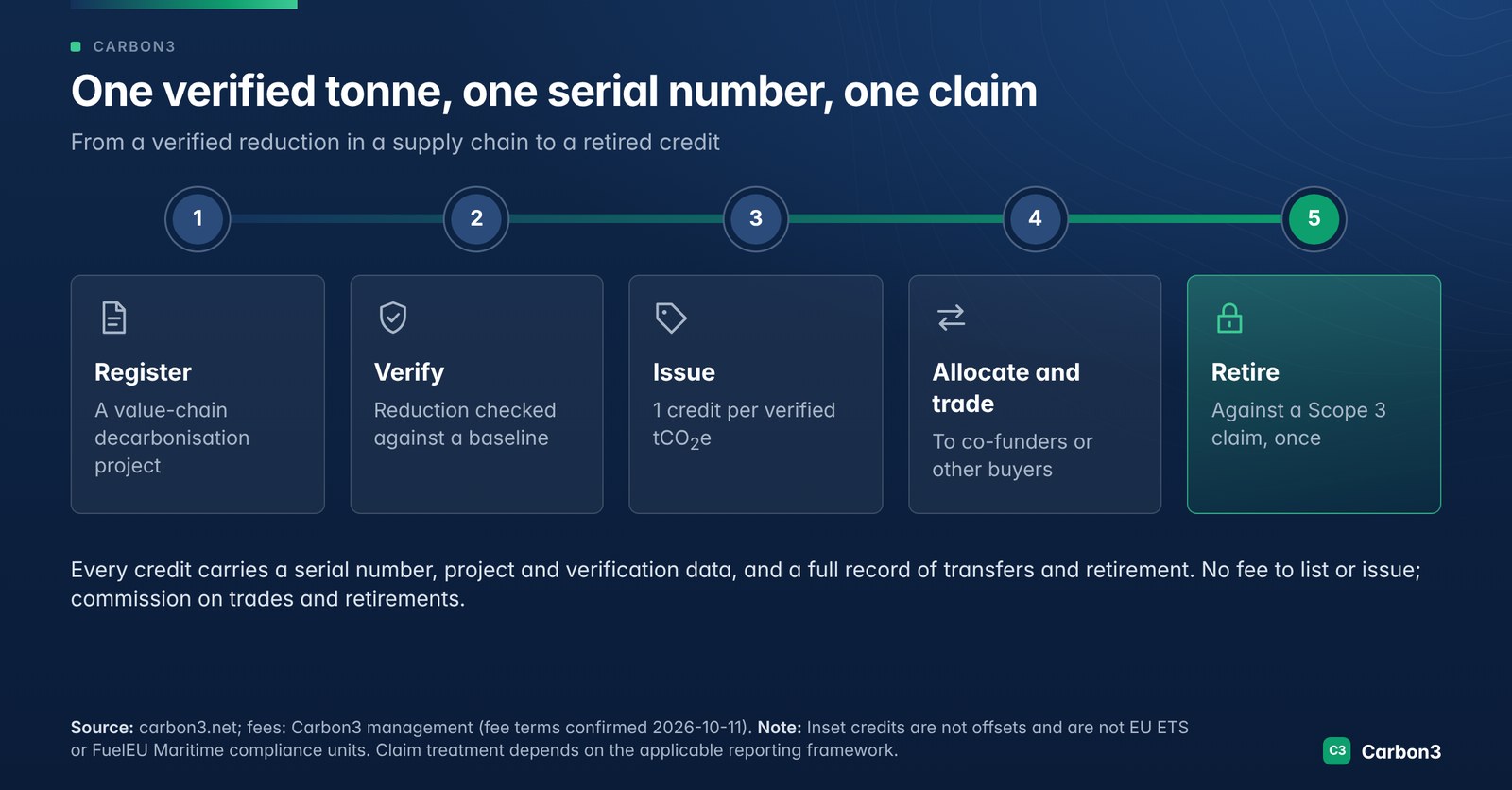
One verified tonne. One serial number. One claim. That is the rule a reduction follows on Carbon3, from the supplier project where it happens to the moment a credit is retired against a Scope 3 claim.
The path has five stages, and each one leaves a record.
1. Register
It starts with a value-chain decarbonization project: a change at a supplier, carrier or other partner that the funding companies buy from. The project is registered on Carbon3 with its owner, its scope and the baseline the reduction will be measured against.
2. Verify
The reduction is measured against that baseline and checked by a verifier. Carbon3 does not verify reductions itself. The verification report is what turns a planned change into a confirmed number of tonnes.
3. Issue
The project developer issues inset credits on the Carbon3 registry, one credit per verified tonne of CO₂e. Each credit carries a serial number and stays linked to its project and its verification data.
The path described here is for realized credits, which follow the verification report. Carbon3 also supports future credits, which a project developer can issue earlier, once the project is validated, so funders can help finance the change before it delivers. Every credit shows which kind it is.
4. Allocate and trade
Credits are allocated to the companies that co-funded the project, or traded to other buyers. Every allocation and transfer is recorded against the credit's serial number, so ownership is always traceable back to the project.
5. Retire
Finally, a holder retires the credit against a Scope 3 claim. Retirement is recorded once, and a retired credit cannot be used again.
Why the record matters
The point of the five stages is that the same tonne cannot be claimed twice. Because every credit carries its serial number, its project and verification data, and a full history of transfers and retirement, a buyer, auditor or advisor can follow a claim back to the reduction behind it.
Inset credits are not offsets. They represent reductions inside a company's own value chain rather than compensation bought from projects outside it. They are also not EU ETS allowances or FuelEU Maritime compliance units.
What it costs
There is no fee to list a project or to issue credits. A commission applies on trades and retirements.
Claim treatment depends on the applicable reporting framework.
Correction, 30 October 2026: An earlier version of this article said Carbon3 credits carry serial numbers. They do not yet. Each batch of credits has its own record ID on the Carbon3 registry, and every transfer, split and retirement is recorded against it. Source: Carbon3 registry.
Correction, 30 October 2026: An earlier version of this article said the reductions behind Carbon3 credits are independently verified. Credits are issued once a verification report is on file. Carbon3 asks for a verifier that is independent of the project, but the registry does not yet check who wrote the report.
Source: Carbon3.
Learn more
How insetting works, step by step
Originally published on LinkedIn, 20 October 2026.
Read more from the research team.
Product
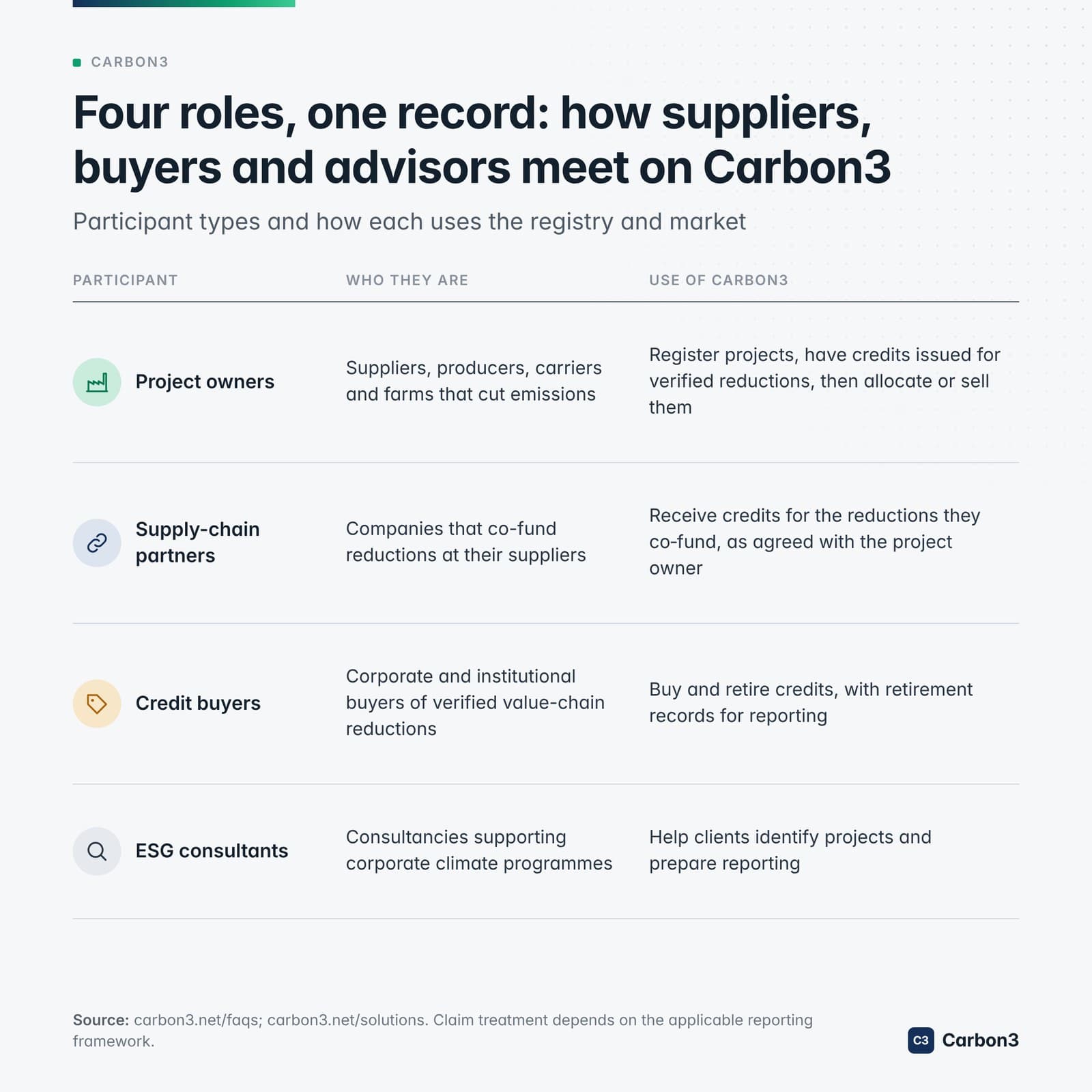
Suppliers, buyers and advisors rarely work from the same record of a reduction
Carbon3 has four participant types: project developers, supply-chain partners, credit buyers and ESG consultants.
Read the articleProduct
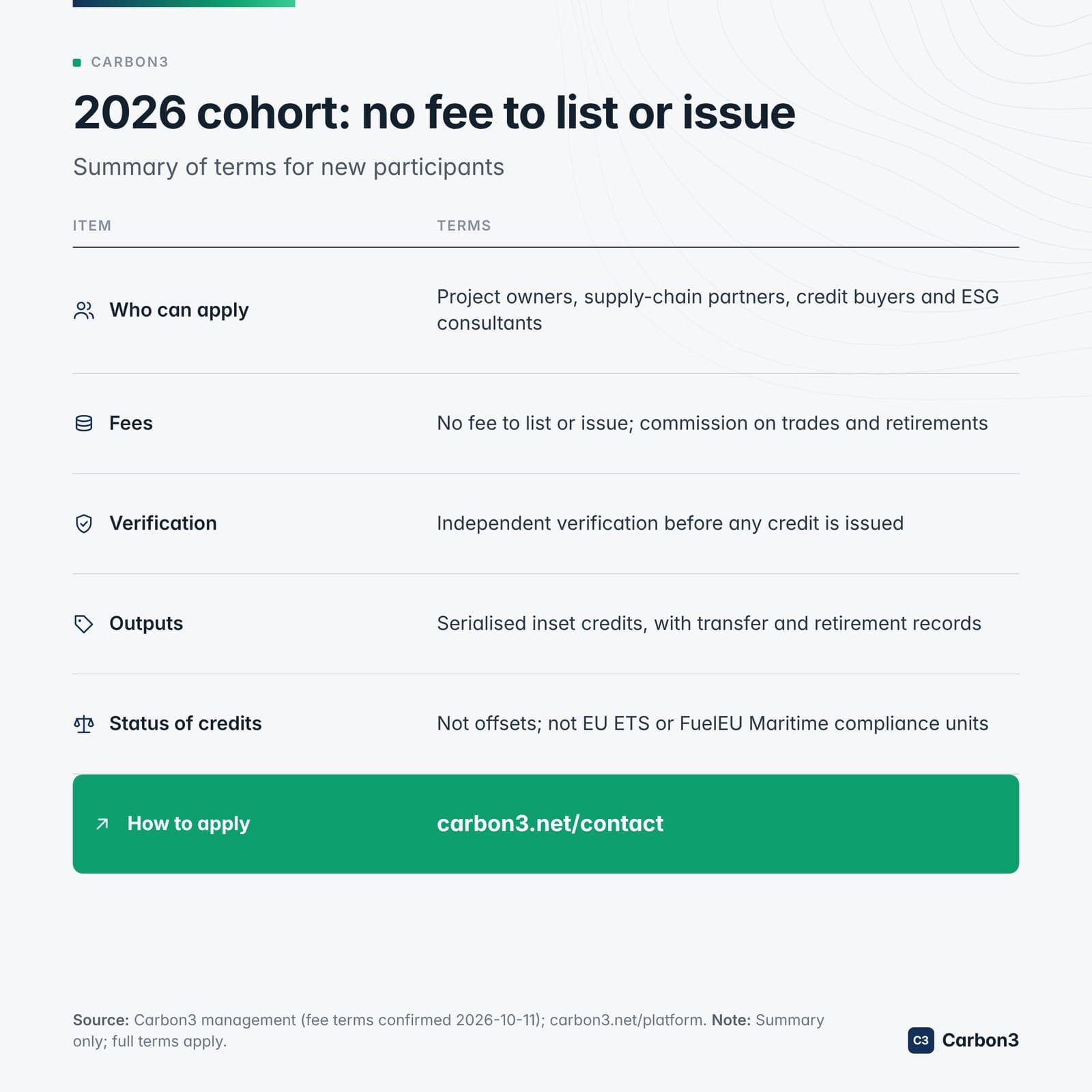
Applications are open for the Carbon3 2026 cohort, with no fee to list or issue
The 2026 cohort is open to project developers, supply-chain partners, credit buyers and ESG consultants.
Read the articleMarket structure
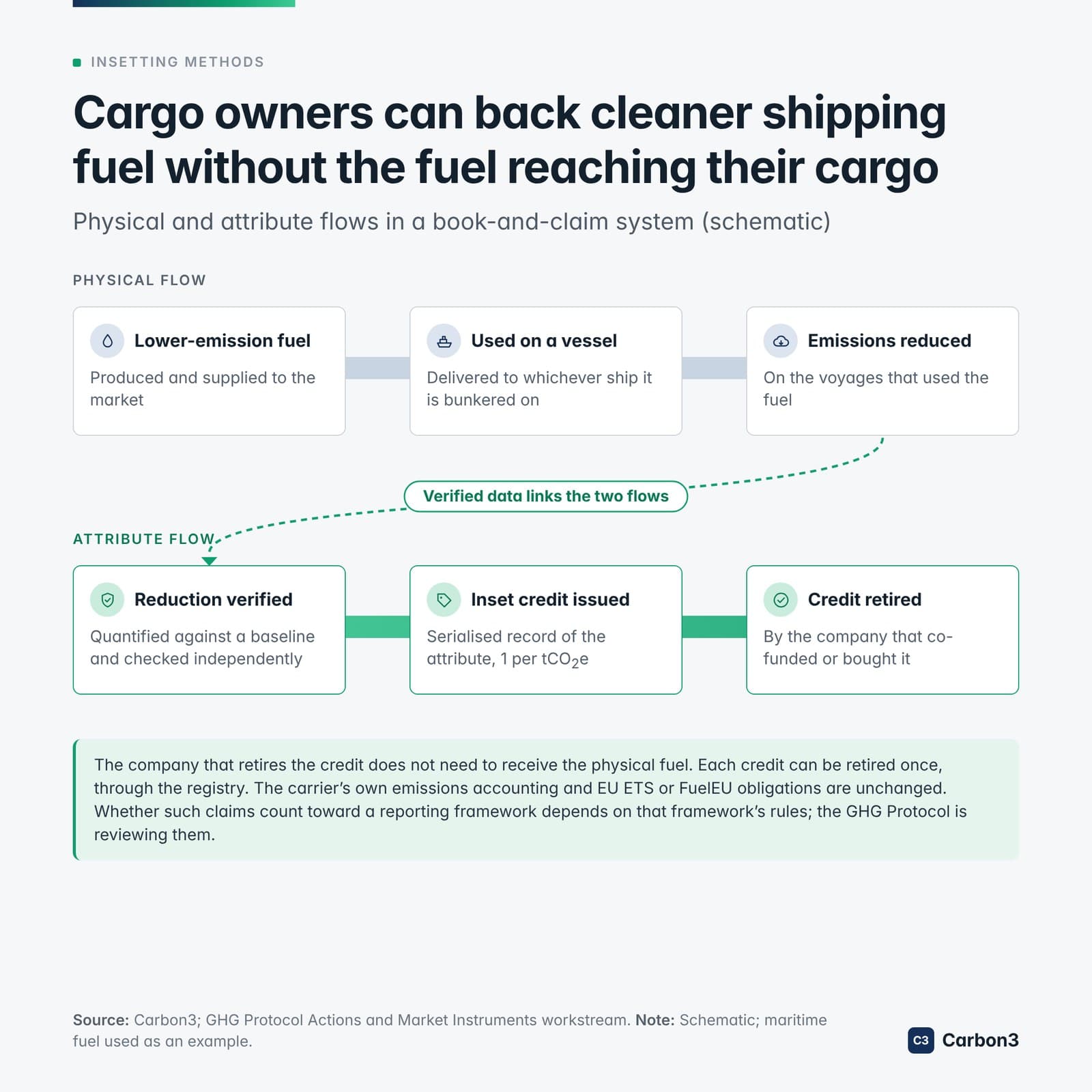
A cargo owner can back cleaner shipping fuel without the fuel reaching its cargo
Book and claim separates the physical flow of a lower-emission fuel from the record of its reduction.
Read the article
See the companies behind these figures in the Data Hub.
Look up your suppliers’ emissions and targets, free.