The Agriculture & Food Outlook 2026
Nine in ten tonnes of a food company's carbon sit on farms it does not own. In 2026 that stops being optional.
By Carbon3 team2 min read
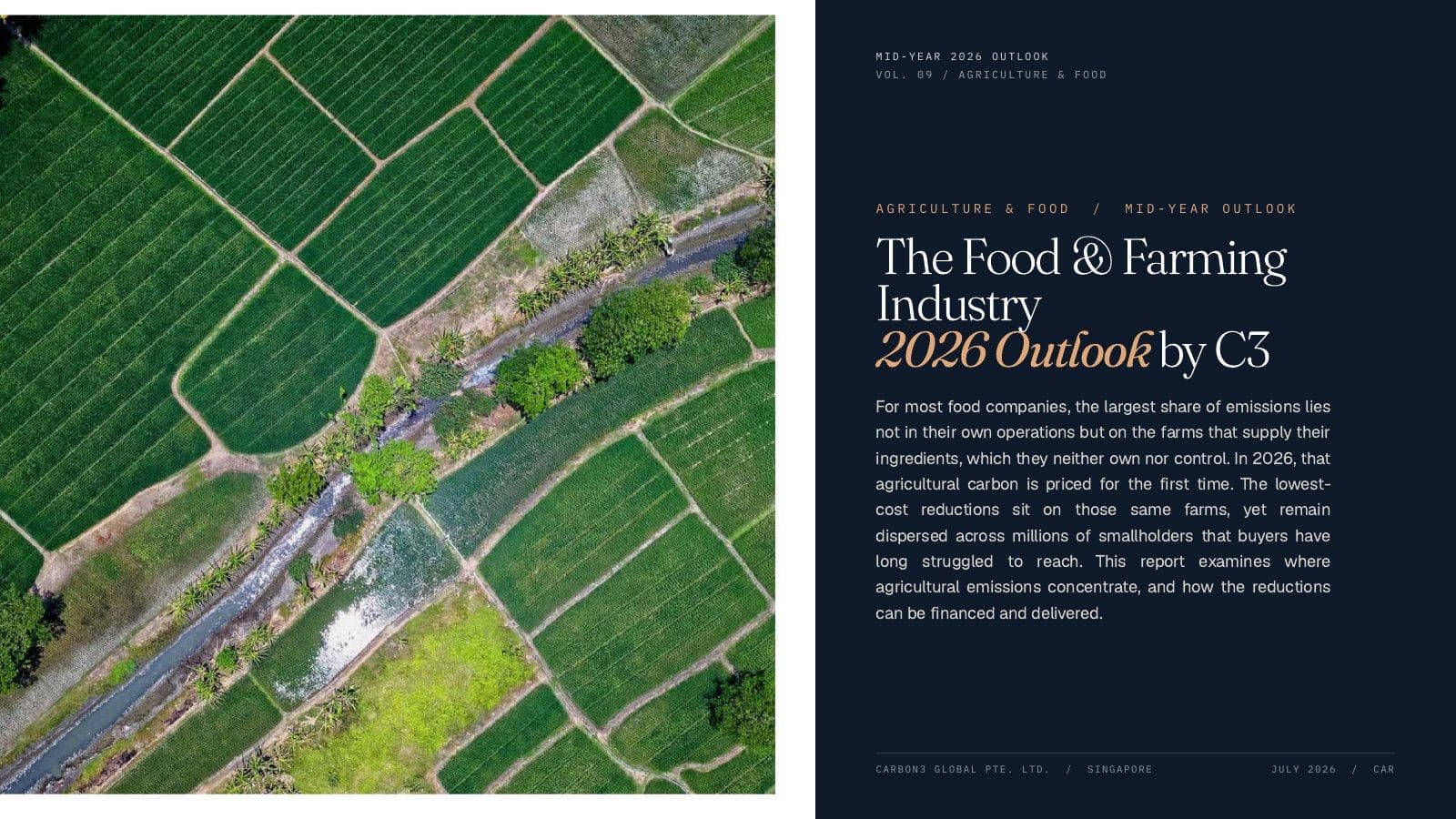
Our 2026 Agriculture & Food Outlook Roughly nine in every ten tonnes of a food company's carbon sit on farms it does not own. For years that has been treated as intractable. In 2026 it stops being optional:
- the EU Deforestation Regulation applies from 30 December,
- Denmark's farm-carbon tax is now law,
- and SBTi FLAG and California's LCFS set the terms.
Farm carbon is becoming a declared, priced liability that travels with the product to the buyer. The counterintuitive part is where the opportunity sits. The lowest-cost emission reductions in the entire economy are on those same farms, much of it profitable before any carbon payment:
- draining rice paddies,
- capturing methane from manure,
- feed additives that reduce methane emissions from cattle.
What holds them back is not capital. It is the difficulty of measuring, aggregating, and claiming a reduction spread across hundreds of millions of smallholders without counting it twice. That gap is what insetting closes.
This outlook report maps where food's carbon really sits, what reduces it fastest, and how the value can reach the farm.
Science Based Targets initiative Greenhouse Gas Protocol (GHG Protocol) Climate Policy Initiative UN Climate Change World Resources Institute The World Bank Group FAO
Document
The full document, as a PDF
Free to download once you have a free account. No payment details are needed.
Originally published on LinkedIn, 5 July 2026.
The Carbon3 Newsletter
Weekly analysis of industrial decarbonization and insetting across Scope 1 to 3, from the Carbon3 team.
Read more from the research team.
Outlook
Australia's chance to move from fuel importer to green fuel exporter
Without economic incentives and clear policy mandates, companies see little reason to invest in more expensive sustainable alternatives.
Read the articleOutlook
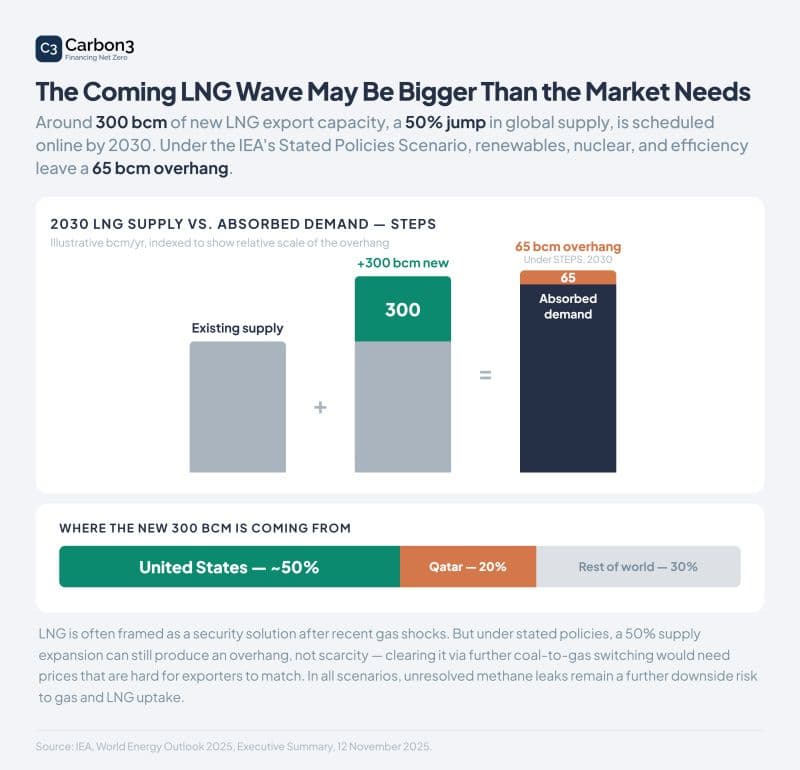
LNG could add 300 bcm of export capacity by 2030 that demand may not absorb
Under the IEA's Stated Policies Scenario, renewables, nuclear and efficiency leave a potential 65 bcm overhang.
Read the articleSector: Agriculture
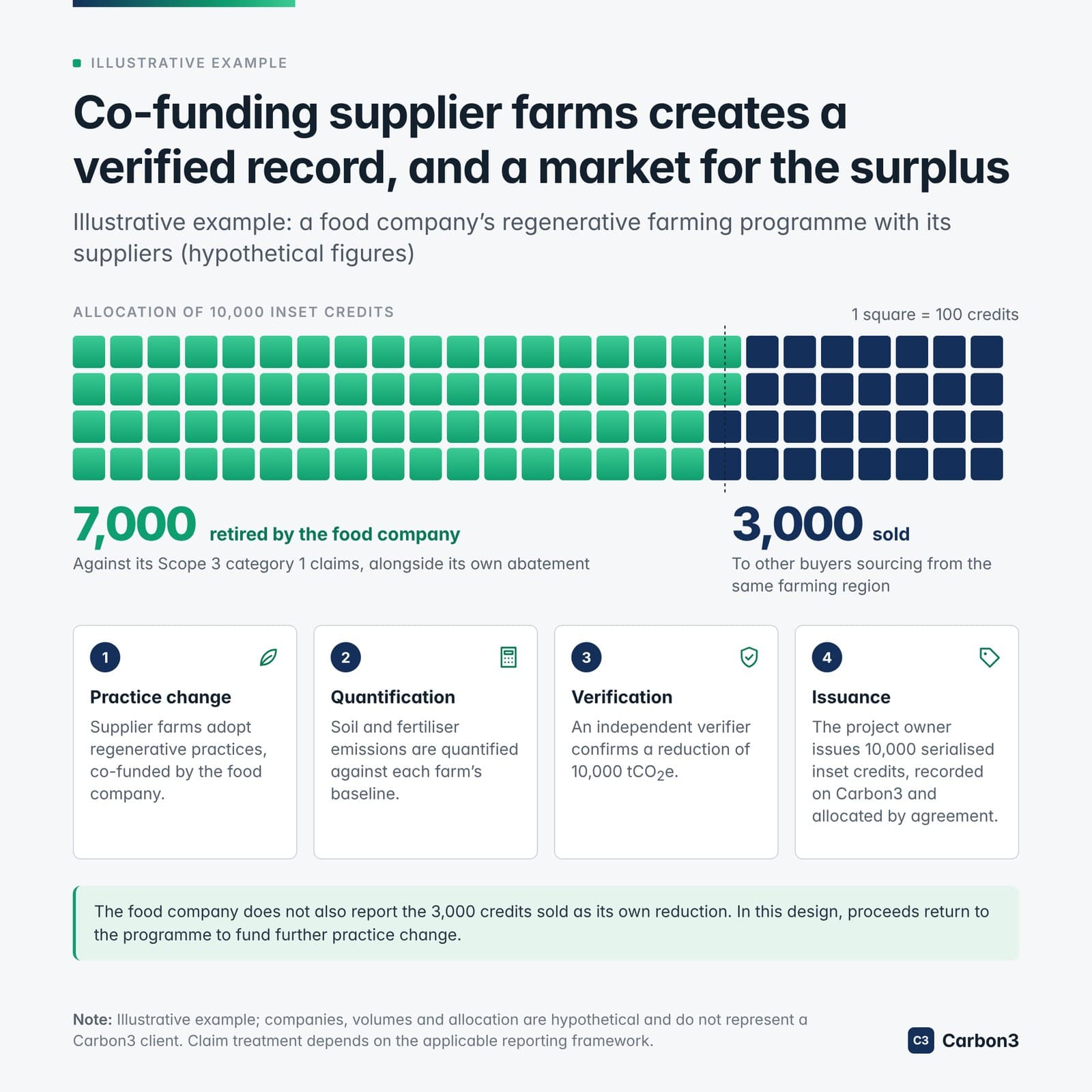
When a food company co-funds change on its own supplier farms
An illustrative example: 10,000 inset credits from regenerative practices, 7,000 retired against Scope 3 claims, 3,000 sold to regional buyers, and every tonne counted once.
Read the article
See the companies behind these figures in the Data Hub.
Look up your suppliers’ emissions and targets, free.