When a food company co-funds change on its own supplier farms
An illustrative example: 10,000 inset credits from regenerative practices, 7,000 retired against Scope 3 claims, 3,000 sold to regional buyers, and every tonne counted once.
By Carbon3 team2 min read
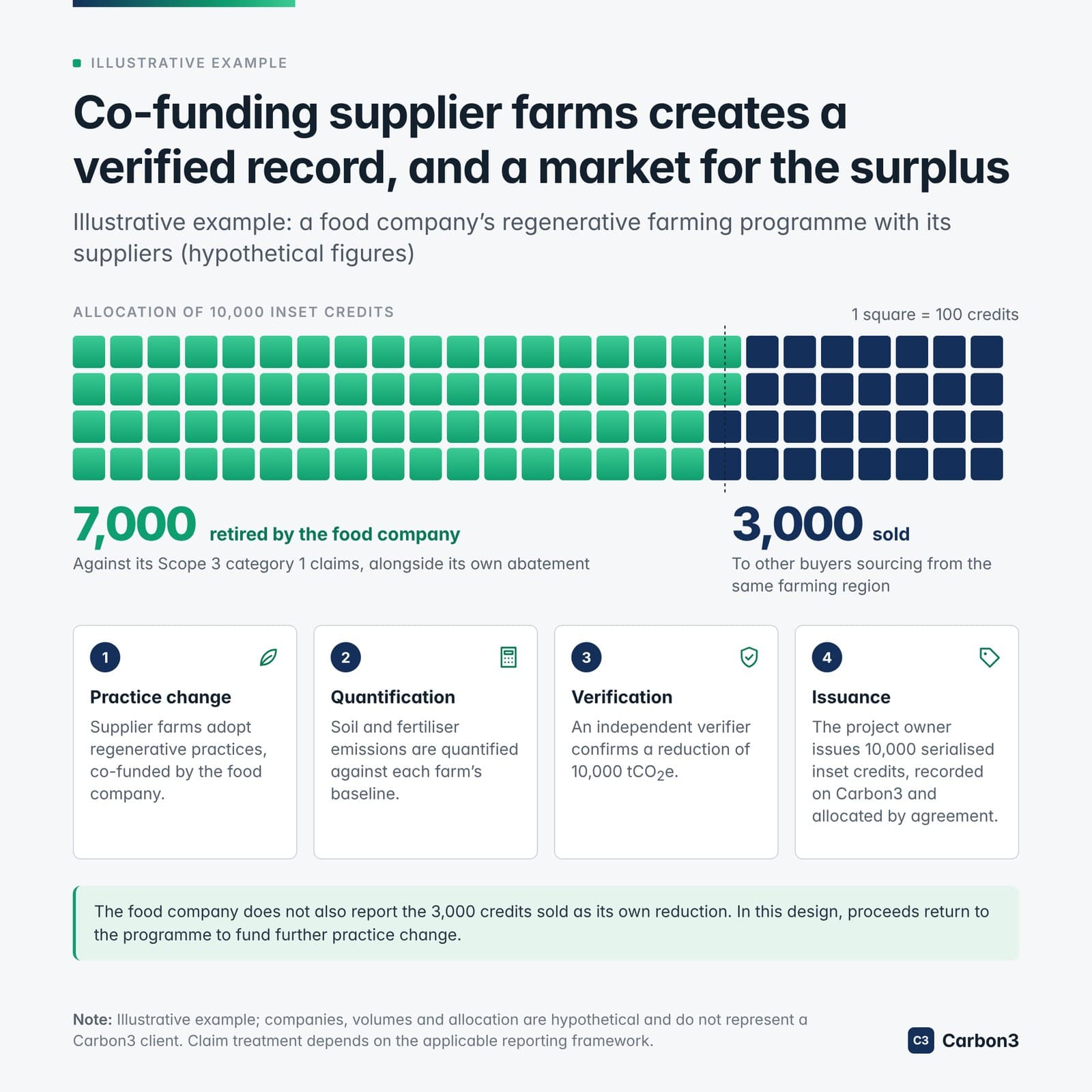
What does it look like when a food company co-funds change on its own supplier farms? An illustrative example, using hypothetical figures, shows how one verified reduction can be recorded once and shared without being counted twice.
The setup
A food company sources from farms in one region. Most of the emissions tied to its products sit there, upstream of its own operations and inside its Scope 3 inventory. The company co-funds regenerative practices on those supplier farms.
The resulting reduction is verified, and the verified reduction is issued as 10,000 inset credits. Each credit is a record of a reduction that happened inside the food company's own value chain, not a tonne bought from an unrelated project somewhere else. That is the difference between insetting and offsetting.
Splitting the record
In this example, the food company retires 7,000 of the 10,000 inset credits against its Scope 3 claims. It does this alongside its own abatement, not in place of it. The inset credits sit next to the reductions the company makes in its own operations and purchasing.
The other 3,000 are sold to other buyers in the same farming region. Those buyers may source from the same farms, or have the same agricultural supply base in their own value chains. For them, the credits record a share of a verified reduction that is relevant to their own Scope 3 inventories.
Counted once
The important step is what the food company does not do. Having sold 3,000 inset credits, it does not also report those 3,000 as its own reduction. The record shows who holds each part of the verified reduction, and each part is claimed by one party only.
One verified record, counted once. That is the point of issuing the reduction as inset credits rather than leaving each company to describe the same farm-level change in its own sustainability report. Without a shared record, two buyers can each tell a separate story about the same tonnes. With one, the split is visible.
Why it matters for food companies
For food companies, supplier farms are often where the largest share of value-chain emissions sits. Co-funding change there is a direct way to act on those emissions. Recording the result as inset credits gives the company a verified basis for its claim, and gives the farms and other regional buyers a way to take part in the same reduction without confusion over who claims what.
Selling part of the record can also help the economics. Other buyers sharing in the reduction can share in the cost of making it happen.
A note on claims
The figures here are hypothetical and the example is illustrative. Claim treatment depends on the applicable reporting framework.
Originally published on LinkedIn, 15 October 2026.
The Carbon3 Newsletter
Weekly analysis of industrial decarbonization and insetting across Scope 1 to 3, from the Carbon3 team.
Read more from the research team.
Sector: Agriculture
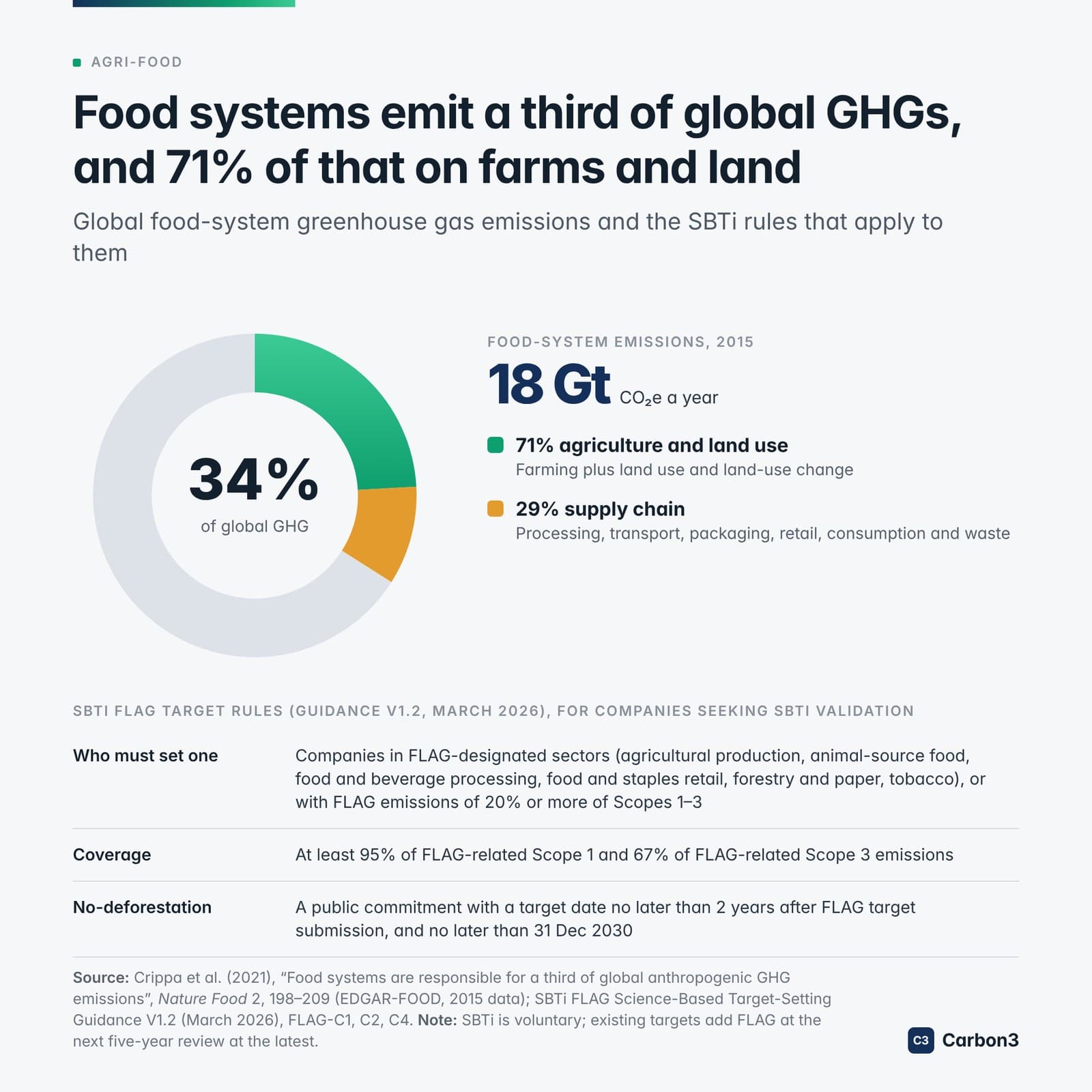
Most food-system emissions start before the factory gate
Agriculture and land use account for 71% of food-system emissions, and SBTi's FLAG guidance points food brands toward their supplier farms.
Read the articleSector: Agriculture
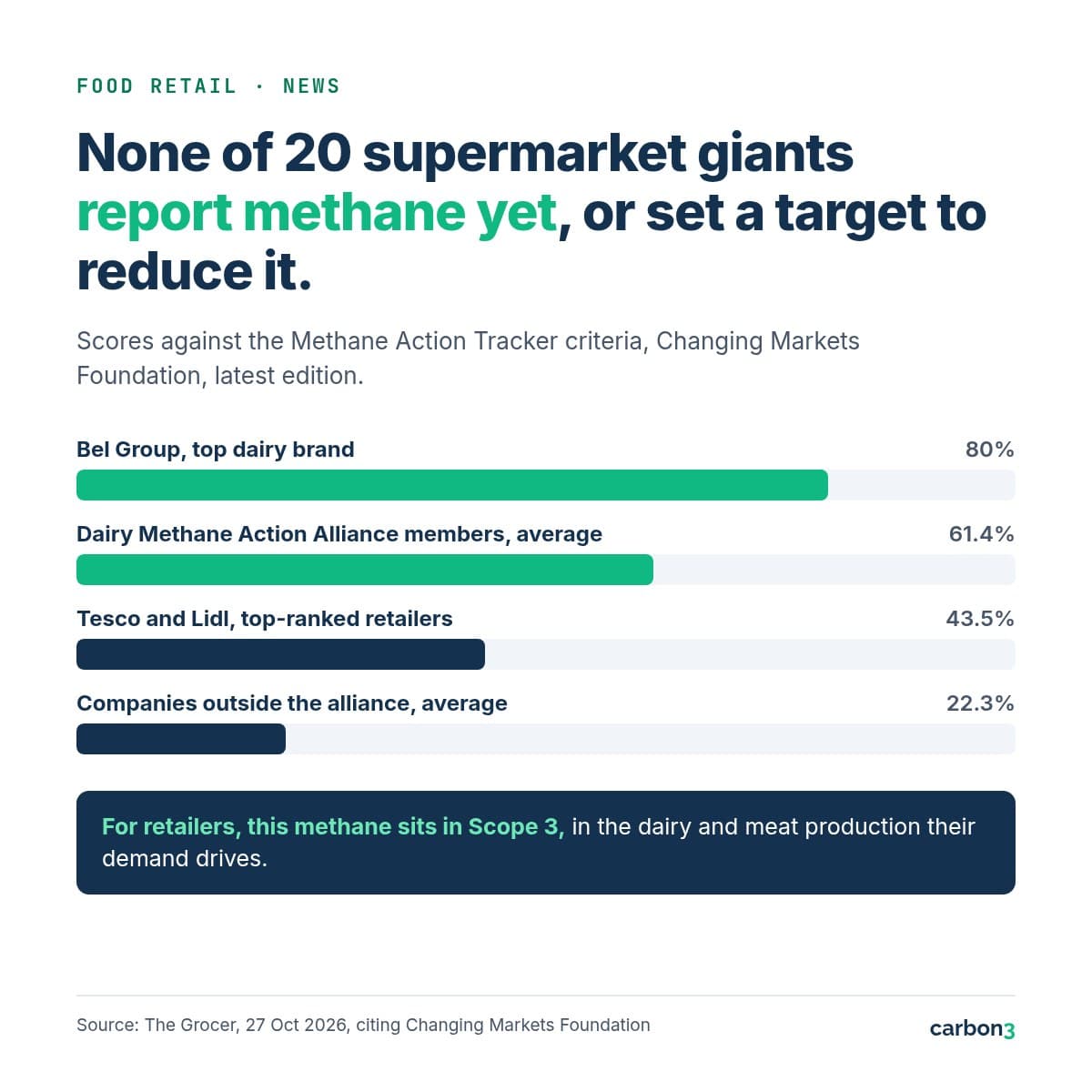
None of 20 supermarket giants reports methane in its supply chain
Changing Markets Foundation's Methane Action Tracker finds that none of the 20 largest retailers it assessed reports supply-chain methane or has a target to reduce it.
Read the articleProduct
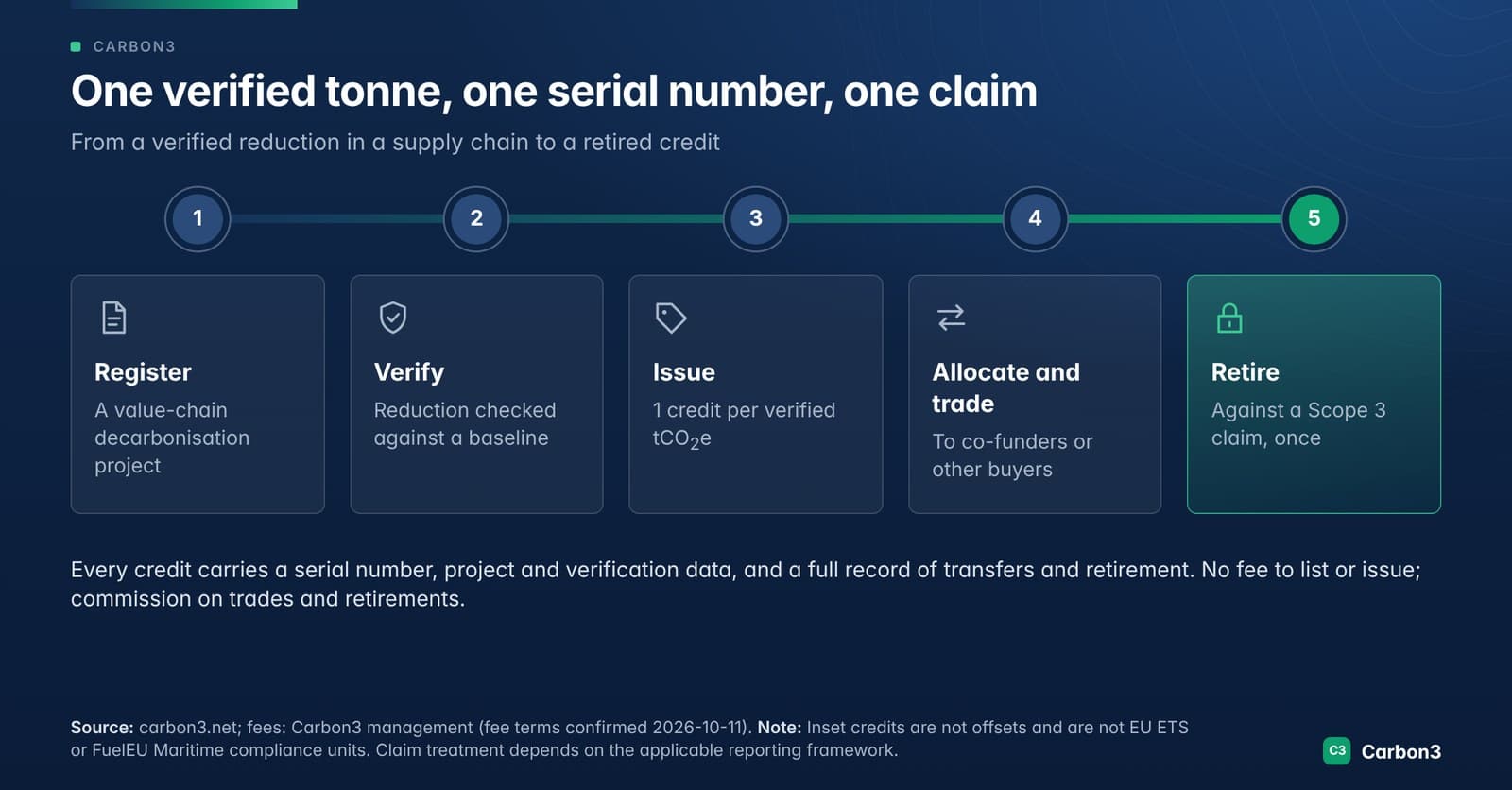
One verified tonne, one serial number, one claim
The five stages a reduction passes through on Carbon3, from supplier project to retired credit, and the record each stage leaves so the same tonne is never claimed twice.
Read the article
See the companies behind these figures in the Data Hub.
Look up your suppliers’ emissions and targets, free.