Most food-system emissions start before the factory gate
Agriculture and land use account for 71% of food-system emissions, and SBTi's FLAG guidance points food brands toward their supplier farms.
By Carbon3 team2 min read
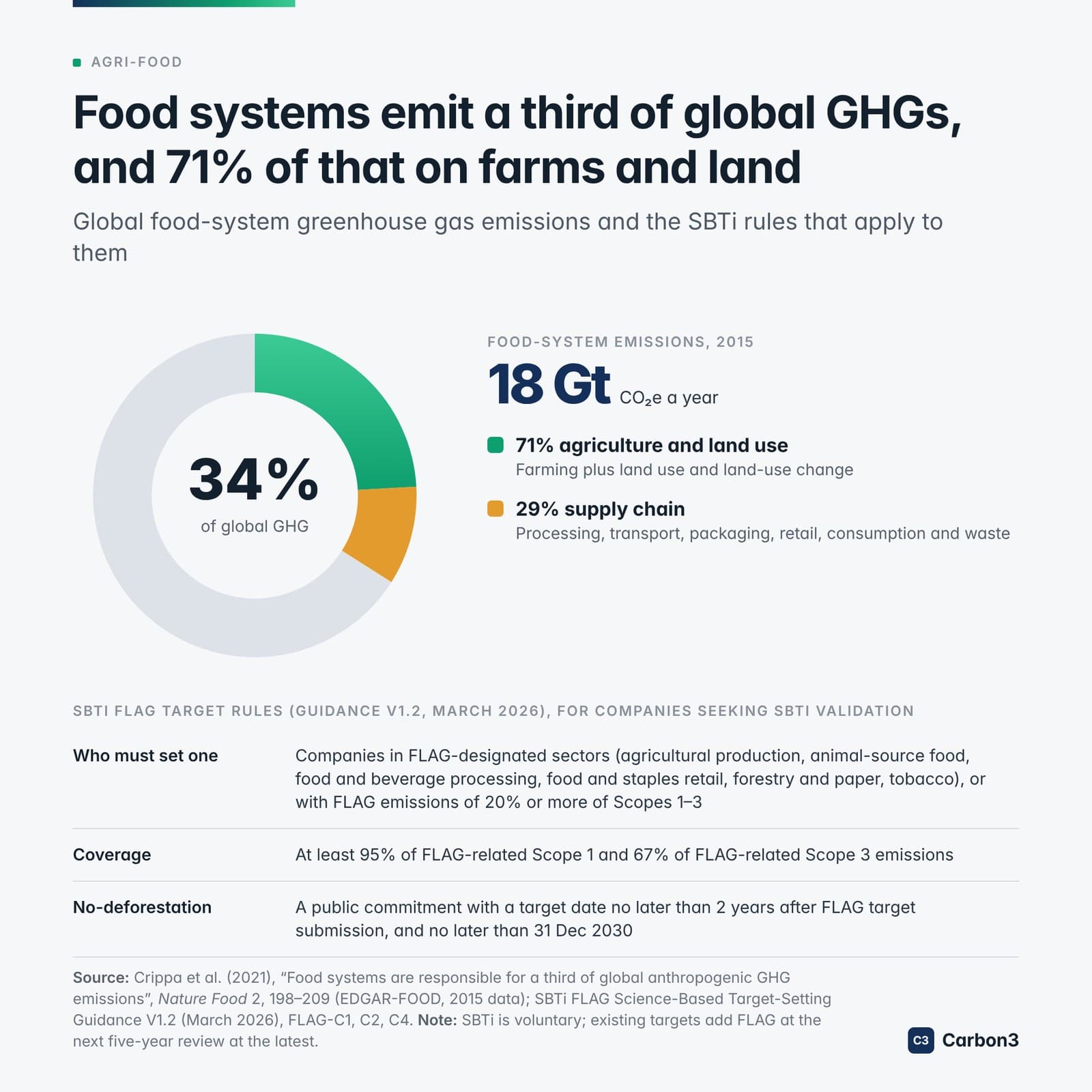
Most food-system emissions start before a product reaches the factory gate.
Where the emissions sit
Crippa et al. (2021) estimate global food-system emissions at 18 Gt CO2e in 2015, 34% of global greenhouse gas emissions. Of that total, 71% came from agriculture and land use. The remaining 29% came from everything after the farm: processing, transport, packaging, retail, consumption and waste.
For a food brand, that split is important. The parts of the system a brand controls most directly, its own factories, logistics and packaging decisions, sit in the smaller share. The larger share sits on farms and in land use, usually several tiers up the supply chain.
What FLAG asks for
The Science Based Targets initiative's Forest, Land and Agriculture (FLAG) guidance, version 1.2 from March 2026, makes this explicit. It requires a FLAG target from companies in designated food, forestry and tobacco sectors, or from companies whose FLAG emissions are 20% or more of their total. It also requires a no-deforestation commitment with a target date no later than 2030.
In practice, a FLAG target for a food brand points straight to supplier farms. Meeting it depends on what happens in fields, herds and land management that the brand does not own.
From target to reductions
That is where co-funding comes in. Farm-level practice changes often carry an upfront cost or a period of risk for the farmer. A brand that shares that cost has a direct route to reductions in the part of its footprint that matters most.
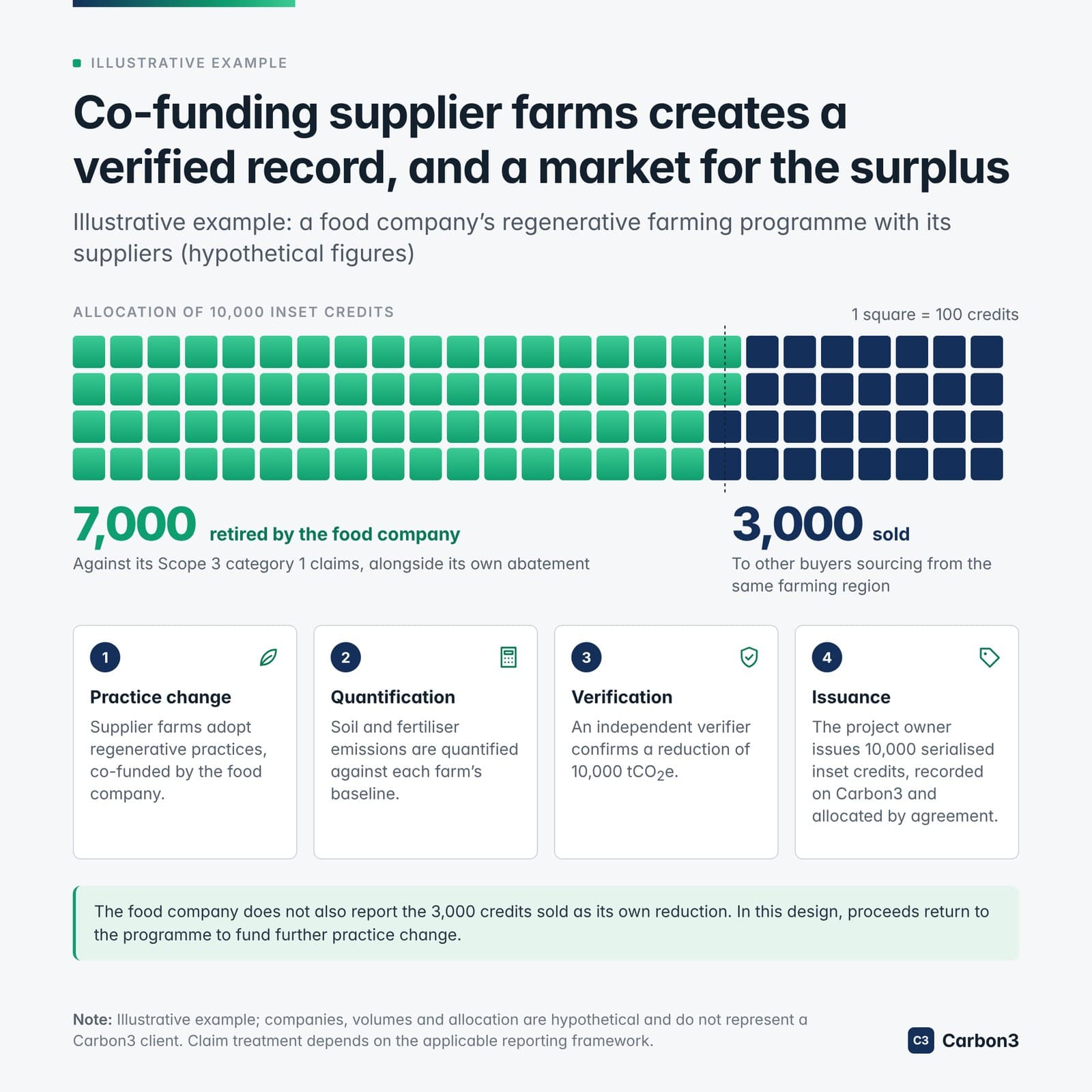
Co-funded, verified farm-level reductions can be recorded as inset credits. The credit records the verified reduction and which party holds it, so the brand and its supplier work from the same record rather than separate estimates.
Insetting funds reductions inside the value chain; it is not offsetting. The reductions happen in the brand's own sourcing base, on farms it already buys from.
Claim treatment depends on the applicable reporting framework.
The point for food brands
The numbers make the priority clear. If most of the footprint starts before the factory gate, most of the reduction work has to start there too, and FLAG targets give that work a deadline.
Originally published on LinkedIn, 12 October 2026.
The Carbon3 Newsletter
Weekly analysis of industrial decarbonization and insetting across Scope 1 to 3, from the Carbon3 team.
Read more from the research team.
Sector: Agriculture
Supermarkets are struggling with food emissions
Madre Brava's UK director on why farm-level change is too slow and too small to hit near-term retail targets.
Read the articleSector: Agriculture
When a food company co-funds change on its own supplier farms
An illustrative example: 10,000 inset credits from regenerative practices, 7,000 retired against Scope 3 claims, 3,000 sold to regional buyers, and every tonne counted once.
Read the articleClaims & reporting
Scope 3 rules are being rewritten between 2026 and 2028
Revised ESRS apply from financial year 2027, and SBTi's Net-Zero Standard V2.0 becomes mandatory in February 2028.
Read the article
See the companies behind these figures in the Data Hub.
Look up your suppliers’ emissions and targets, free.