Amazon opens one path for climate technology across devices, cloud and its own brands
The new Amazon Sustainability Deep Tech Accelerator lets climate technology companies be evaluated for adoption by Amazon Devices, AWS and Amazon Private Brands, with no equity required to join.
By Carbon3 team2 min read
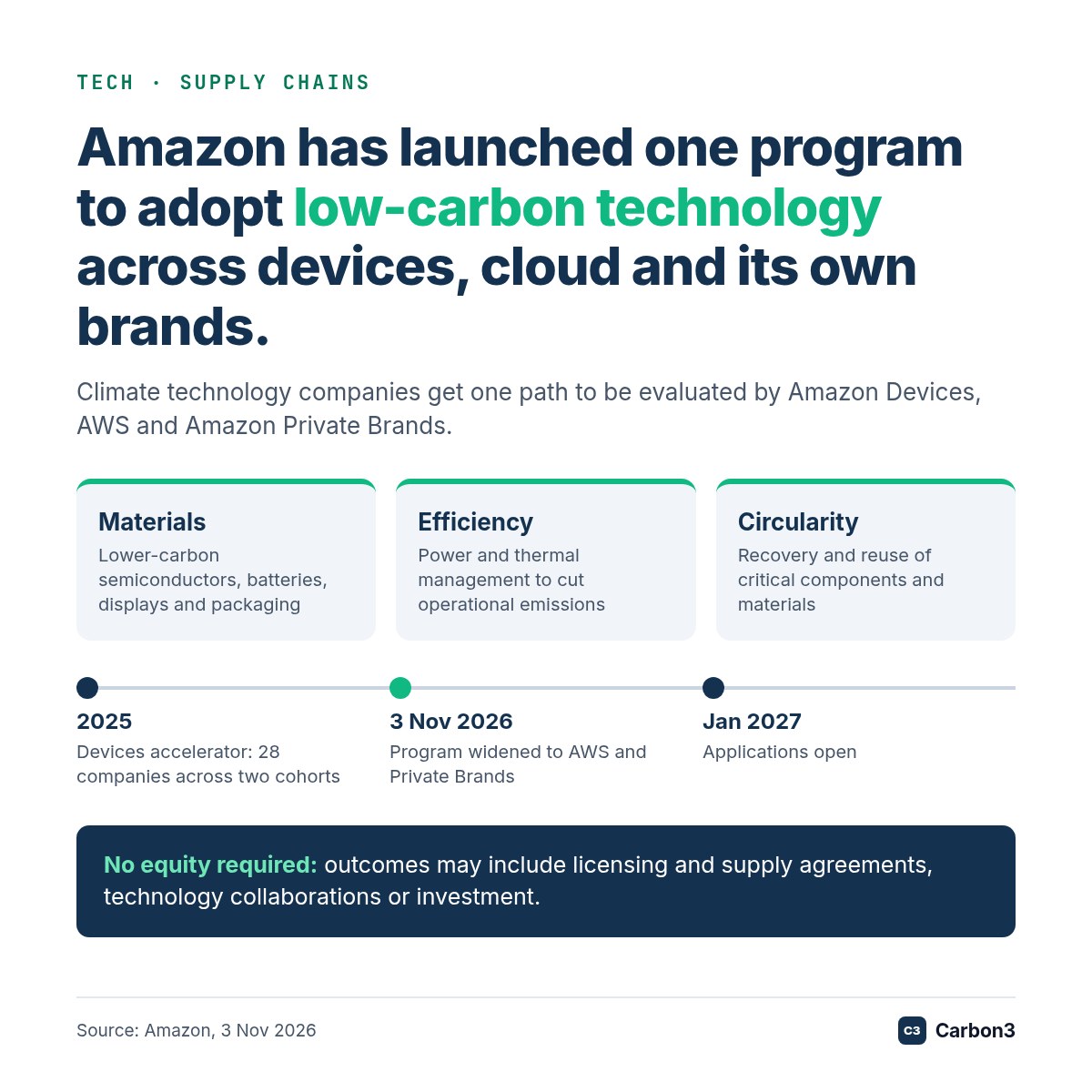
Amazon has launched the Amazon Sustainability Deep Tech Accelerator, a single program through which climate technology companies can be evaluated for adoption across Amazon Devices, AWS and Amazon Private Brands, according to Amazon's announcement on 3 November 2026.
A buyer can matter as much as funding
For a young climate technology company, the hardest step is often not raising money but finding a first large customer willing to put the technology into real products and a real supply chain. A buyer that is ready to adopt can do as much for a company's progress as a funding round, because adoption turns a pilot into volume.
That is the gap this program targets. Instead of approaching each part of Amazon separately, a company now has one path to be assessed by three large buying organizations at once.
What Amazon is looking for
The program focuses on lower-carbon materials for semiconductors, batteries, displays and packaging, on energy efficiency through power and thermal management, and on the recovery and reuse of critical components and materials.
It builds on a devices accelerator that Amazon ran in 2025, which worked with 28 companies across two cohorts. The new program widens that approach to AWS and Amazon Private Brands. Amazon takes no equity as a condition of joining, and applications open in January 2027. Possible outcomes include licensing and supply agreements, technology collaborations or investment.
Who gets the credit for the savings
Programs like this raise a practical accounting question. When a large buyer adopts a supplier's cleaner technology, the emissions reductions show up in more than one place. The supplier made the change, and the buyer's value-chain (Scope 3) footprint gets smaller because of it.
Both sides have a fair interest in the result, and each reduction should still be claimed only once. Being clear about who funded the change, who carried it out and who reports it helps avoid double counting as these supplier programs grow. Claim treatment depends on the applicable reporting framework.
Carbon3 works on that problem from the buyer and supplier side: it records reductions in value chains so that each one is traceable to the project that delivered it. The difference between insetting inside a value chain and offsetting outside it is explained on Carbon3's insets vs offsets page.
When a buyer adopts a supplier's cleaner technology, who should get credit for the emissions savings?
Learn more
How insetting works, step by step
Originally published on LinkedIn, 4 November 2026.
Read more from the research team.
Market structure
In Australia, cutting methane can cost less than buying credits
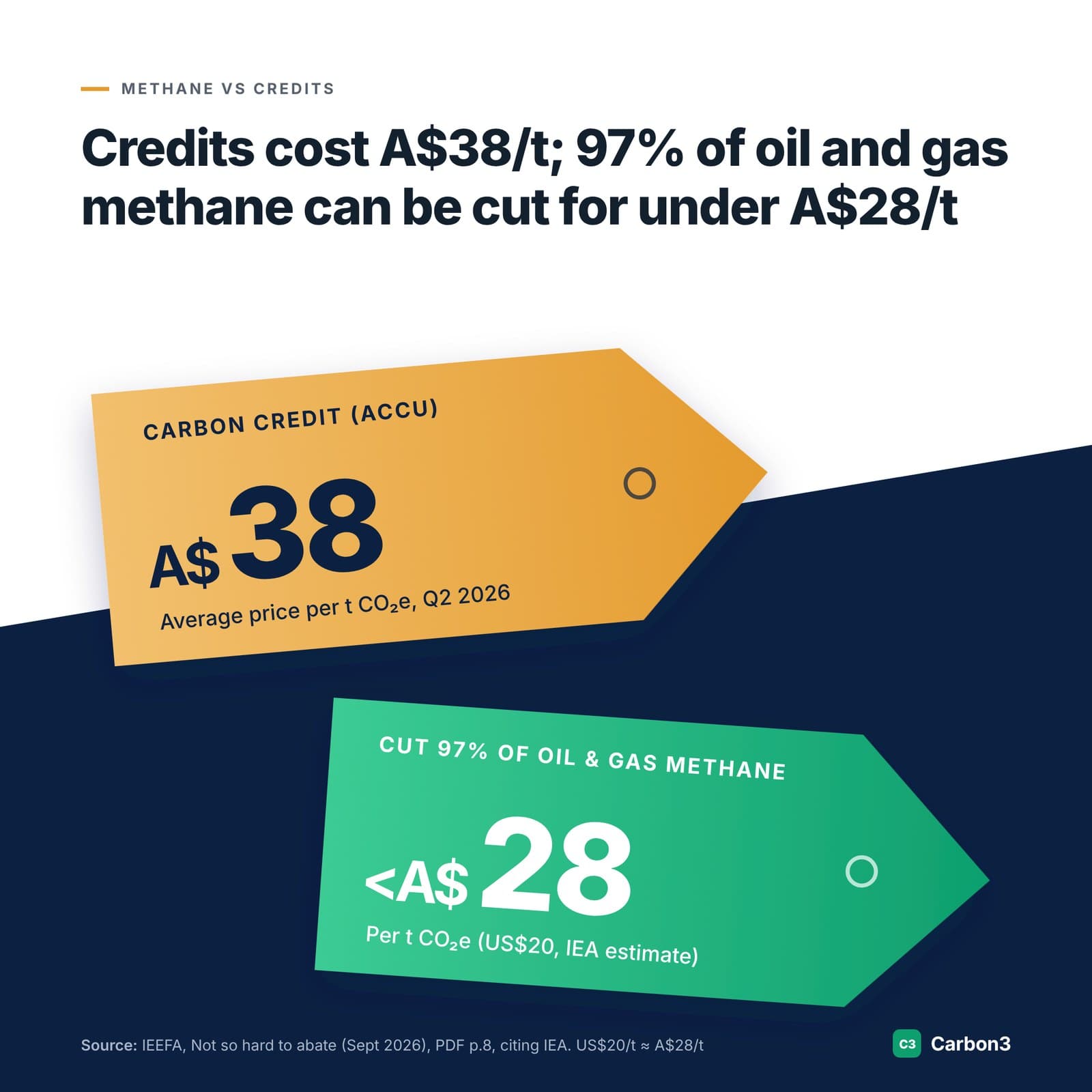
IEEFA, citing the IEA, notes 97% of oil and gas methane could be abated for under US$20 a tonne, about A$28, while ACCUs averaged A$38 a tonne in Q2 2026.
Read the articleMarket structure
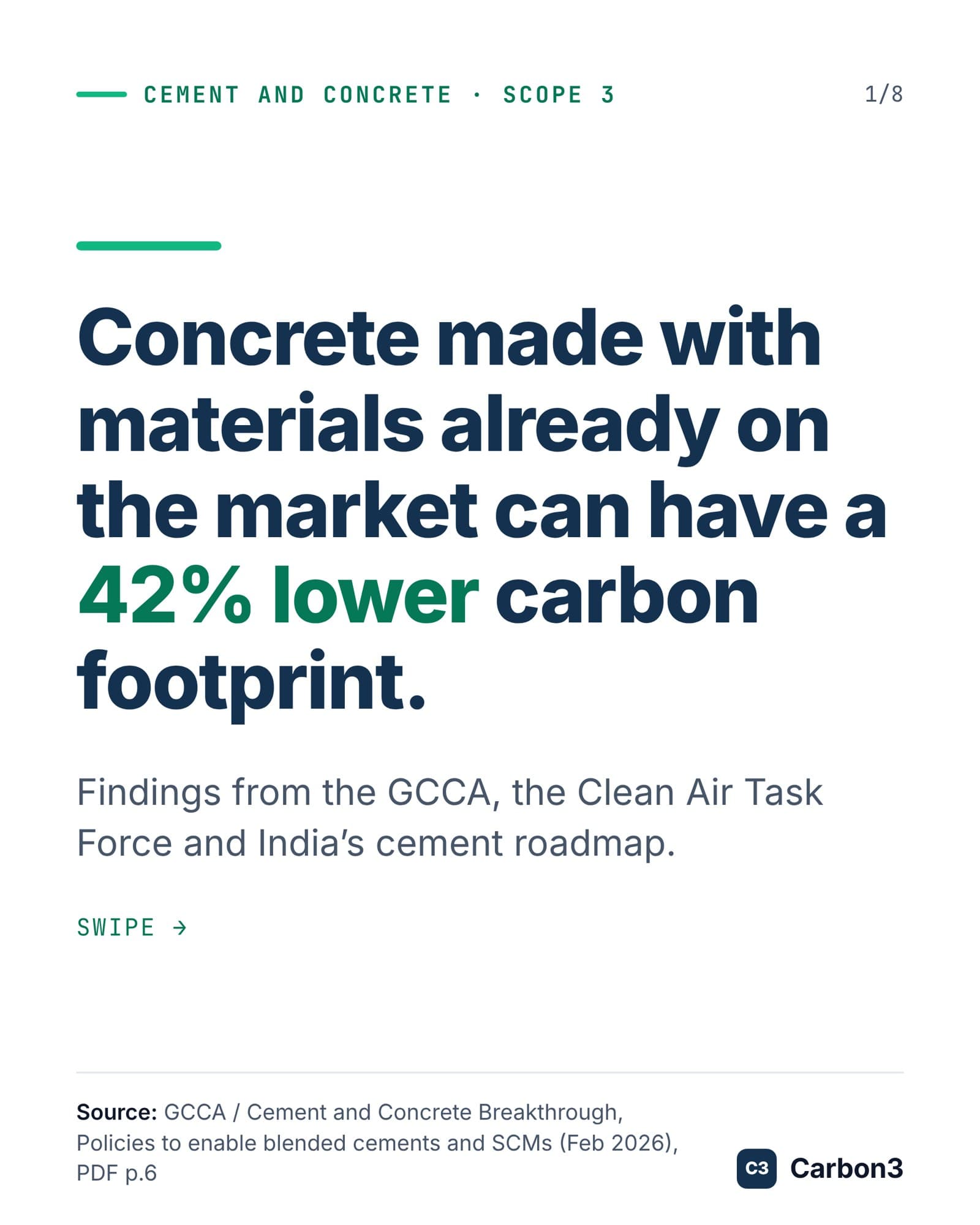
Concrete made with materials already on the market can have a 42% lower carbon footprint
Work by the GCCA, the Clean Air Task Force and India's cement roadmap points to one lever for concrete: using less clinker, with materials that already exist.
Read the articleClaims & reporting
The SBTi has set the rules for using value-chain projects toward targets
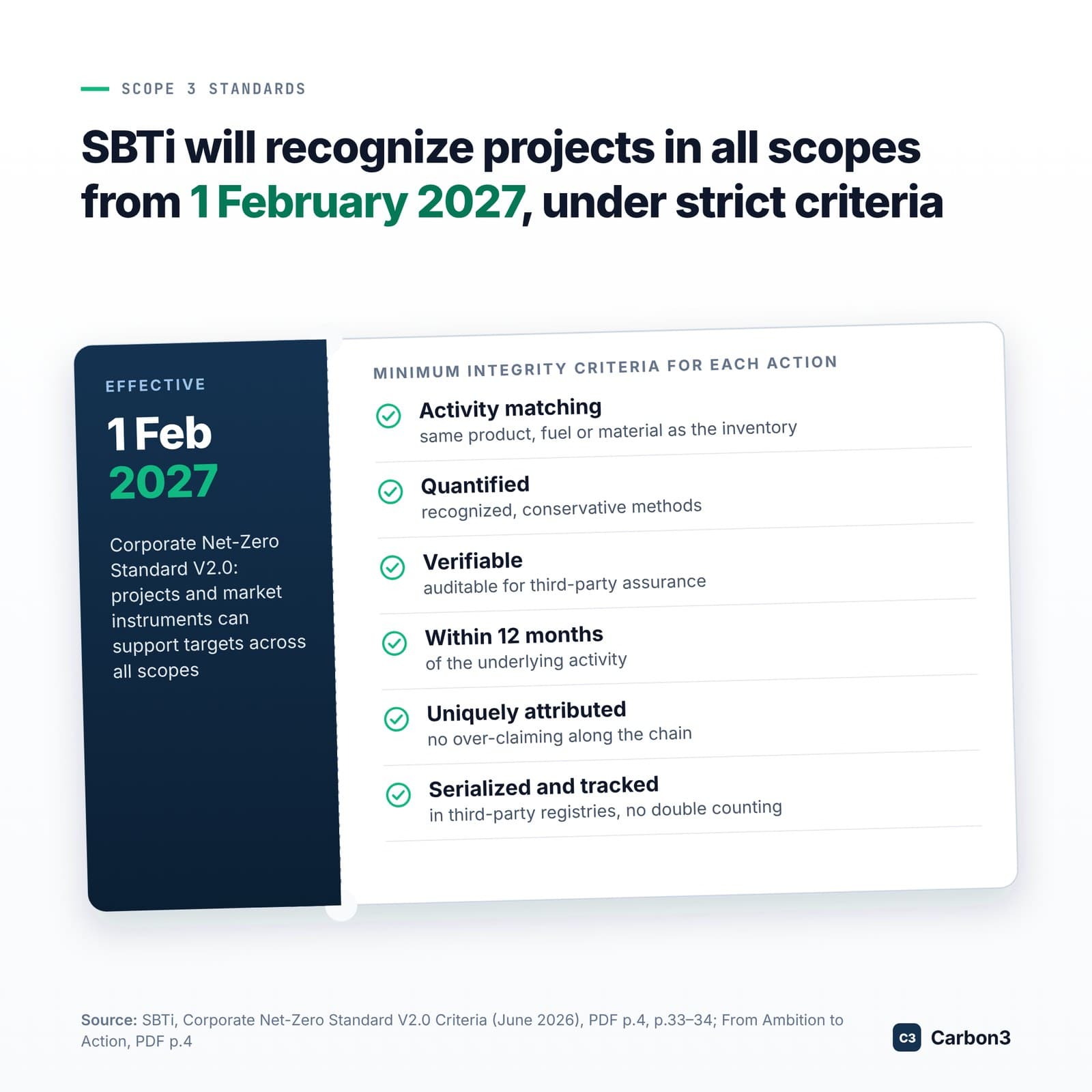
The Corporate Net-Zero Standard V2.0 opens for validations on 1 February 2027, becomes mandatory for new targets on 1 February 2028, and lets projects support targets across all scopes, provided each action is verifiable, timely, uniquely attributed and serialized.
Read the article
See the companies behind these figures in the Data Hub.
Look up your suppliers’ emissions and targets, free.