Battery storage reaches 110 GW
Battery storage capacity has reached 110 GW, and storage is becoming part of how clean power is delivered rather than an add-on.
By Carbon3 team2 min read
Battery storage has reached 110 GW of capacity. That figure marks storage moving from a niche technology to an ordinary part of how power systems are planned and run.
Why storage matters for clean power
Solar and wind produce power when the sun shines and the wind blows, not necessarily when demand peaks. Storage closes that gap. Batteries take in power when it is plentiful and release it when it is needed, which lets a grid use more of the renewable output it already has and rely less on fossil plants to cover the evening peak.
At 110 GW, storage is no longer a pilot. It is infrastructure that grid operators, developers and large energy buyers plan around.
What it means for supply chains
For companies working on supply-chain emissions, the electricity their suppliers use is often one of the largest levers. A supplier's electricity is its Scope 2, and for the customer it becomes part of Scope 3. Cleaner, firmer power changes what suppliers can realistically do: running electrified processes on renewable power becomes more practical when storage can smooth out supply.
That widens the set of reductions that a buyer and supplier can work on together, from electrifying heat and equipment to shifting operations onto cleaner supply.
From system change to recorded reductions
Grid-level change on its own lowers emissions gradually across everyone connected. Specific projects at specific suppliers, such as an electrified process or on-site renewables with storage, produce reductions that can be measured at the facility.
When a buyer co-funds a project like that, the verified reduction can be recorded as an inset credit, tied to the supplier where it happened and to the party that holds it. Insetting is not offsetting: it funds reductions inside the value chain.
The direction of travel
Storage at this scale is a sign that the building blocks of a cleaner power system are arriving. The question for companies is how quickly those building blocks reach the factories and facilities in their own supply chains, and whether they help fund the projects that get them there.
Originally published on LinkedIn, 22 September 2026.
The Carbon3 Newsletter
Weekly analysis of industrial decarbonization and insetting across Scope 1 to 3, from the Carbon3 team.
Read more from the research team.
Outlook
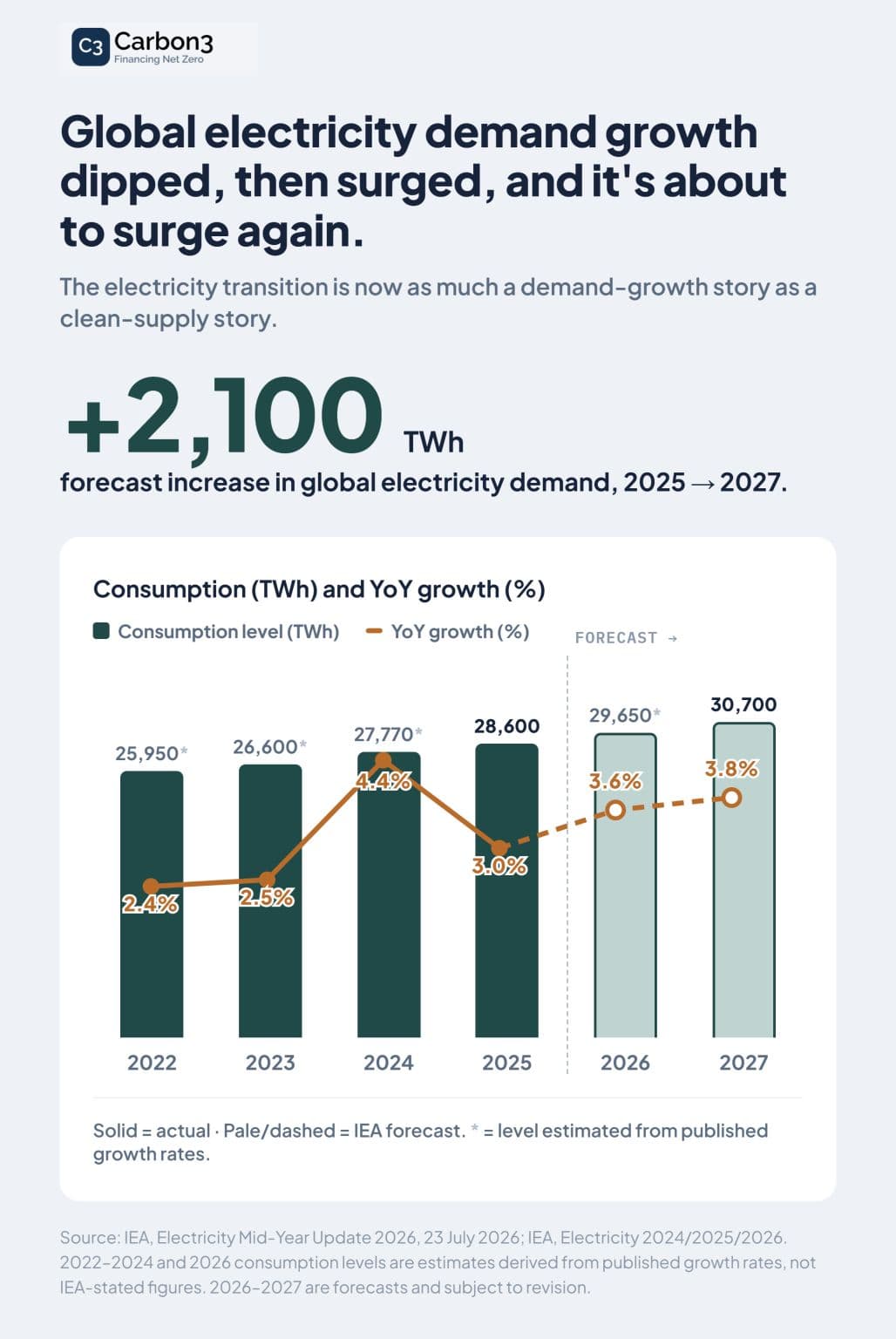
Global electricity demand growth is accelerating again
After easing in 2025, the IEA expects demand growth to climb through 2027, adding more than the annual use of many major economies in two years.
Read the articleOutlook
Electrification is also a fuel-import strategy
In the IEA's high-electrification scenario, oil imports fall by 15 mb/d and 120 bcm of gas imports are avoided by 2035.
Read the articleOutlook
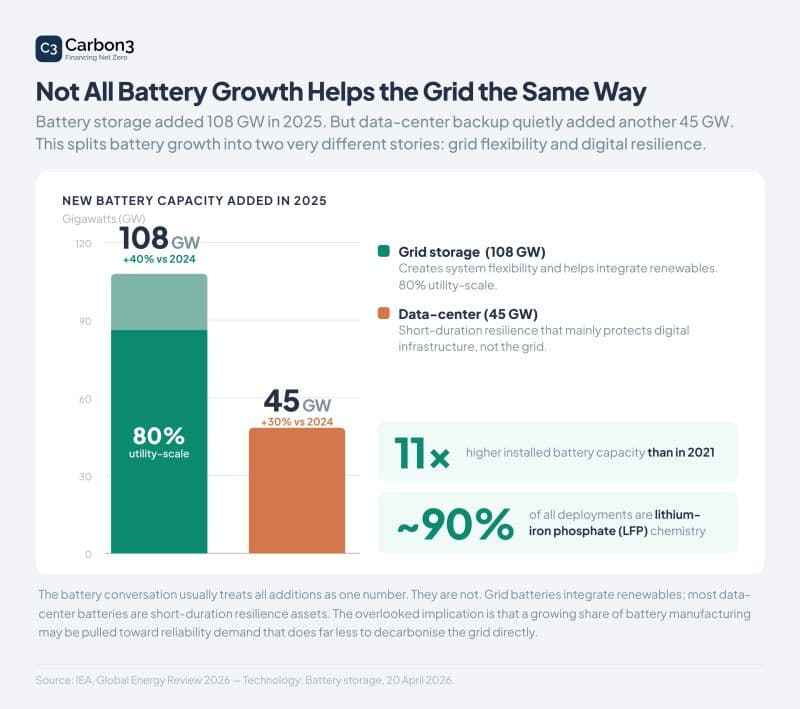
The battery boom is no longer one story
Grid-scale storage is scaling fast, while data centers add backup capacity to protect uptime rather than to make the grid more flexible.
Read the article
See the companies behind these figures in the Data Hub.
Look up your suppliers’ emissions and targets, free.