Chinese EV exports are being redirected, not disappearing
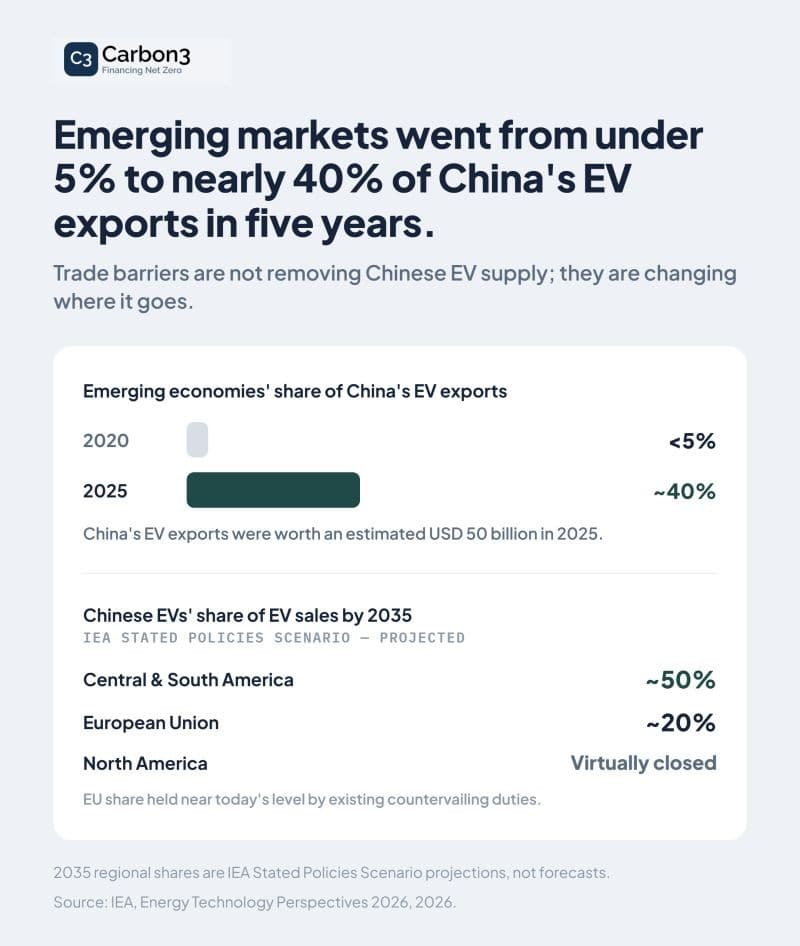
Emerging economies' share of China's EV exports rose from under 5% in 2020 to nearly 40% in 2025, according to the IEA. Whether charging, grid capacity and affordable finance can keep pace is the open question.
By Paul Cruickshank2 min read
Chinese EV exports are not disappearing. They are being redirected.
According to the International Energy Agency's Energy Technology Perspectives 2026, emerging economies' share of China's electric vehicle exports rose from under 5% in 2020 to nearly 40% in 2025. China's EV exports were worth an estimated US$50 billion in 2025.
Trade barriers are not removing Chinese EV supply. They are changing where it goes.
Where the IEA sees the shares heading
The IEA's Stated Policies Scenario projects how the share of Chinese-made vehicles in EV sales could look by 2035, region by region:
- Central and South America: around 50% of EV sales.
- European Union: around 20%, held near today's level by existing countervailing duties.
- North America: virtually closed to Chinese EVs.
These 2035 figures are scenario projections under current policy settings, not forecasts. They show the direction of travel if today's trade measures stay in place, rather than a prediction of what will happen.
A shift in where the transition happens
The pattern is clear in the numbers. Markets that have raised barriers are seeing Chinese supply held flat or shut out. Markets without those barriers are absorbing a growing share of it. In five years, emerging economies went from a marginal destination to taking close to two in every five Chinese EVs exported.
For those economies, a larger supply of EVs is an opportunity to electrify road transport sooner. But vehicles are only one part of the system.
Can the rest of the system keep pace?
The question the shift raises is whether the infrastructure and capital around the vehicles can move as fast as the vehicles themselves:
- Charging. EVs need public and private charging networks in place where they are sold.
- Grid capacity. More EVs mean more demand on electricity networks, which have to be planned and reinforced.
- Affordable finance. Buyers, fleet operators and infrastructure developers in emerging markets need access to capital at a cost that makes the switch viable.
If any of these lags, the arrival of cheaper vehicles alone will not deliver the transition. Climate finance that reaches charging, grids and buyers in these markets is part of what decides whether the redirected supply turns into lasting emissions reductions.
Source: IEA, Energy Technology Perspectives 2026.
Originally published on LinkedIn, 20 October 2026.
The Carbon3 Newsletter
Weekly analysis of industrial decarbonization and insetting across Scope 1 to 3, from the Carbon3 team.
Read more from the research team.
Outlook
Electrification changes what each dollar of energy delivers
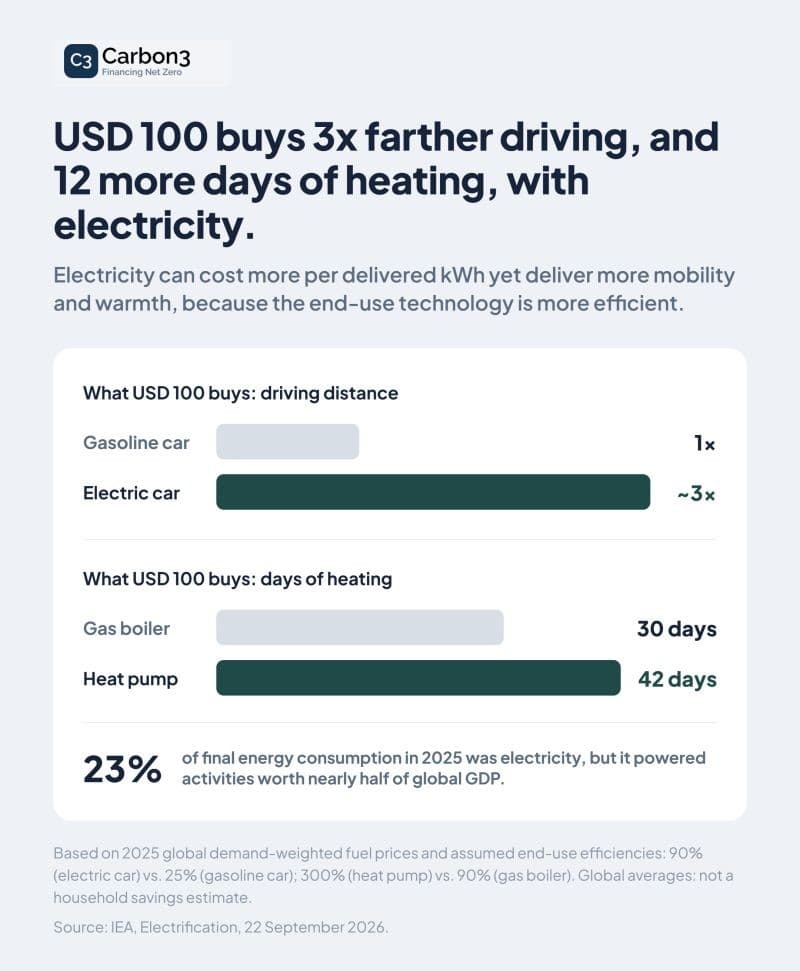
In the IEA's global averages, US$100 of electricity drives a car about three times farther than petrol and heats a home for 42 days rather than 30.
Read the articleOutlook
Most CSOs still frame sustainability as compliance
In the World Economic Forum's 2026 CSO Outlook, 65% of respondents described sustainability primarily as a compliance obligation, and 41% as a source of growth or value.
Read the articlePolicy
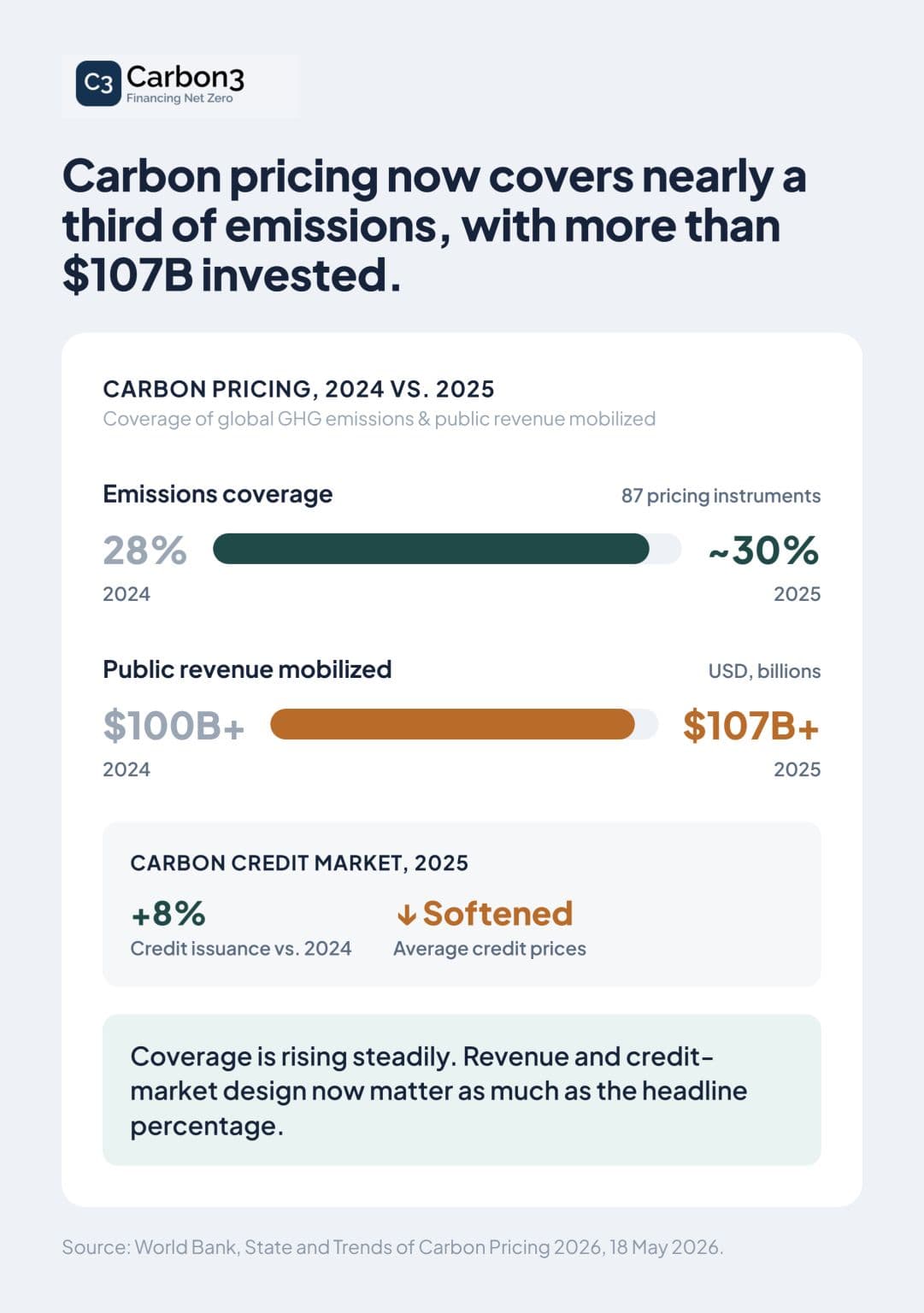
Carbon pricing covers nearly 30 percent of global emissions
Pricing systems raised more than $107 billion for public budgets in 2025.
Read the article

See the companies behind these figures in the Data Hub.
Look up your suppliers’ emissions and targets, free.