Hydrogen has a demand problem, and the contracts show it
The IEA's Global Hydrogen Review 2026 finds new low-emissions hydrogen offtake was about 1.7 Mt in 2025, and only around 20% of newly signed volumes were firm.
By Carbon3 team2 min read
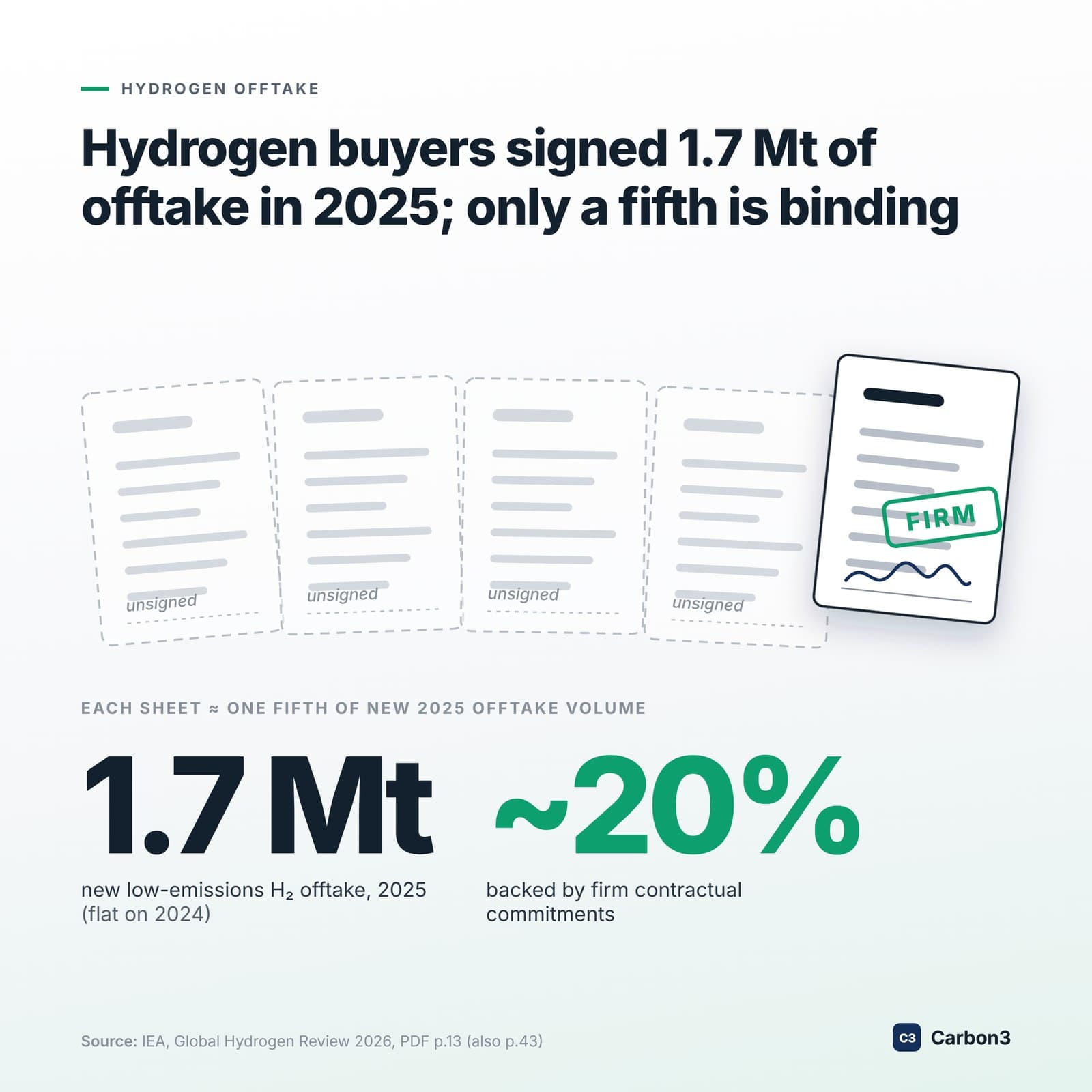
Hydrogen has a demand problem, and the contracts show it.
Low-emissions hydrogen has no shortage of announced projects. What it lacks is enough buyers willing to commit to volumes in writing, and the International Energy Agency's Global Hydrogen Review 2026 puts numbers on that gap.
What the contracts say
According to the IEA, new offtake agreements for low-emissions hydrogen came to about 1.7 Mt in 2025, roughly flat on the year before. Only around 20% of the newly signed volumes were backed by firm contractual commitments, which means most of the year's announced demand still sits in memoranda, letters of intent and other agreements that a lender cannot rely on.
Project developers say the same thing in their own words. The IEA reports that developers widely cite demand creation as a key barrier to investment.
Why firm offtake matters
A memorandum of understanding signals interest, but it does not finance an electrolyzer. Lenders and equity investors look for contracted revenue before they commit capital to a plant, and a soft agreement that either side can walk away from does not provide it.
As a result, the gap between announced and contracted demand shows up directly in investment decisions. Projects without firm buyers struggle to reach final investment decision, and the volumes they were meant to supply do not arrive.
Where supply-chain buyers come in
The industries that already use large amounts of hydrogen, such as refining, chemicals and fertilizer, are the natural first buyers of low-emissions supply. Companies that buy from these sectors carry the related emissions in their own Scope 3 inventories.
When those buyers sign firm, verified offtake, they give developers the bankable signal that soft agreements cannot. Additionally, the switch from conventional to low-emissions hydrogen reduces emissions inside the buyer's own value chain, rather than somewhere outside it.
On Carbon3, that verified reduction can be recorded once as an inset credit and linked to the hydrogen supply, the producer and the buyer that funded it. Credits are issued to the project developer after independent verification, and Carbon3 records them in its registry, so each tonne is claimed only once.
Insetting is not offsetting. The reduction happens in the supply chain the buyer already depends on.
Claim treatment depends on the applicable reporting framework.
Source: IEA, Global Hydrogen Review 2026.
Originally published on LinkedIn, 25 October 2026.
The Carbon3 Newsletter
Weekly analysis of industrial decarbonization and insetting across Scope 1 to 3, from the Carbon3 team.
Read more from the research team.
Transition finance
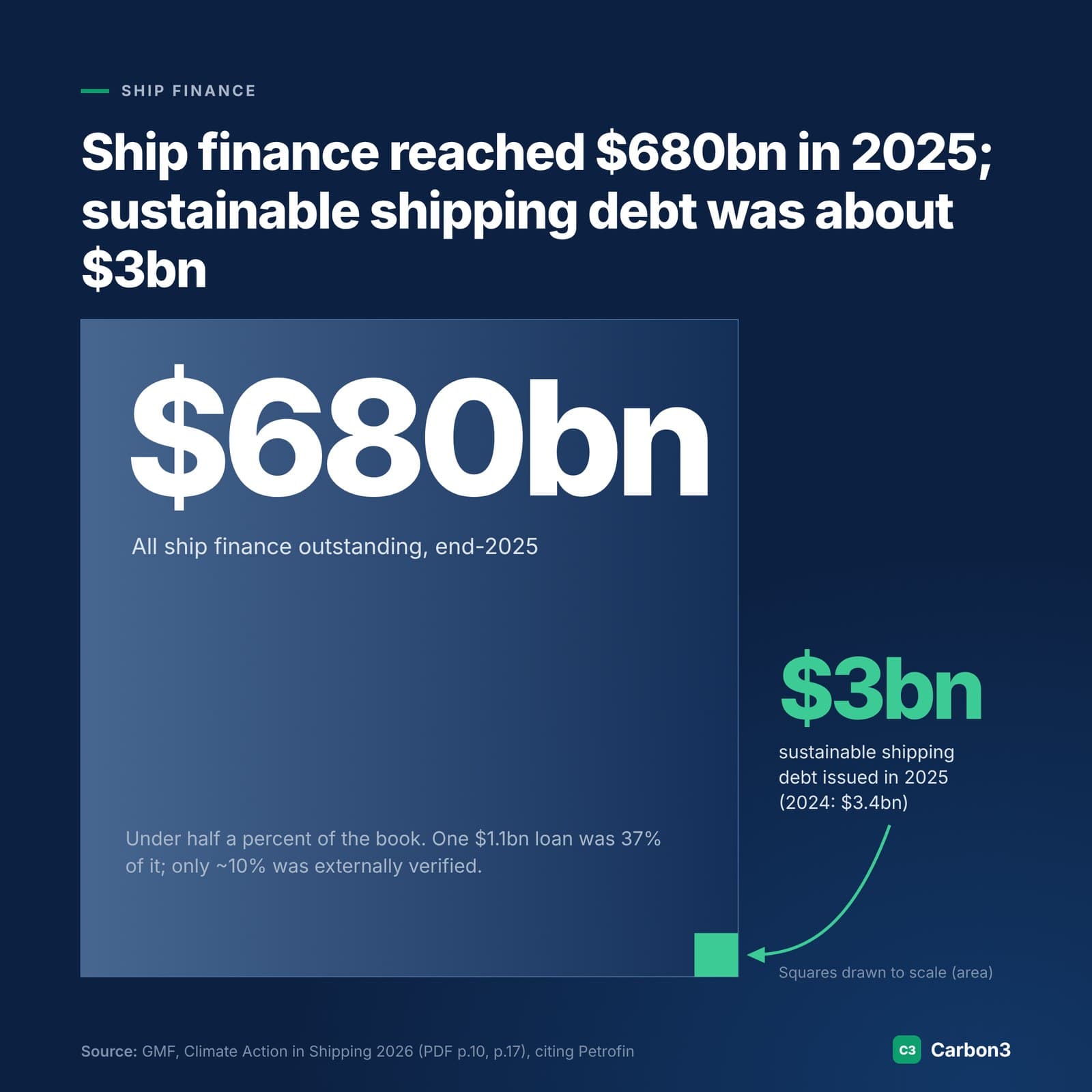
Ship finance is a $680bn book; sustainable shipping debt was about $3bn
Global ship finance stood at about $680bn at the end of 2025, while shipping-specific sustainable debt issuance was about $3.0bn, and only about 10% of it was externally verified.
Read the articleTransition finance
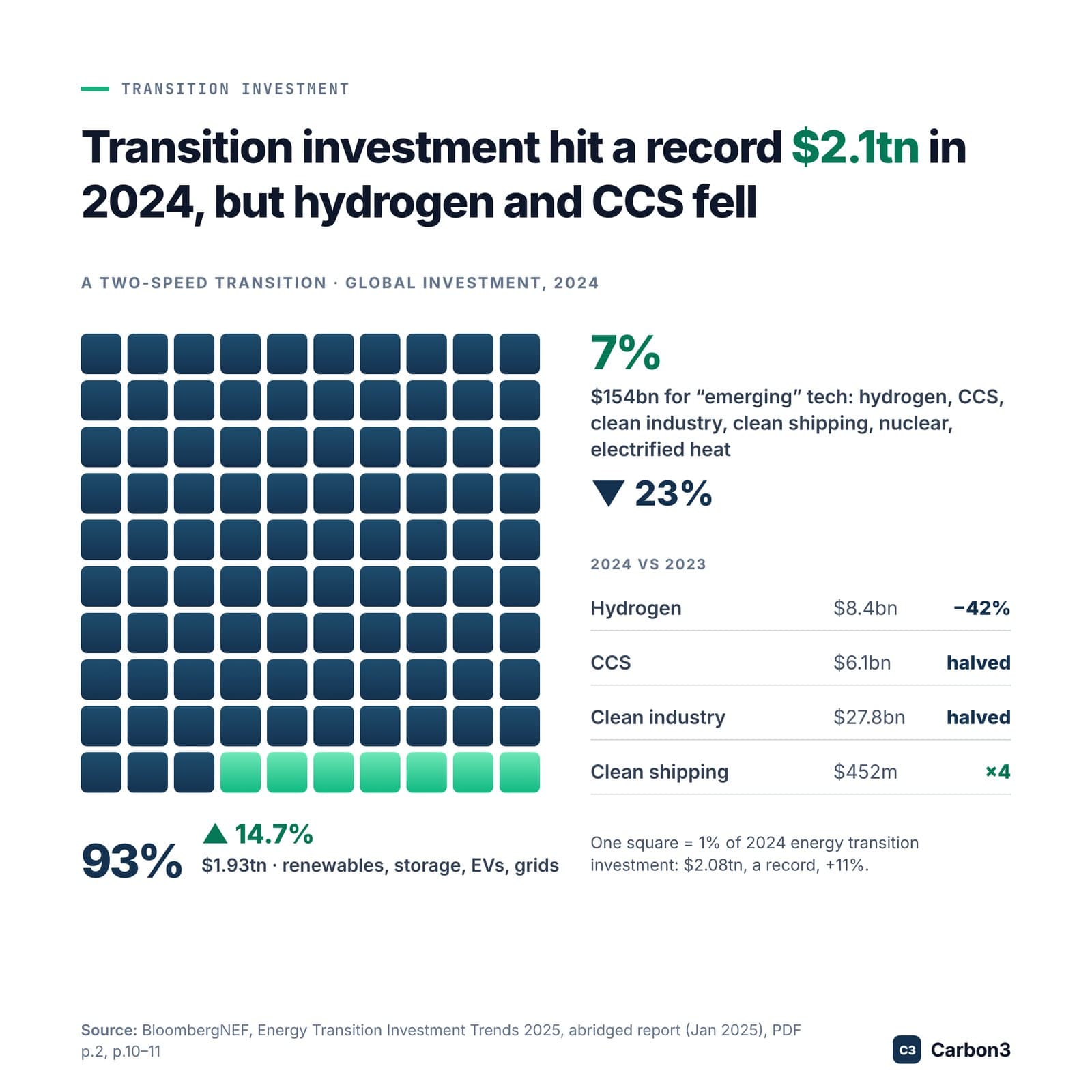
Transition investment hit a record, but not where heavy industry needs it
BloombergNEF counts a record $2.08 trillion in energy transition investment in 2024, yet hydrogen fell 42% and carbon capture and clean industry each roughly halved.
Read the articleSector: Steel
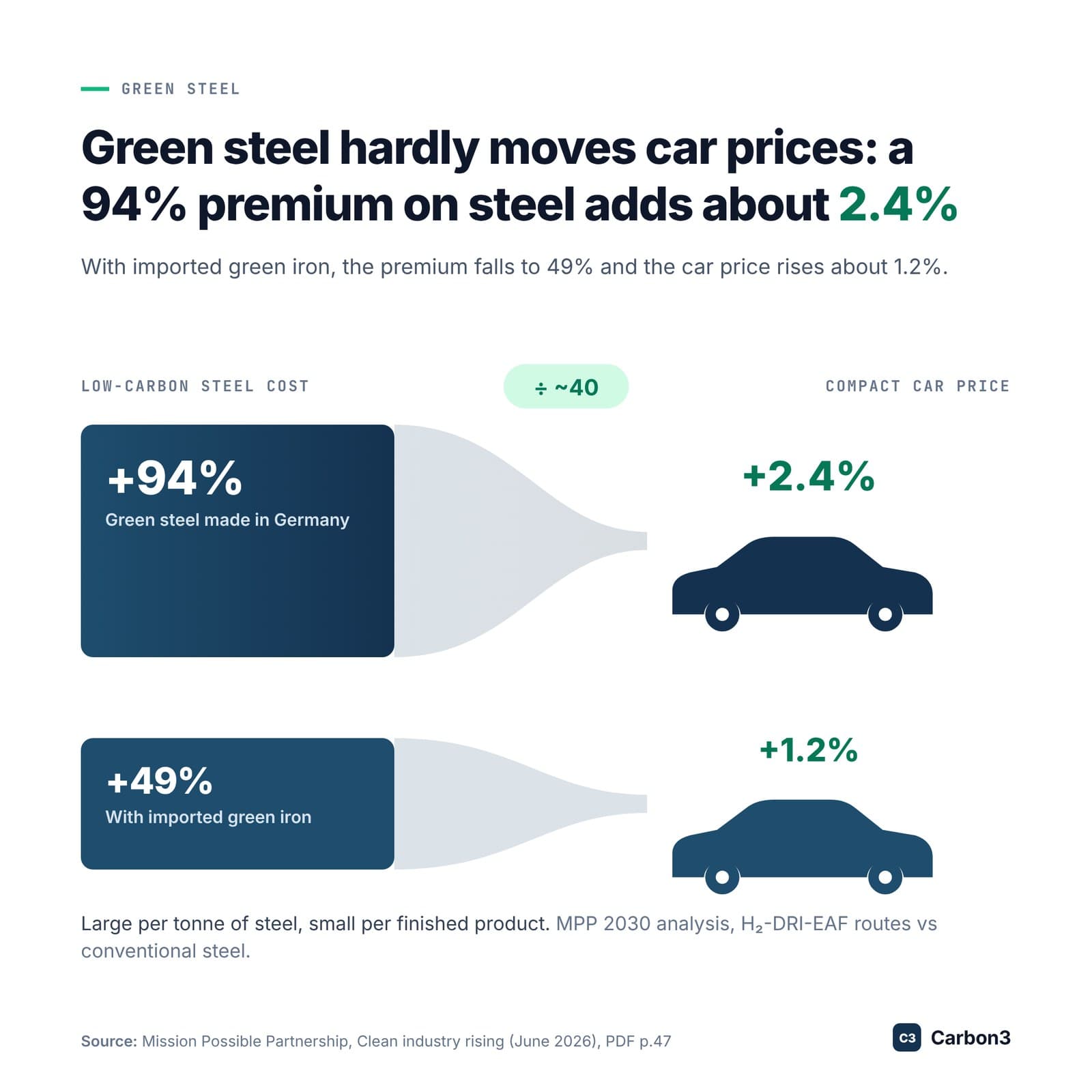
Green steel looks expensive at the mill and cheap in the showroom
Mission Possible Partnership finds a 94% premium on hydrogen-based steel adds only about 2.4% to the cost of a compact car in 2030, which gives buyers a cheap way to act on purchased-goods emissions.
Read the article
See the companies behind these figures in the Data Hub.
Look up your suppliers’ emissions and targets, free.