Low-carbon supply is a procurement problem
In the Scope 3 Peer Group's survey of 180+ suppliers, 43% say low-carbon options cost more, yet contracts are still awarded on unit price.
By Carbon3 team2 min read
The Scope 3 Peer Group surveyed more than 180 suppliers about what stops them reducing emissions. The answers point less to technology and more to how buyers buy.
What suppliers said
43% of suppliers said the low-carbon option costs more, but contracts are awarded on unit price. Just under a quarter said that buyers' specifications limit the emissions reductions they can make.
Put together, those two findings describe a procurement problem. Suppliers can often offer a lower-carbon product. But if the tender compares only the price per unit, the lower-carbon option loses. And if the specification fixes a material, process or format, the supplier may not be allowed to offer the alternative at all.
Why unit price works against reductions
Unit-price procurement is designed to find the cheapest way to meet a fixed requirement. It is good at that. It is not designed to reward a lower-emission product that costs a little more, because the emissions do not appear in the comparison.
The result is a gap between what a company says about its Scope 3 target and what its buyers are incentivized to do. The sustainability team wants the emissions to come down. The procurement team is measured on cost. The supplier sees only the tender.
Specifications as a hidden constraint
The specification finding is just as practical. Many specifications were written before emissions were a consideration. They can lock in a material or method that suppliers know how to improve on, but cannot change without the buyer's agreement. Revisiting them is often a low-cost way to open up reductions.
Making the premium explicit
Co-funding addresses the price problem directly. Instead of hoping a supplier absorbs the cost of the low-carbon option, the buyer agrees to fund part of the difference. That makes the premium explicit: a known amount, for a known reduction, rather than a hidden cost that gets squeezed out in the tender.
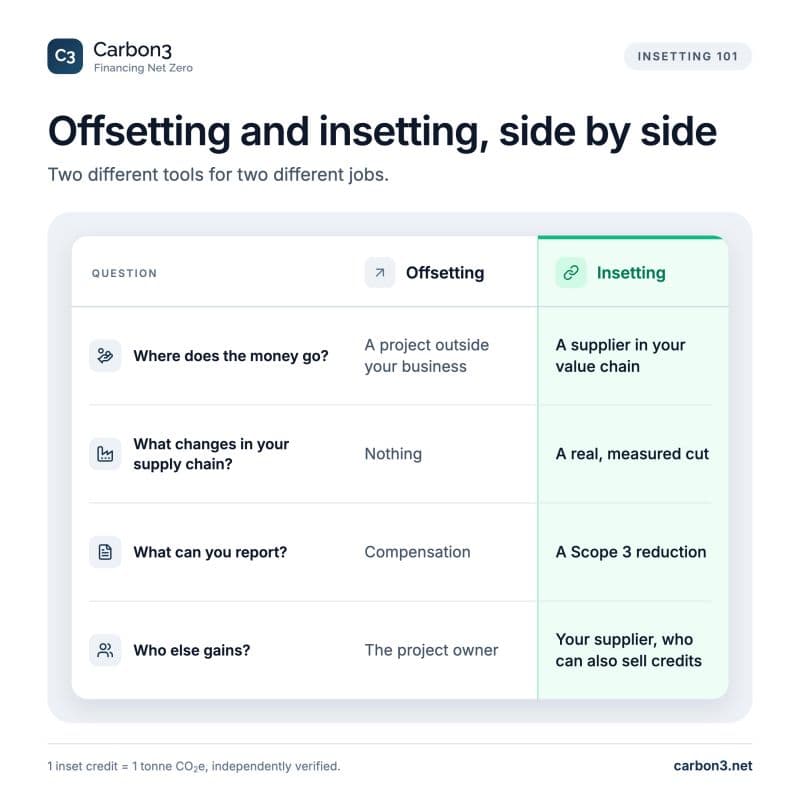
When the reduction is verified, it can be recorded as an inset credit, so buyer and supplier share a single record of what the co-funding achieved and who holds it. Insetting is not offsetting: the funding goes to emissions inside the buyer's own value chain.
The takeaway
The survey suggests that many suppliers are ready to reduce emissions if their customers make room for it. That starts in procurement: in how contracts are scored, how specifications are written, and who pays the premium.
Originally published on LinkedIn, 3 October 2026.
The Carbon3 Newsletter
Weekly analysis of industrial decarbonization and insetting across Scope 1 to 3, from the Carbon3 team.
Read more from the research team.
Field notes
Insetting turns a sustainability expense into a supplier relationship
BASF and Boortmalt on barley emissions, Royal Canin and Soil Capital on 300,000 hectares of farmland, and ZEMBA on pooled buying power for low-emission shipping.
Read the articleField notes
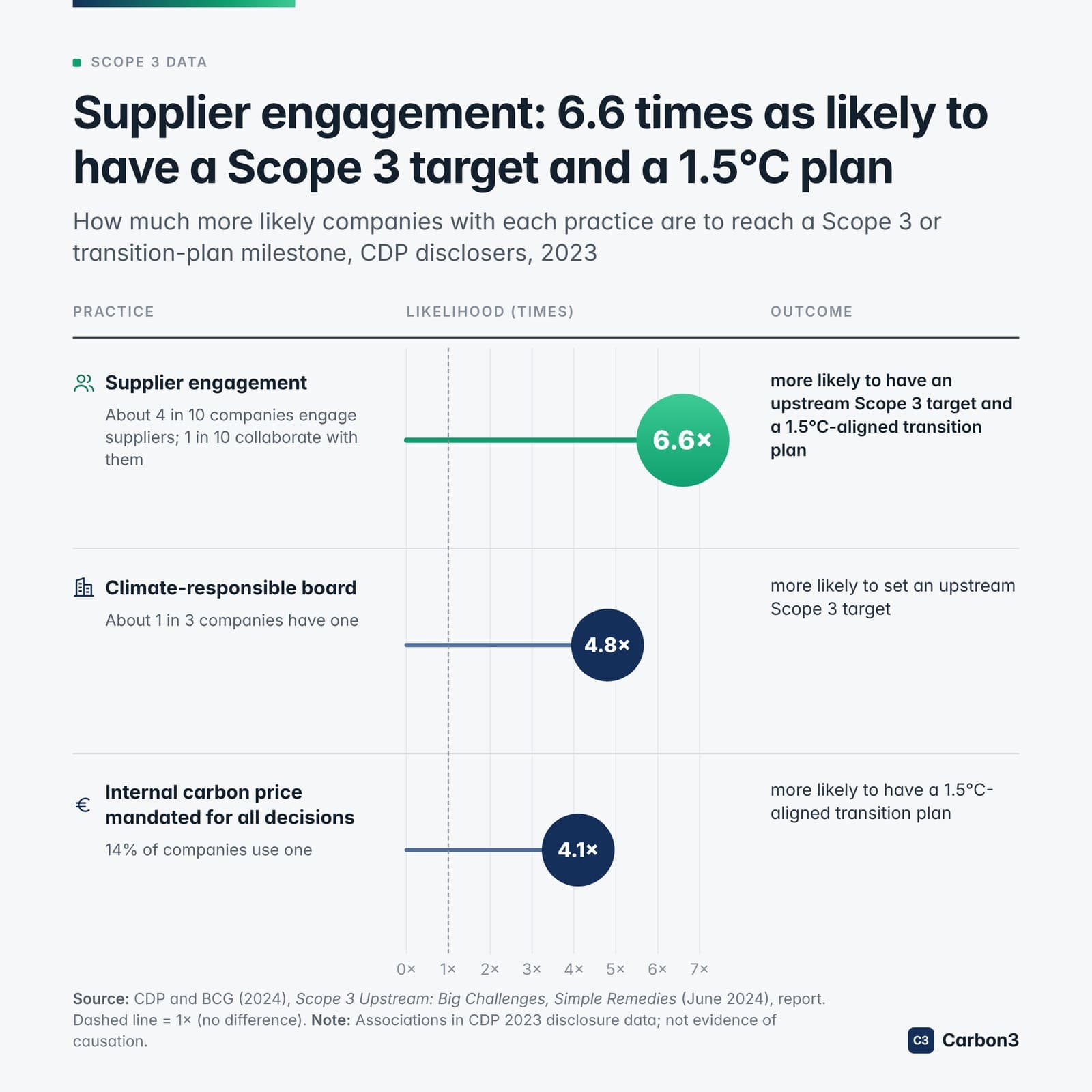
Companies that engage suppliers are 6.6 times as likely to have an upstream Scope 3 target
CDP and BCG examined more than 20 factors.
Read the articleSector: Steel
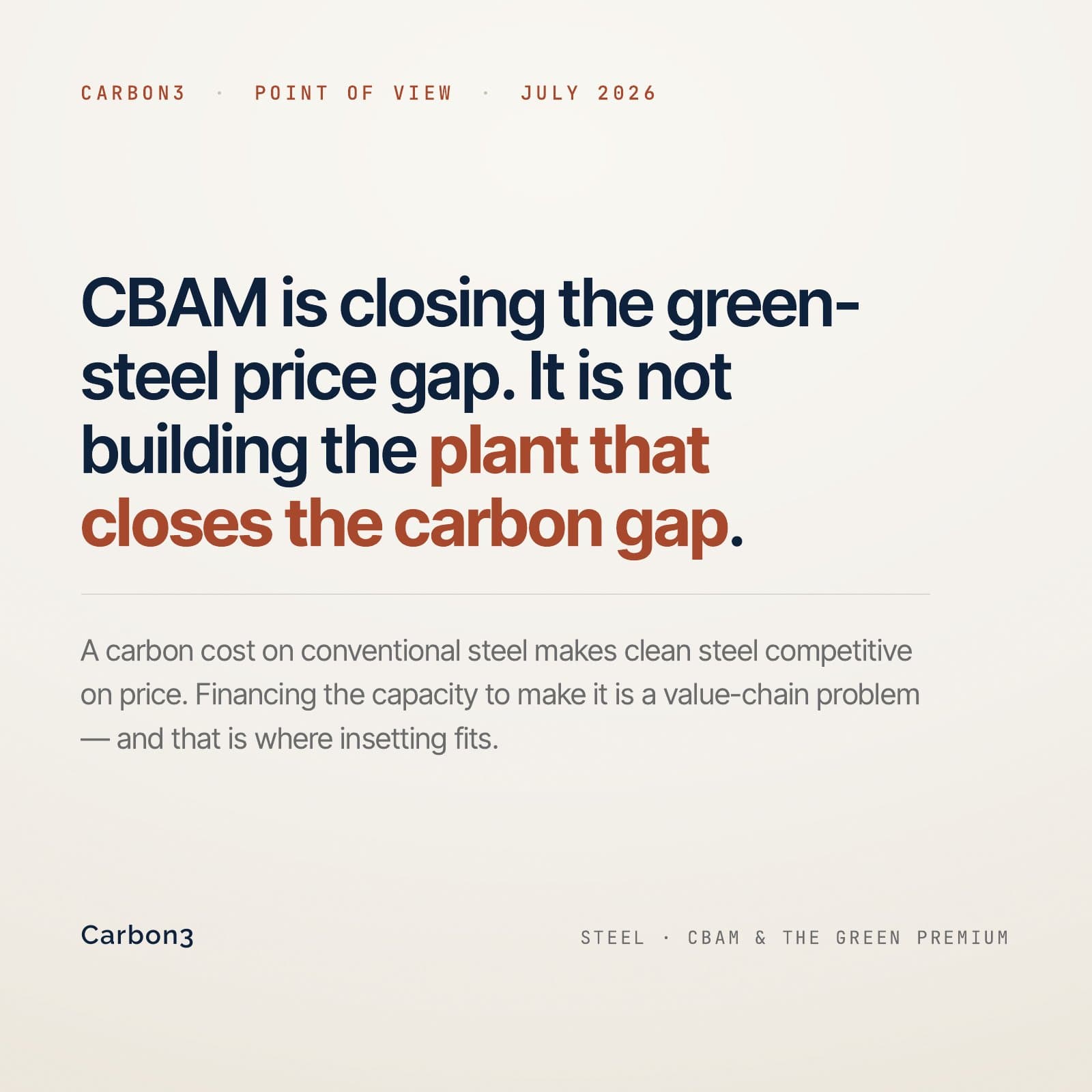
The cost case against green steel is eroding
CBAM is pushing the carbon cost on conventional steel toward the green premium.
Read the article
See the companies behind these figures in the Data Hub.
Look up your suppliers’ emissions and targets, free.