The EU wants to pay most of shipping’s clean fuel premium, and cargo owners would fund the rest
A proposed reserve of 110 million carbon allowances would narrow the price gap for green marine fuels, which makes the question of who claims the reduction more pressing.
By Carbon3 team5 min read
Europe's carbon market may soon start paying shipowners to switch fuels. In its review of the EU Emissions Trading System (EU ETS), proposed on 17 July 2026, the European Commission would reserve up to 110 million allowances between 2028 and 2040 for a new Sustainable Maritime Alternative Propulsion mechanism, known as SMAP. The money would cover part of the price gap between fossil bunker fuel and cleaner alternatives, and part of the extra cost of zero-emission propulsion such as wind-assisted and electric systems.
The timing matters because shipping is now fully inside the carbon market. As Rystad Energy notes, from 2026 shipping companies surrender allowances for 100% of their verified emissions in scope, now including methane and nitrous oxide. The same review would bring certain ships of 400 to 5,000 gross tonnage, such as general cargo ships, tankers and gas carriers, into the EU ETS from 1 January 2031.
How much of the gap the reserve would cover
Support is tiered by fuel. According to Engine, renewable fuels of non-biological origin (RFNBOs) such as e-methanol and e-ammonia would receive allowances worth 90% of the price difference with conventional bunker fuel, low-carbon hydrogen and its derivatives 80%, and biogas and advanced biofuels 55%. Rystad Energy adds that fuels made from feedstock sourced in the EU would earn 10 more percentage points, and that support is halved on voyages into or out of the EU.
The reserve is large but not unlimited. Spread evenly, Rystad Energy puts the budget at around $900 million per year, and claims are cut pro rata when the reserve is oversubscribed, so owners learn their support only after the year ends. It also leaves out biodiesel made from used cooking oil and animal fats, one of the most widely used marine biofuels today, because only advanced biofuels from listed feedstocks qualify.
Public money changes the claim question
If the proposal passes in this form, a shipping company burning e-methanol on an intra-EU route could see most of its fuel premium paid from carbon market revenues. The remaining share, between 10% and 45% of the gap depending on the fuel, still has to come from somewhere, and in practice that is often the cargo owner paying a green freight premium or co-financing a fuel contract.
That is where Scope 3 accounting comes in. Scope 3 covers the emissions in a company's value chain outside its own operations, and for a retailer or manufacturer shipping goods, ocean freight sits in that inventory. A public subsidy pays part of the cost of a cleaner voyage, but it does not by itself decide which cargo owner can report the resulting reduction, or how much of it. When public funds, a shipping line and several cargo owners all pay toward the same fuel, the reduction has to be split carefully so that each part is claimed only once.
The same review pushes in that direction for public money. Under the proposal, EU countries would have to spend at least 50% of their auction revenues on priority areas, including shipping, from 1 January 2029, and make the source of the funding visible. Cargo owners will face similar questions about their own share.
Where insetting fits
Insetting means financing emissions reductions in a company's own value chain, and for cargo owners that includes the ships carrying their goods. Carbon3 provides the record that keeps such co-financing clean. The reduction is verified by an independent third party, credits are issued to the project developer after verification, Carbon3 records them in its registry, and they are allocated in proportion to each party's contribution, so a reduction partly paid by the EU ETS is not counted again in full by a cargo owner. One inset credit equals one ton of CO2e of independently verified emissions reductions.
Claim treatment depends on the applicable reporting framework. Cargo owners should ask their carriers which share of a green voyage was publicly funded before they count it.
What to watch
Nothing is law yet. Environment ministers are targeting a negotiating position on 11 December 2026, the indicative date for Parliament's plenary vote is 14 December 2026, and both institutions are targeting an agreement in the first three months of 2027. The size of the reserve, the support rates and the start date could all change in those talks.
For shippers, the direction is already clear: the EU wants to make clean marine fuel cheaper, and the companies that co-finance the rest will need a precise record of what they paid for.
Sources
- European Commission, proposal COM(2026) 616 amending the EU ETS Directive, 17 July 2026 (SMAP mechanism, new Article 3gaa; targeted extension to ships below 5,000 GT but not below 400 GT)
- Rystad Energy, "EU Proposed SMAP subsidy favors e-fuels and bioLNG" (110 million allowances 2028 to 2040; 100% surrender from 2026 including methane and nitrous oxide; 55% and 90%; +10 points for EU feedstock; halved on voyages into or out of the EU; around $900 million per year; pro rata cuts; UCO and animal fats excluded)
- Engine, "The Week in Alt Fuels: EU omits e-fuel earmarking" (RFNBOs 90%, low-carbon hydrogen 80%, biogas and advanced biofuels 55%; zero-emission propulsion 90%; electric and wind-assisted systems)
- Green Fine Print, "EU ETS review 2026: what the Commission's proposal would change, for whom and from when," 25 Oct 2026 (17 July 2026 proposal; ships of 400 to 5,000 GT from 1 January 2031; at least 50% of auction revenues on priority areas from 1 January 2029 with funding source visible; Council 11 December 2026; Parliament plenary 14 December 2026; agreement targeted Q1 2027)
- Carbon3, insetting vs offsetting
If this was useful, subscribe to get our weekly analysis of industrial decarbonization and insetting across Scope 1, 2 and 3, from shipping fuels to steel and supplier data. It is free and lands in your inbox once a week.
More analysis at carbon3.net/insights.
The Carbon3 Newsletter
Weekly analysis of industrial decarbonization and insetting across Scope 1, 2 and 3, from the Carbon3 team.
Read more from the research team.
Sector: Maritime
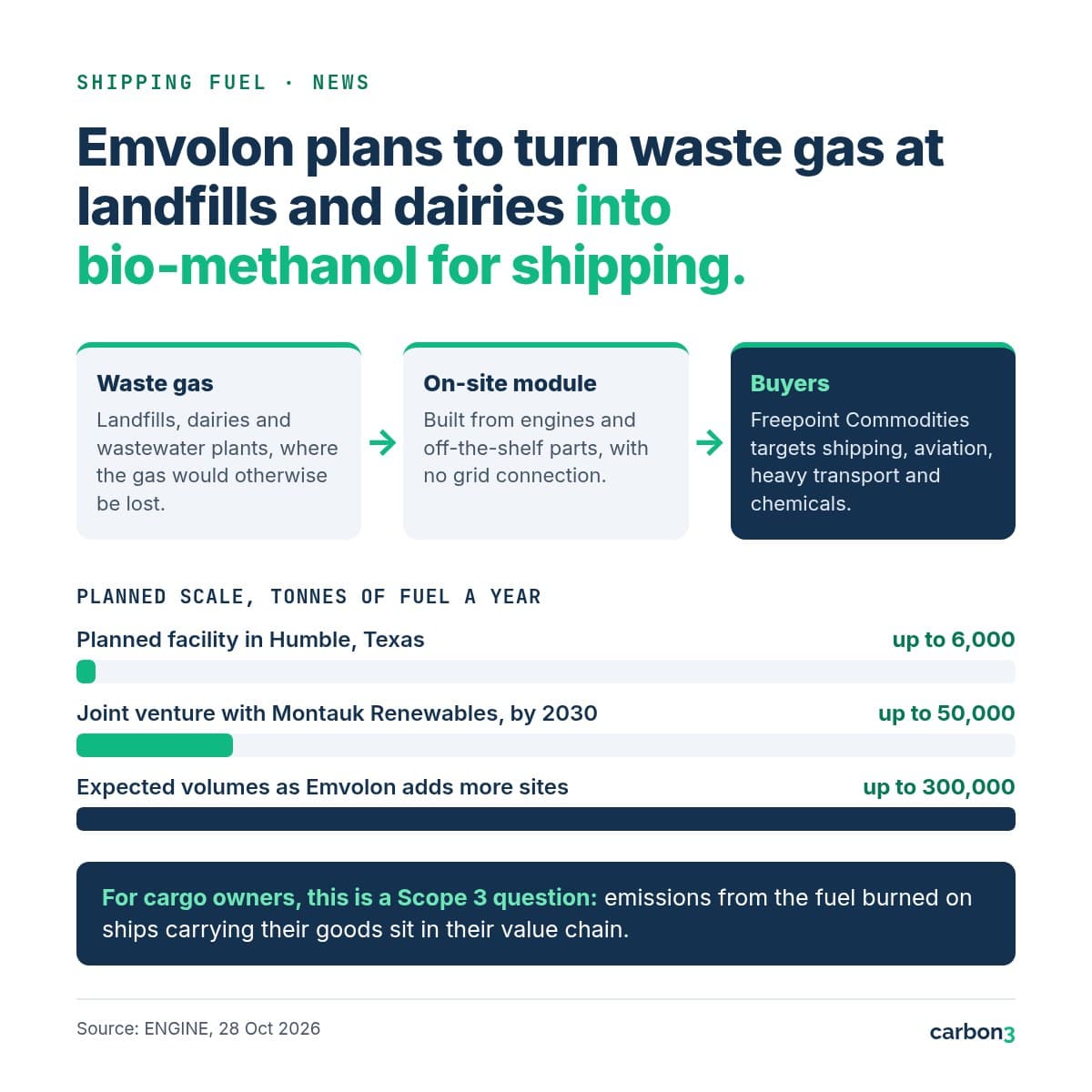
Emvolon will turn waste gas into bio-methanol for shipping
The US start-up will build its first commercial plant with a $22 million Series A round and government grants, and Freepoint Commodities holds a first purchase option on up to $450 million worth of its fuel.
Read the articleSector: Maritime
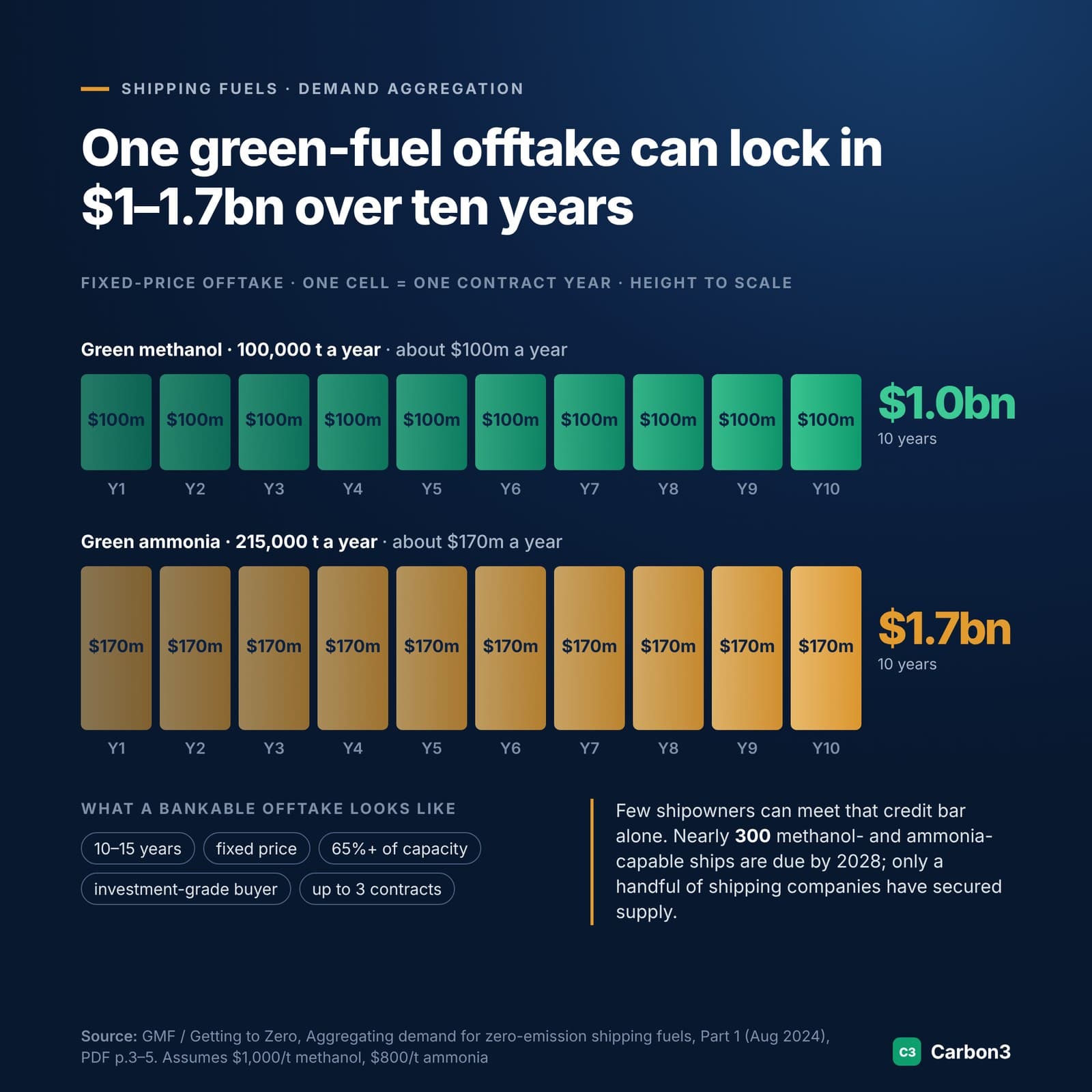
One green shipping fuel contract can commit a buyer to $1 billion or more
The Global Maritime Forum and the Getting to Zero Coalition price a 10-year green methanol or ammonia offtake at $1 billion to $1.7 billion, while nearly 300 capable ships are due by 2028.
Read the articleSector: Maritime
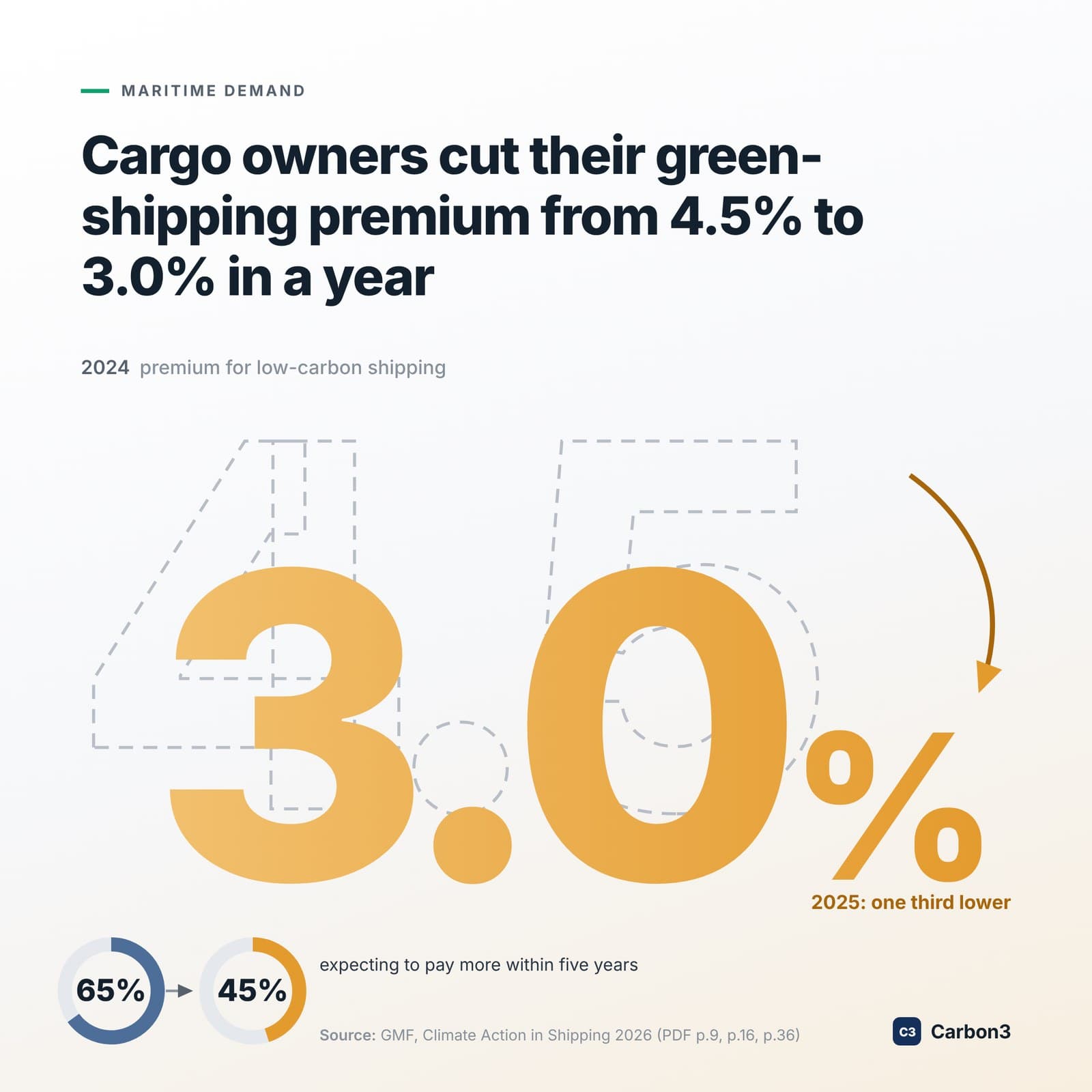
The market premium for green shipping is shrinking
Cargo owners' willingness to pay for low-carbon shipping fell from 4.5% to 3.0% in a year, according to the Global Maritime Forum.
Read the article
See the companies behind these figures in the Data Hub.
Look up your suppliers’ emissions and targets, free.