The market premium for green shipping is shrinking
Cargo owners' willingness to pay for low-carbon shipping fell from 4.5% to 3.0% in a year, according to the Global Maritime Forum. Contracts give fuel developers a firmer signal than surveys.
By Carbon3 team2 min read
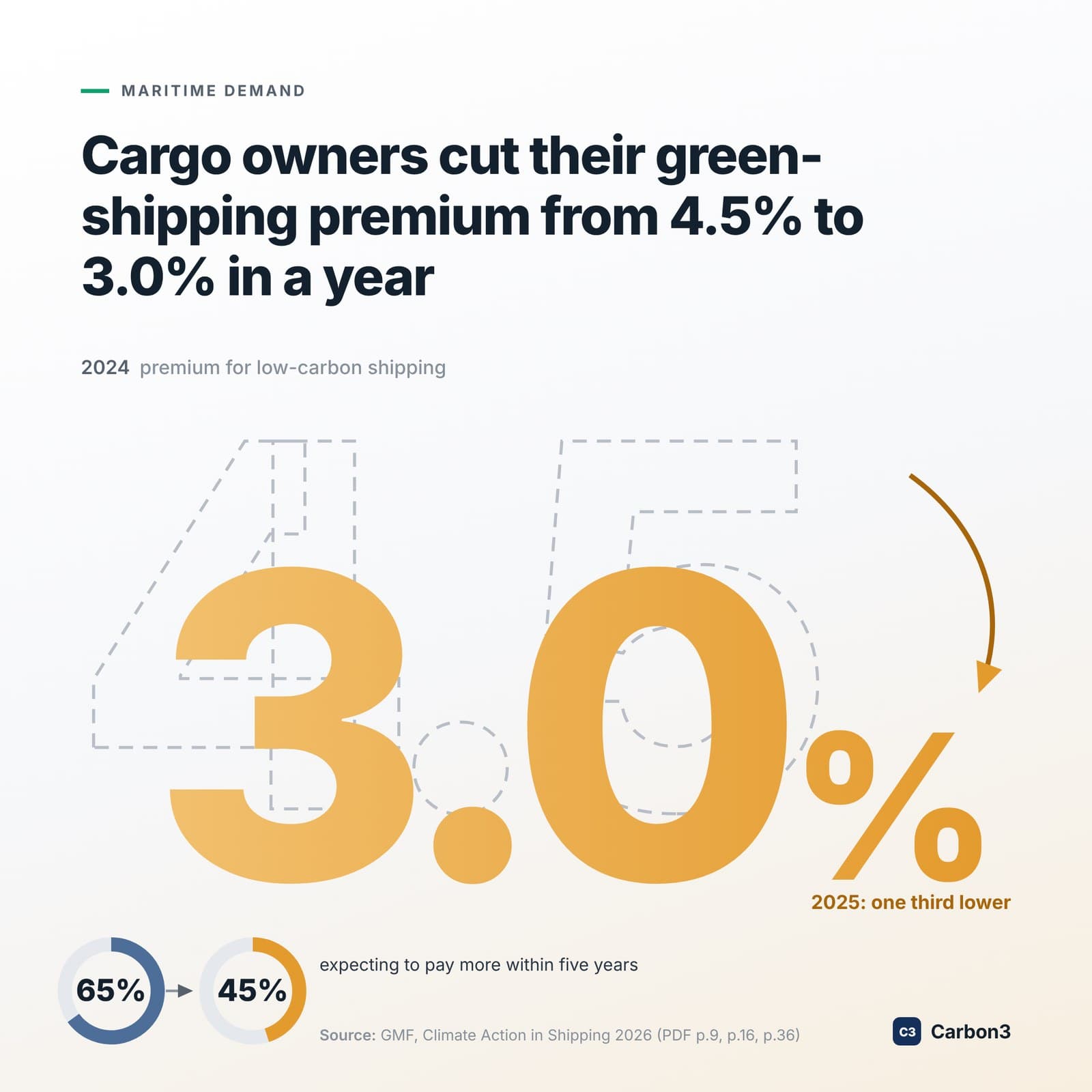
The market premium for green shipping is shrinking.
The Global Maritime Forum's 2026 progress report, Climate Action in Shipping: 2026 Edition, finds that cargo owners' willingness to pay a premium for low-carbon shipping fell from 4.5% in 2024 to 3.0% in 2025. Over the same period, the share of cargo owners expecting to pay more for shipping within five years dropped from 65% to 45%.
The report describes this as a significant weakening of demand-side conditions for zero-emission fuels.
Why a smaller premium matters
Zero-emission shipping fuels cost more than conventional fuel, and someone has to carry that difference while production scales. Cargo owners are one of the clearest candidates: they buy the transport, and the emissions from shipping their goods sit in their Scope 3 footprint.
A willingness-to-pay figure from a survey is a measure of sentiment. When that sentiment softens, the signal reaching fuel producers and shipowners softens with it. A drop from 4.5% to 3.0% in a single year, together with fewer cargo owners expecting to pay more at all, is the kind of shift that makes investment decisions harder to take.
Sentiment does not finance a plant
Fuel developers cannot finance projects on survey sentiment. Lenders and investors look for contracted demand: a named buyer, a volume and a price, over a defined period.
That is where the gap between stated willingness and actual commitment shows. A stated premium can change from one survey to the next. A contract does not.
A firmer signal
A contract with a cargo owner that co-funds a verified, lower-emission voyage is a firmer signal than any survey result. It ties the premium to a specific shipment and a specific reduction, and it gives the fuel supplier or carrier something it can point to when raising capital.
On Carbon3, the reduction from such a voyage can be measured, independently verified and recorded once as an inset credit, linked to the project that delivered it. The cargo owner that co-funded the voyage holds a record of a reduction inside its own value chain, rather than a general claim about the market.
Insetting is not offsetting. The reduction happens in the cargo owner's own supply chain, not in an unrelated project elsewhere.
Claim treatment depends on the applicable reporting framework.
Source: Global Maritime Forum, Climate Action in Shipping: 2026 Edition.
Originally published on LinkedIn, 21 October 2026.
The Carbon3 Newsletter
Weekly analysis of industrial decarbonization and insetting across Scope 1 to 3, from the Carbon3 team.
Read more from the research team.
Sector: Maritime
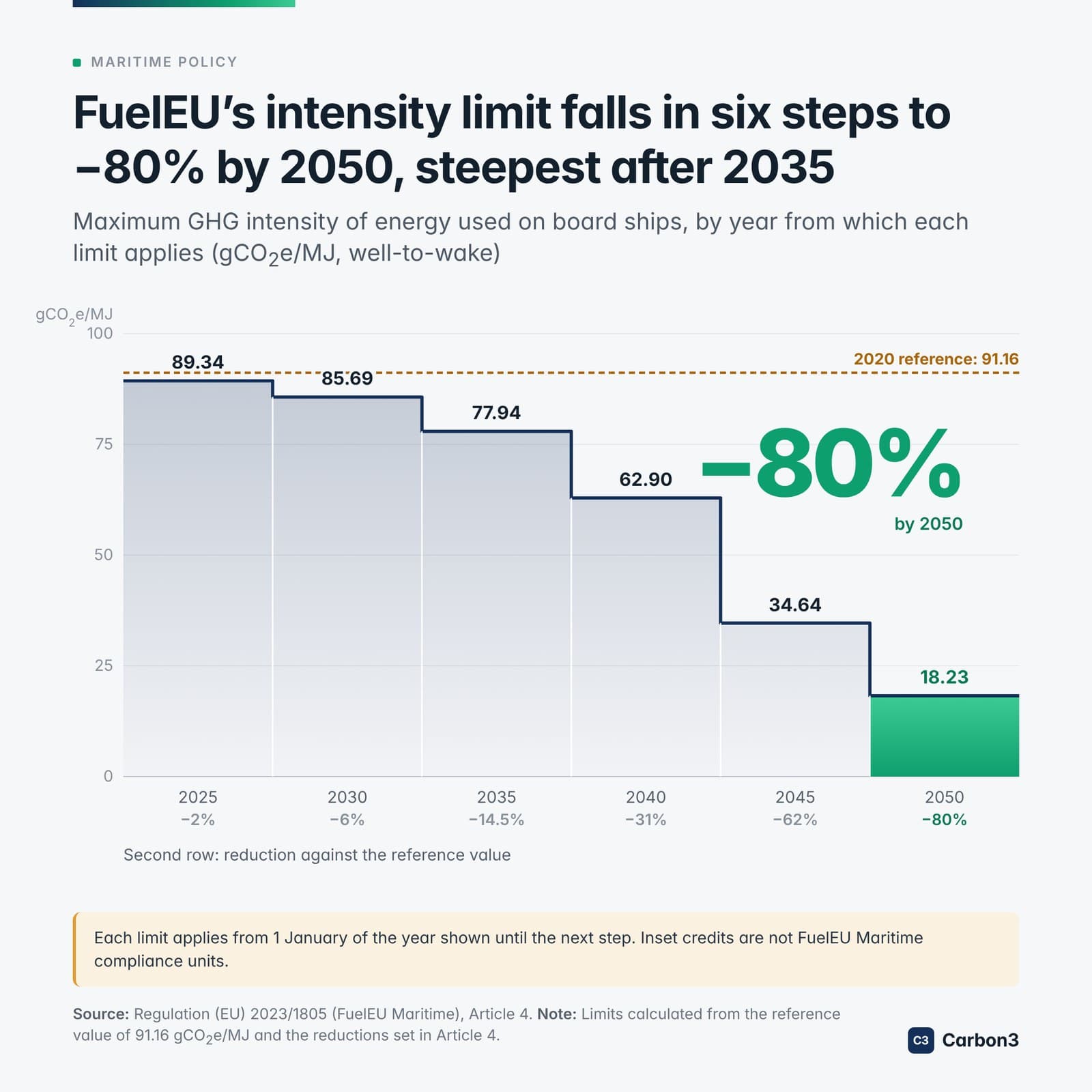
FuelEU Maritime lowers allowed GHG intensity by 80% by 2050, with the steepest steps after 2035
Article 4 of Regulation (EU) 2023/1805 lowers the limit in six steps, from 89.34 gCO₂e/MJ in 2025 to 18.23 in 2050.
Read the articleSector: Maritime
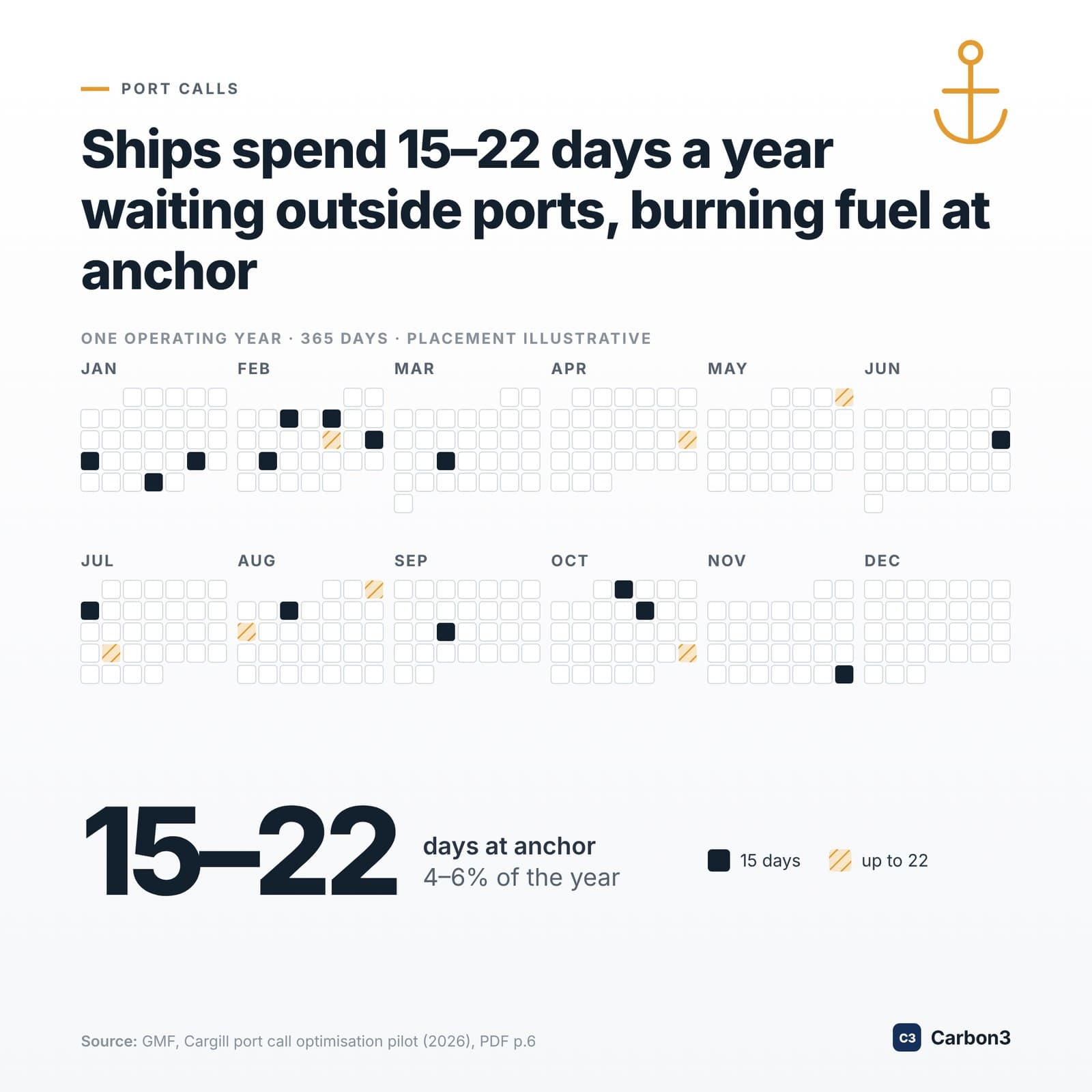
Some of the cheapest shipping emissions to cut are burned at anchor
Ships spend 4–6% of their operating year waiting outside ports.
Read the articleSector: Maritime
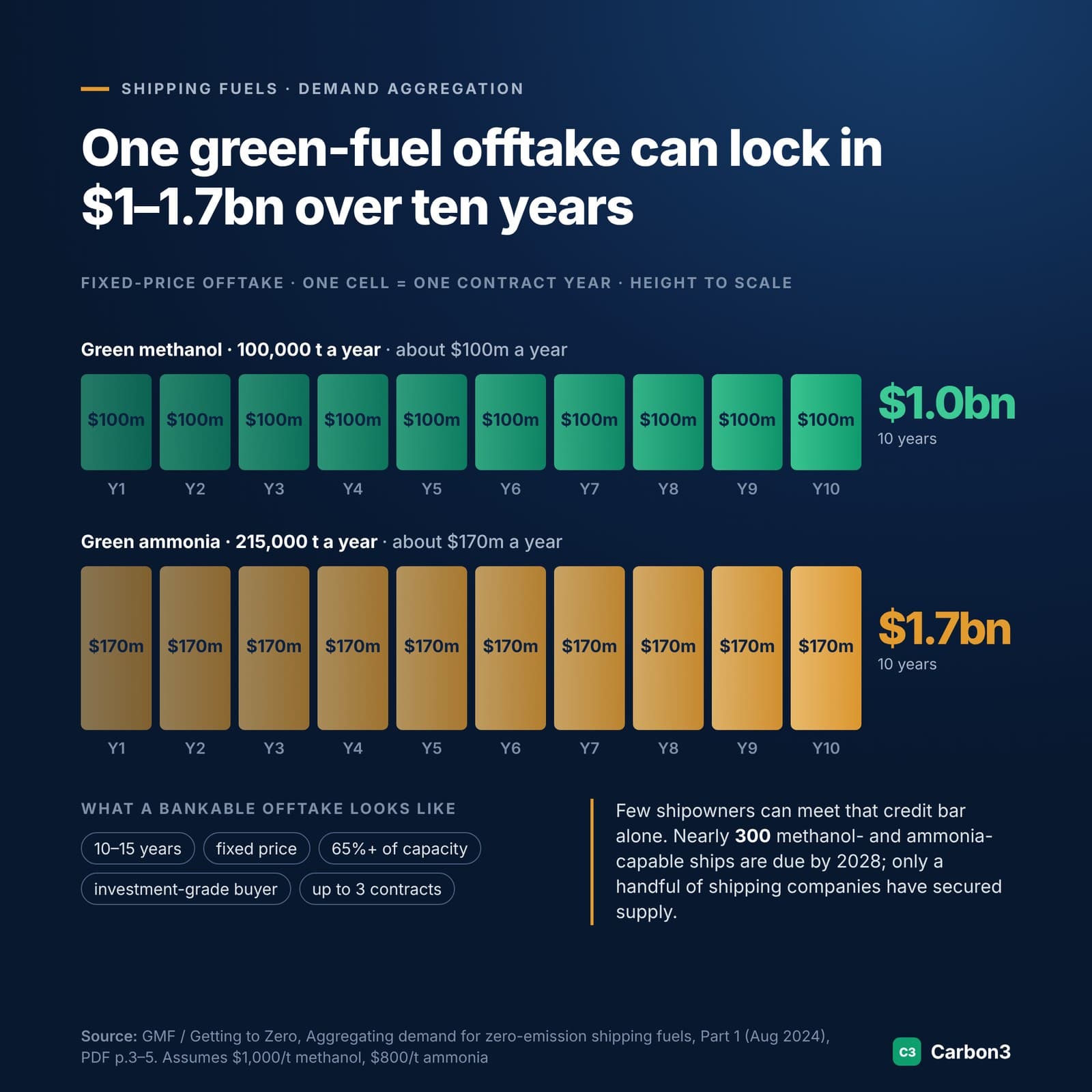
One green shipping fuel contract can commit a buyer to $1 billion or more
The Global Maritime Forum and the Getting to Zero Coalition price a 10-year green methanol or ammonia offtake at $1 billion to $1.7 billion, while nearly 300 capable ships are due by 2028.
Read the article
See the companies behind these figures in the Data Hub.
Look up your suppliers’ emissions and targets, free.