FuelEU Maritime lowers allowed GHG intensity by 80% by 2050, with the steepest steps after 2035
Article 4 of Regulation (EU) 2023/1805 lowers the limit in six steps, from 89.34 gCO₂e/MJ in 2025 to 18.23 in 2050. Most of the reduction comes after 2035.
By Carbon3 team2 min read
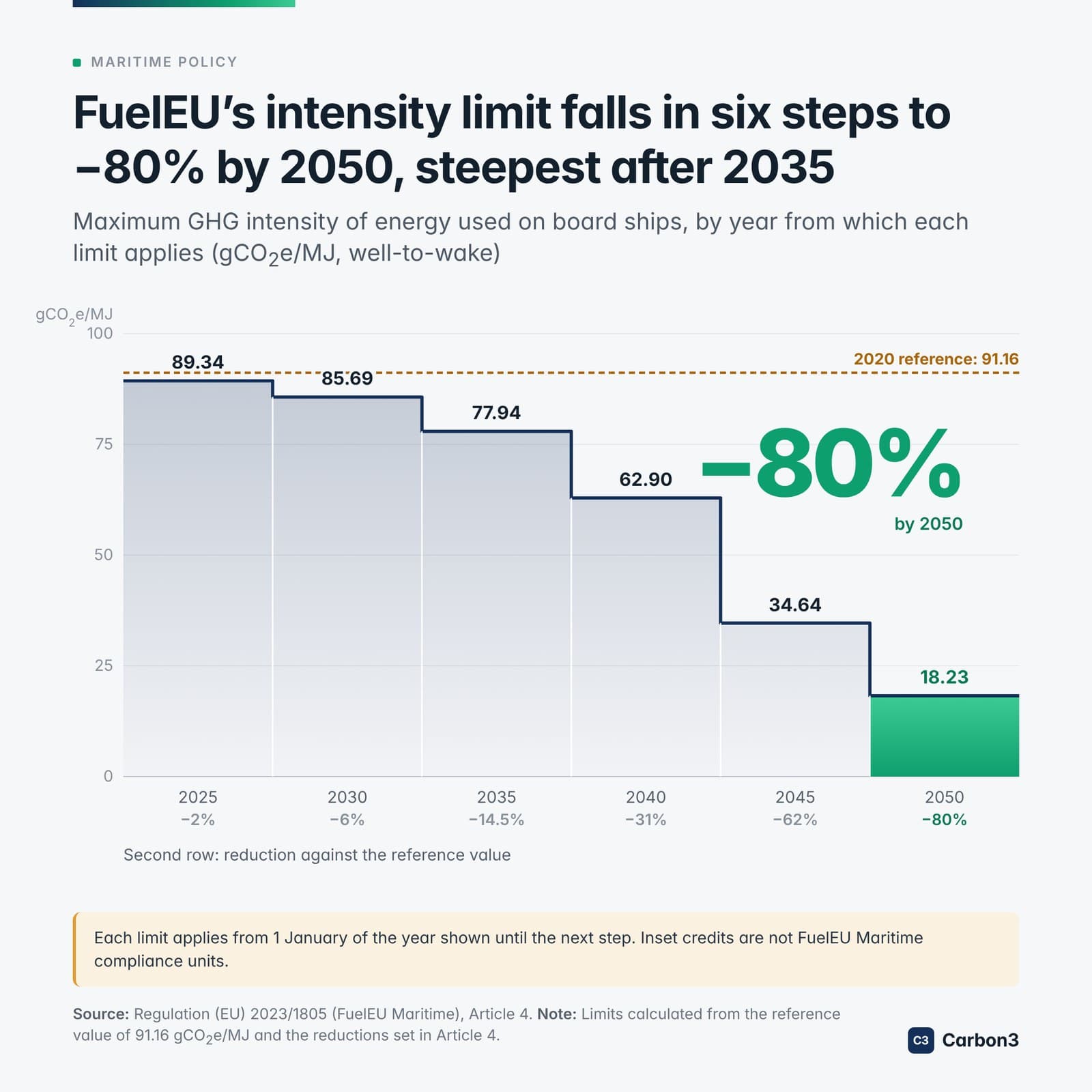
FuelEU Maritime lowers the allowed greenhouse gas intensity of the energy used on board ships by 80% by 2050, and most of that reduction comes late. Regulation (EU) 2023/1805 sets the limit in six steps against a 2020 reference value of 91.16 gCO₂e/MJ, measured well-to-wake. The early steps are small. The steepest ones arrive after 2035.
Six steps, set in Article 4
Article 4 of the regulation fixes each reduction against the reference value. Each limit applies from 1 January of the year shown until the next step takes over.
- 2025: 2% below the reference, a limit of 89.34 gCO₂e/MJ
- 2030: 6% below, 85.69 gCO₂e/MJ
- 2035: 14.5% below, 77.94 gCO₂e/MJ
- 2040: 31% below, 62.90 gCO₂e/MJ
- 2045: 62% below, 34.64 gCO₂e/MJ
- 2050: 80% below, 18.23 gCO₂e/MJ
The limits are calculated from the 91.16 reference and the percentages in Article 4.
Why the shape of the curve matters
Read as a chart, the trajectory is gentle for its first decade. From 2025 to 2035 the limit falls by 12.5 percentage points. From 2035 to 2045 it falls by 47.5 points, and the final step to 2050 takes it down by a further 18. A fleet that meets the 2025 or 2030 limit with modest changes is not on course for the later ones.
That is what turns lower-emission fuel into a long-term planning question rather than a short-term compliance task. Ships ordered or contracted now are likely to still be operating when the 2040 and 2045 limits apply, and the fuel supply needed to meet those limits has to be planned and financed well ahead of them.
Carriers and cargo owners
The obligation sits with the companies responsible for the ships. Cargo owners are not regulated under FuelEU Maritime, but they depend on the carriers that are, and the fuel those carriers use shapes the emissions in their own transport and supply chains. The cost of meeting a falling limit also has to land somewhere along that chain.
For both groups, the later steps of the trajectory are the ones that call for planning now: which fuels, which routes, and who funds the gap between conventional and lower-emission fuel.
Where inset credits fit, and where they do not
Carbon3 notes that inset credits are not FuelEU Maritime compliance units. They do not count towards a ship's GHG intensity limit and cannot settle a FuelEU deficit.
What they do is record verified reductions in the value chain. When cargo owners co-fund lower-emission fuel on the routes they use, the resulting reduction can be measured, independently verified and recorded as inset credits, separately from the carrier's regulatory compliance. Claim treatment depends on the applicable reporting framework.
Source: Regulation (EU) 2023/1805 (FuelEU Maritime), Article 4.
Originally published on LinkedIn, 20 October 2026.
The Carbon3 Newsletter
Weekly analysis of industrial decarbonization and insetting across Scope 1 to 3, from the Carbon3 team.
Read more from the research team.
Sector: Maritime
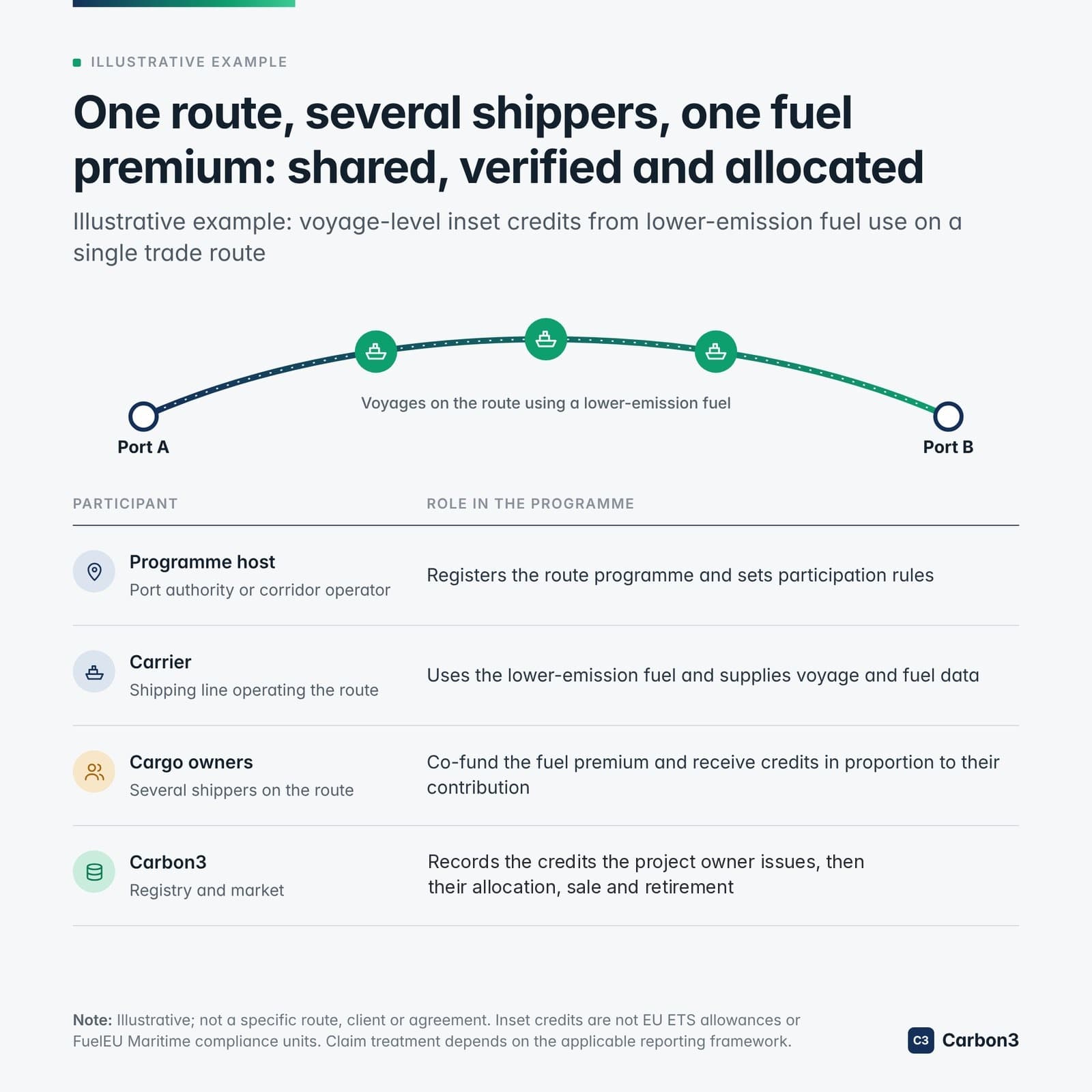
One trade route, several shippers, one fuel premium, shared and verified
An illustrative route program: cargo owners co-fund a carrier's lower-emission fuel, voyage-level inset credits are issued after verification, and each shipper receives its share.
Read the articleSector: Maritime
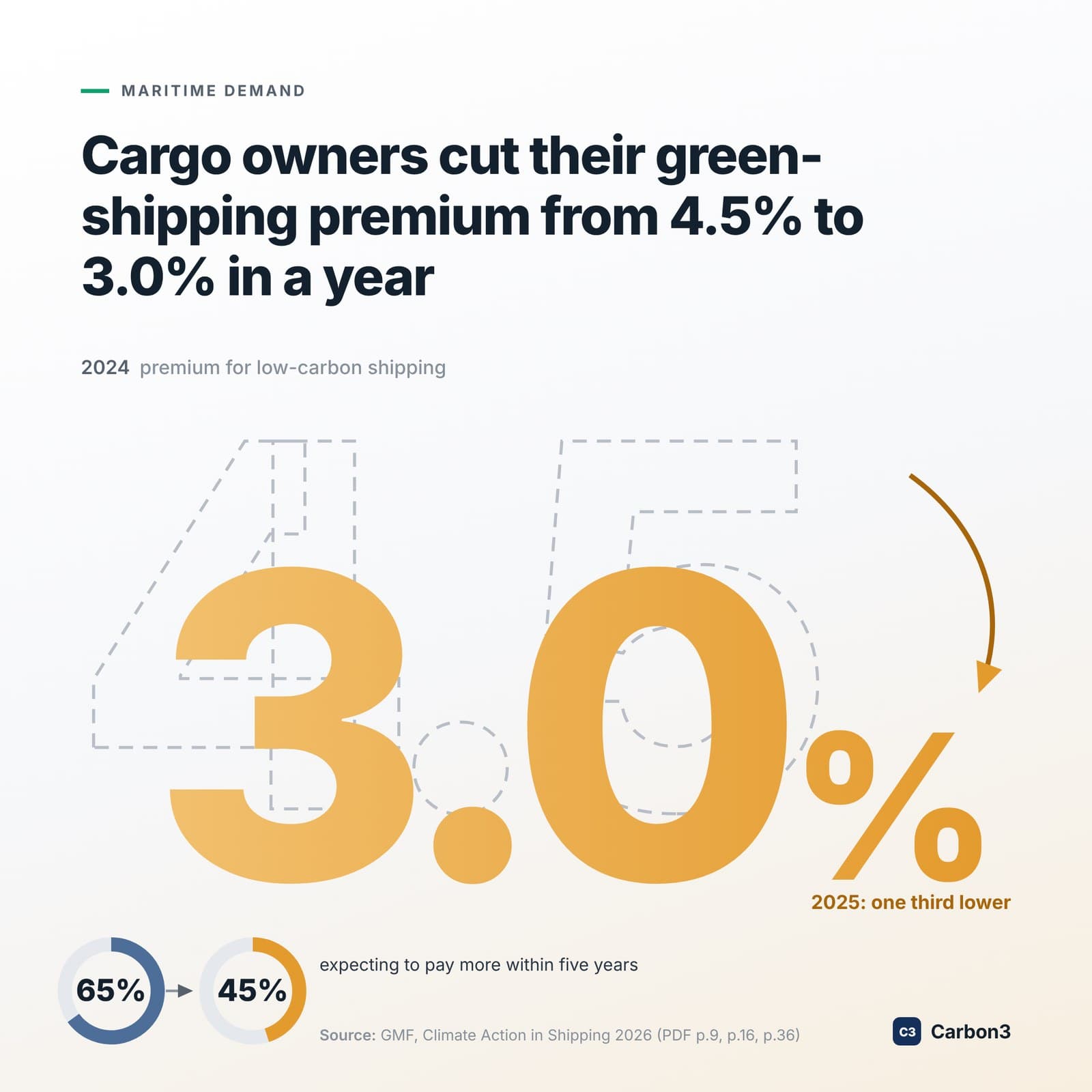
The market premium for green shipping is shrinking
Cargo owners' willingness to pay for low-carbon shipping fell from 4.5% to 3.0% in a year, according to the Global Maritime Forum.
Read the articleSector: Maritime
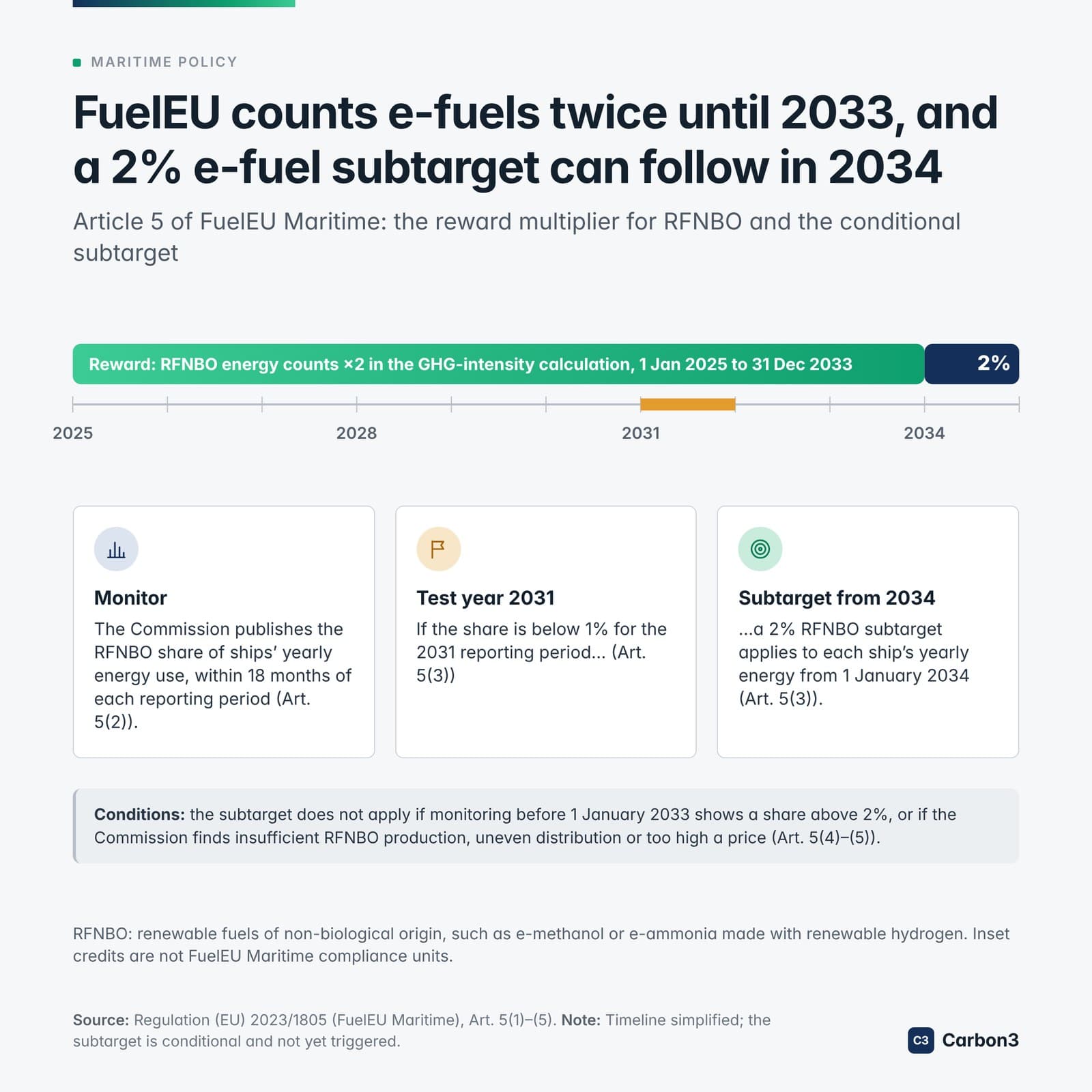
FuelEU counts e-fuels twice until 2033, and a 2% e-fuel subtarget can follow in 2034
Article 5 of FuelEU Maritime doubles the weight of RFNBO energy from 2025 to 2033.
Read the article
See the companies behind these figures in the Data Hub.
Look up your suppliers’ emissions and targets, free.