One trade route, several shippers, one fuel premium, shared and verified
An illustrative route program: cargo owners co-fund a carrier's lower-emission fuel, voyage-level inset credits are issued after verification, and each shipper receives its share.
By Carbon3 team2 min read
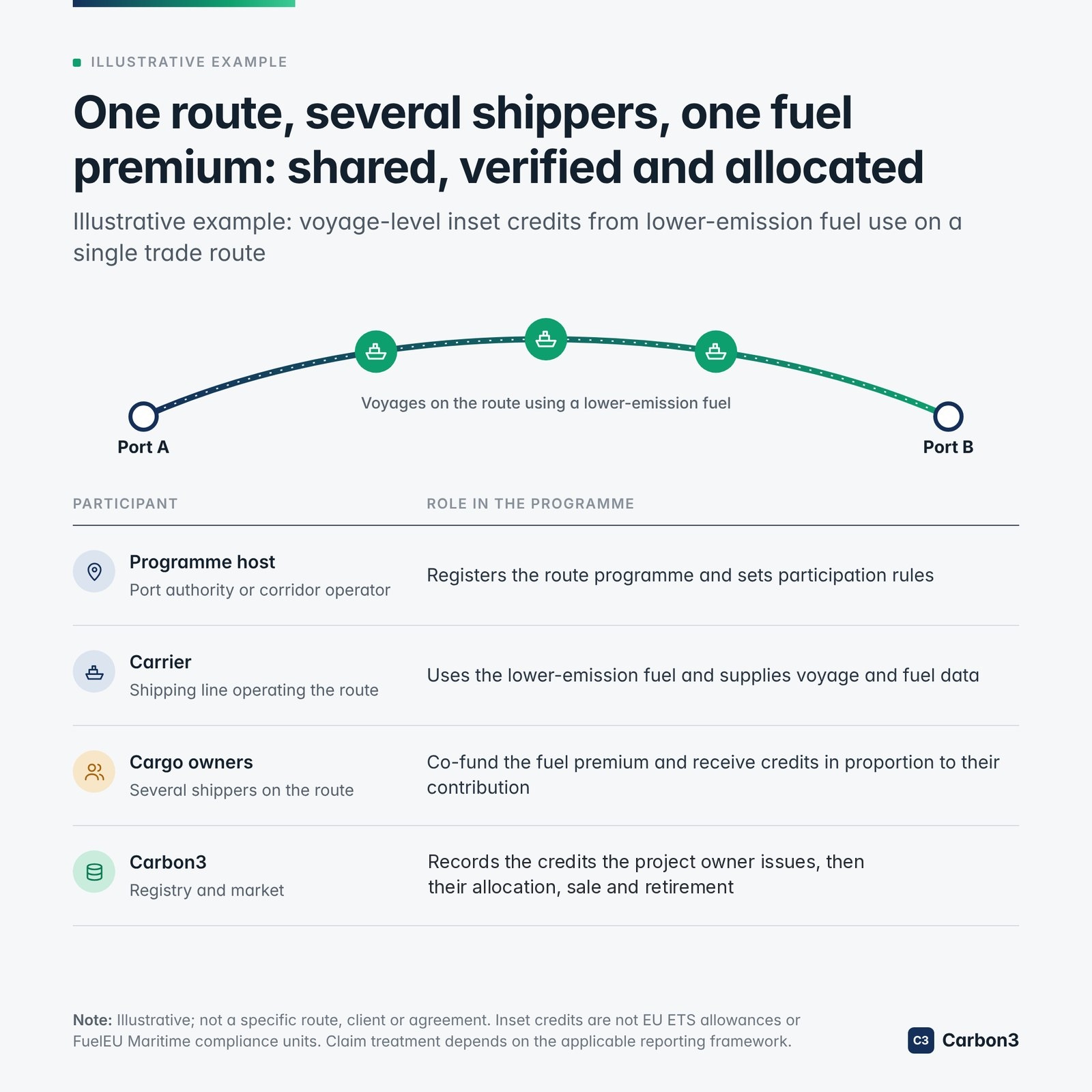
One trade route, several shippers, one fuel premium: shared between them, checked against a verification report and allocated in proportion to what each one paid. That is the shape of a route-level insetting program, and this illustrative example shows how the roles fit together. It is not a specific route, client or agreement.
The problem it addresses
A lower-emission marine fuel usually costs more than the conventional fuel it replaces. On a container route, the vessel carries goods for many cargo owners, and none of them can have a specific batch of fuel routed to their own boxes. A single shipper rarely has the volume to fund a fuel switch alone, and the carrier has little reason to absorb the premium without someone sharing it.
Pooling the premium across the shippers on one route is one way through.
Four roles on one route
In the example, four parties each have a defined job.
- Program host. A port authority or corridor operator registers the route program and sets the participation rules.
- Carrier. The shipping line operating the route uses the lower-emission fuel and supplies the voyage and fuel data.
- Cargo owners. Several shippers on the route co-fund the fuel premium and receive credits in proportion to their contribution.
- Carbon3. As registry and market, Carbon3 records the voyage-level credits once they are issued, tracks their allocation and records their retirement.
From voyage to credit
The sequence matters. The carrier runs voyages on the route using the lower-emission fuel and reports the data. The reduction on those voyages is then checked by a verifier. Only after that verification are voyage-level inset credits issued.
The credits are then allocated to the cargo owners according to the share of the premium each one funded. Carbon3 records each credit with a serial number, so every verified reduction is counted once and can be retired once.
Funding that stays in the value chain
Unlike offsetting, where a company buys credits from projects outside its own operations, this funding stays inside the shipping value chain the cargo owners already use. Their freight moves on the route, and the reduction happens on the same route.
The credits also sit apart from compliance. Inset credits are not EU ETS allowances or FuelEU Maritime compliance units, and the carrier's own obligations under those schemes are calculated under their own rules. Claim treatment depends on the applicable reporting framework.
For cargo owners, the practical point is that a fuel switch no single shipper could fund alone can become a shared program, with a verified, serialized record of each participant's share.
Correction, 30 October 2026: An earlier version of this article said Carbon3 credits carry serial numbers. They do not yet. Each batch of credits has its own record ID on the Carbon3 registry, and every transfer, split and retirement is recorded against it. Source: Carbon3 registry.
Correction, 30 October 2026: An earlier version of this article said the reductions behind Carbon3 credits are independently verified. Credits are issued once a verification report is on file. Carbon3 asks for a verifier that is independent of the project, but the registry does not yet check who wrote the report.
Source: Carbon3. Illustrative example; not a specific route, client or agreement.
Learn more
How insetting works in shipping
Originally published on LinkedIn, 19 October 2026.
Read more from the research team.
Sector: Maritime
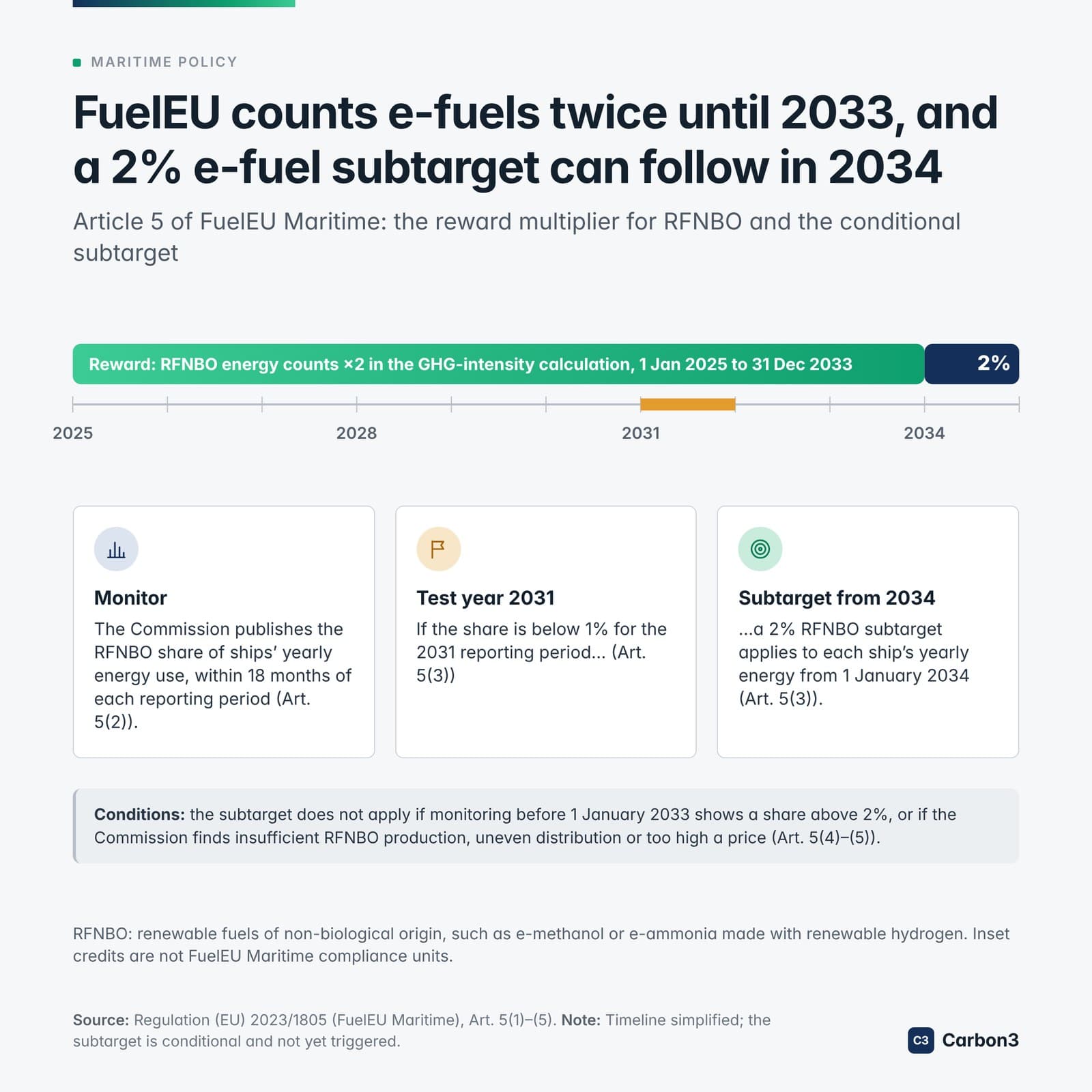
FuelEU counts e-fuels twice until 2033, and a 2% e-fuel subtarget can follow in 2034
Article 5 of FuelEU Maritime doubles the weight of RFNBO energy from 2025 to 2033.
Read the articleSector: Maritime
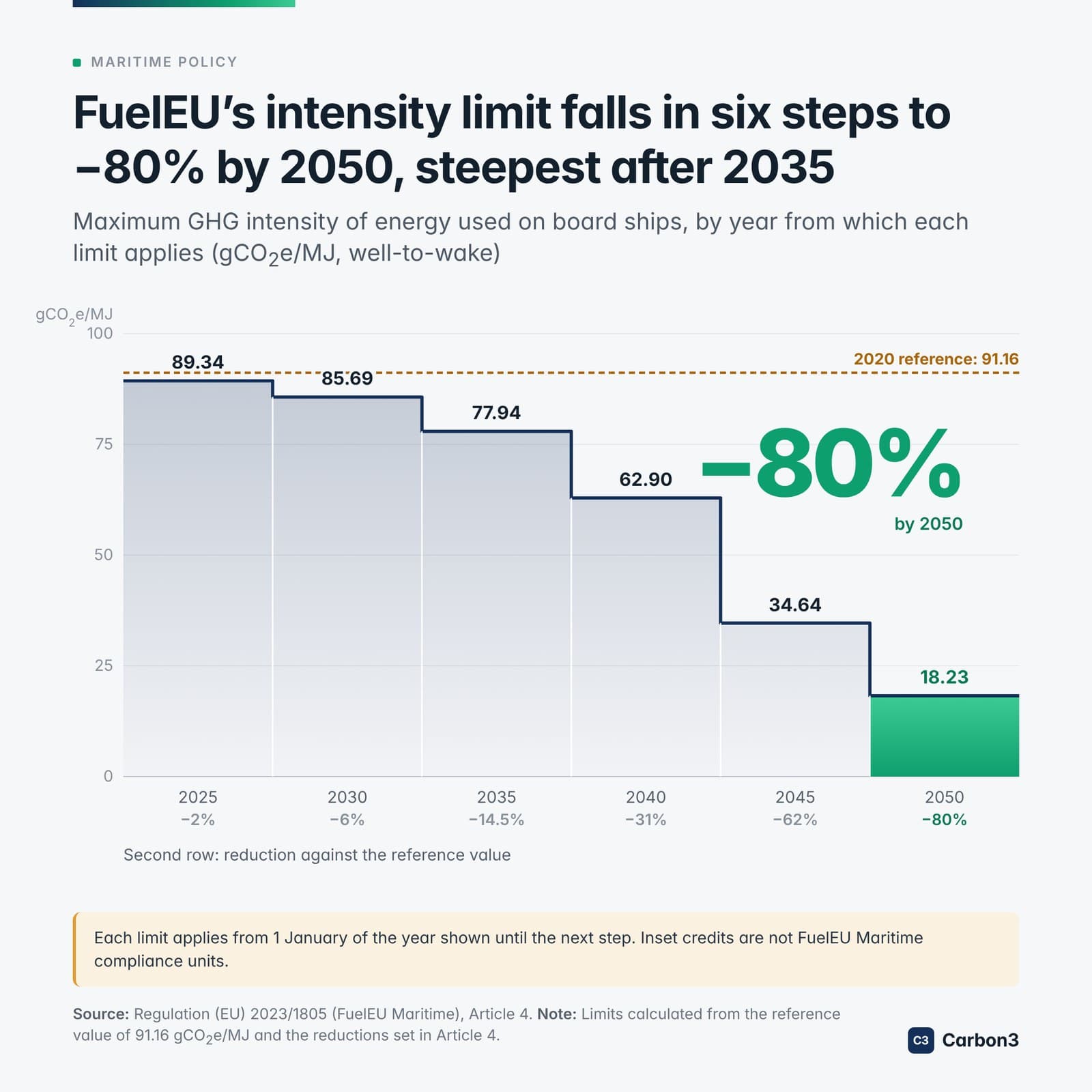
FuelEU Maritime lowers allowed GHG intensity by 80% by 2050, with the steepest steps after 2035
Article 4 of Regulation (EU) 2023/1805 lowers the limit in six steps, from 89.34 gCO₂e/MJ in 2025 to 18.23 in 2050.
Read the articleSector: Maritime
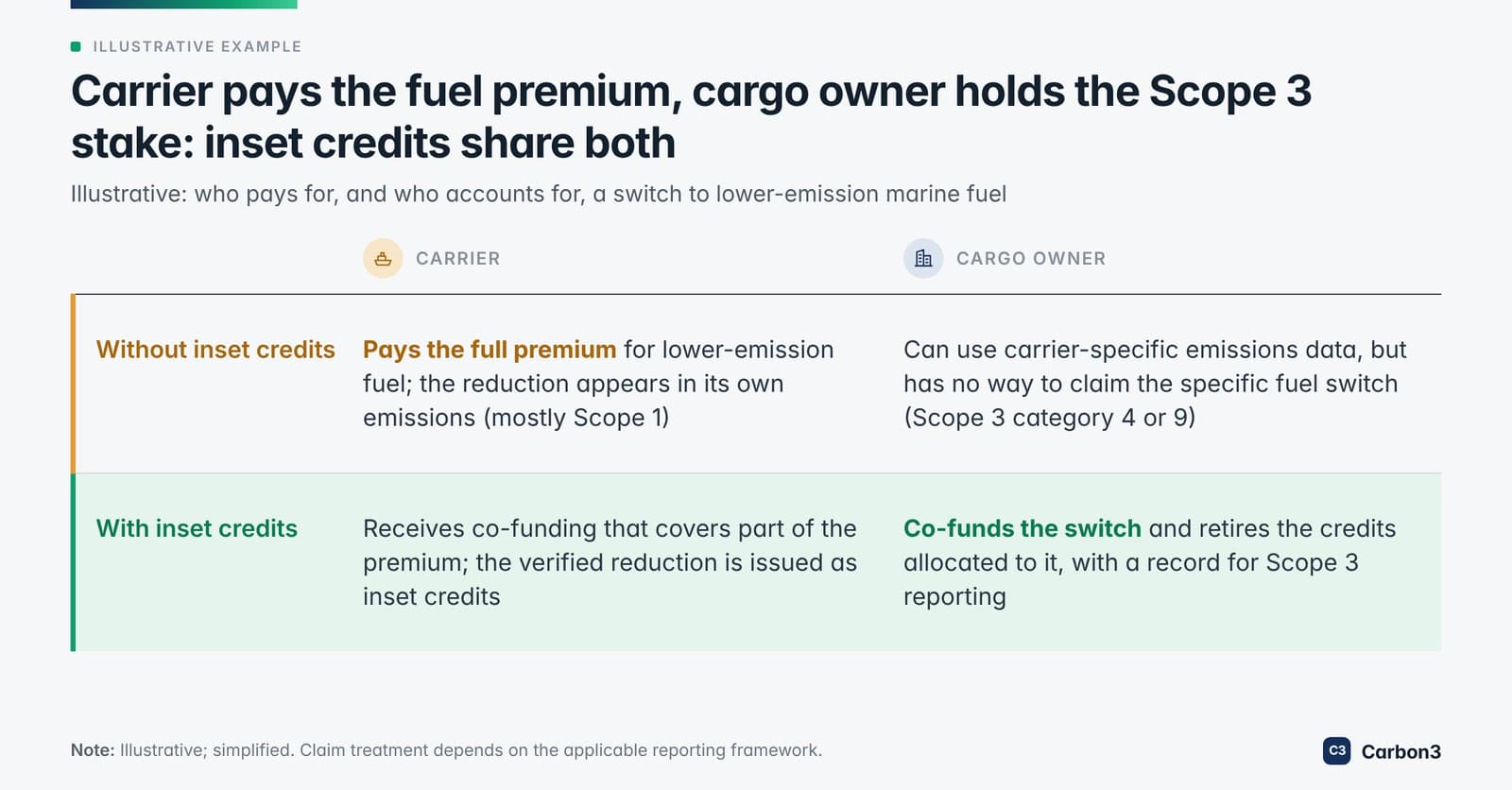
In shipping, the party paying for cleaner fuel is not the party holding the emissions
The carrier pays the fuel premium; the cargo owner reports the emissions in Scope 3.
Read the article
See the companies behind these figures in the Data Hub.
Look up your suppliers’ emissions and targets, free.