FuelEU Maritime only works if someone can pay the green premium
FuelEU Maritime asks ships calling at EU ports to cut the greenhouse gas intensity of their fuel 2% from 2025, rising to 80% by 2050. The open question is who carries the cost of the cleaner fuel.
By Carbon3 team2 min read
Climate policy only works if someone can pay for the change it asks for. FuelEU Maritime is a clear example, because the rule is set and the cleaner fuel exists, yet the cost of switching still has no settled owner.
What FuelEU asks for
FuelEU Maritime applies to ships calling at EU ports. It asks them to reduce the greenhouse gas intensity of the energy they use on board by 2% from 2025, and the required reduction rises step by step to 80% by 2050. The regulation sets the target and the penalty for missing it. It does not say who should fund the price gap between conventional fuel and cleaner alternatives.
That price gap is the green premium. Lower-emission fuels are available today, so the barrier is not technology. The barrier is that the premium has to land on someone's balance sheet before a ship can burn the cleaner fuel.
Where the cost lands today
Today the green premium often falls on shipowners alone. When it cannot be carried, it ends up as a compliance penalty instead of an investment in cleaner fuel. In both cases the cargo owners whose goods are on board, and whose Scope 3 inventories include those shipping emissions, sit outside the decision.
This is the mismatch at the center of maritime decarbonization. The party that pays for the fuel is often not the party that reports the emissions or has a target to meet.
Connecting the cost to demand
Carbon3 provides the financial infrastructure that connects that cost to demand. Cargo owners with Scope 3 targets can co-finance the fuel switch on routes that carry their goods. This is insetting: financing emissions reductions inside a company's own value chain rather than buying reductions elsewhere.
Three pieces make the model work:
- Co-financing spreads the green premium across several buyers instead of leaving it with one shipowner.
- Verification de-risks the claim, because each emissions reduction is checked against a verification report before credits exist.
- Demand unlocks the investment, because a committed buyer turns a cost into a funded project.
After verification, the project developer issues the resulting inset credits on the Carbon3 registry. Carbon3 records allocation, transfer and retirement so that each reduction is claimed only once. Claim treatment depends on the applicable reporting framework.
Beyond shipping
The same question of who pays applies well beyond FuelEU. Carbon3 has mapped how co-financing and verified value-chain claims fit across eight policies, from FuelEU Maritime and the EU Emissions Trading System to CBAM, CORSIA, CSRD and SBTi targets. More on that mapping will follow on Carbon3 Insights.
Learn more
How insetting works in shipping
Originally published on LinkedIn, 15 November 2026.
Read more from the research team.
Sector: Maritime
Maersk and Hapag-Lloyd differ in size, but their footprints share the same shape
Maersk reported about 2.2 times Hapag-Lloyd's Scope 1 and 2 emissions in 2024, yet Scope 3 makes up 59% and 58% of their reported footprints.
Read the articleSector: Maritime
Shipping's climate talks move to London, and cargo owners can act before the IMO rule applies
After COP31 in Antalya, the decisions on shipping's emissions move to the International Maritime Organization in London.
Read the articleSector: Maritime
Ethanol blends cut the ship fuel bill, but biomethanol carries the compliance value
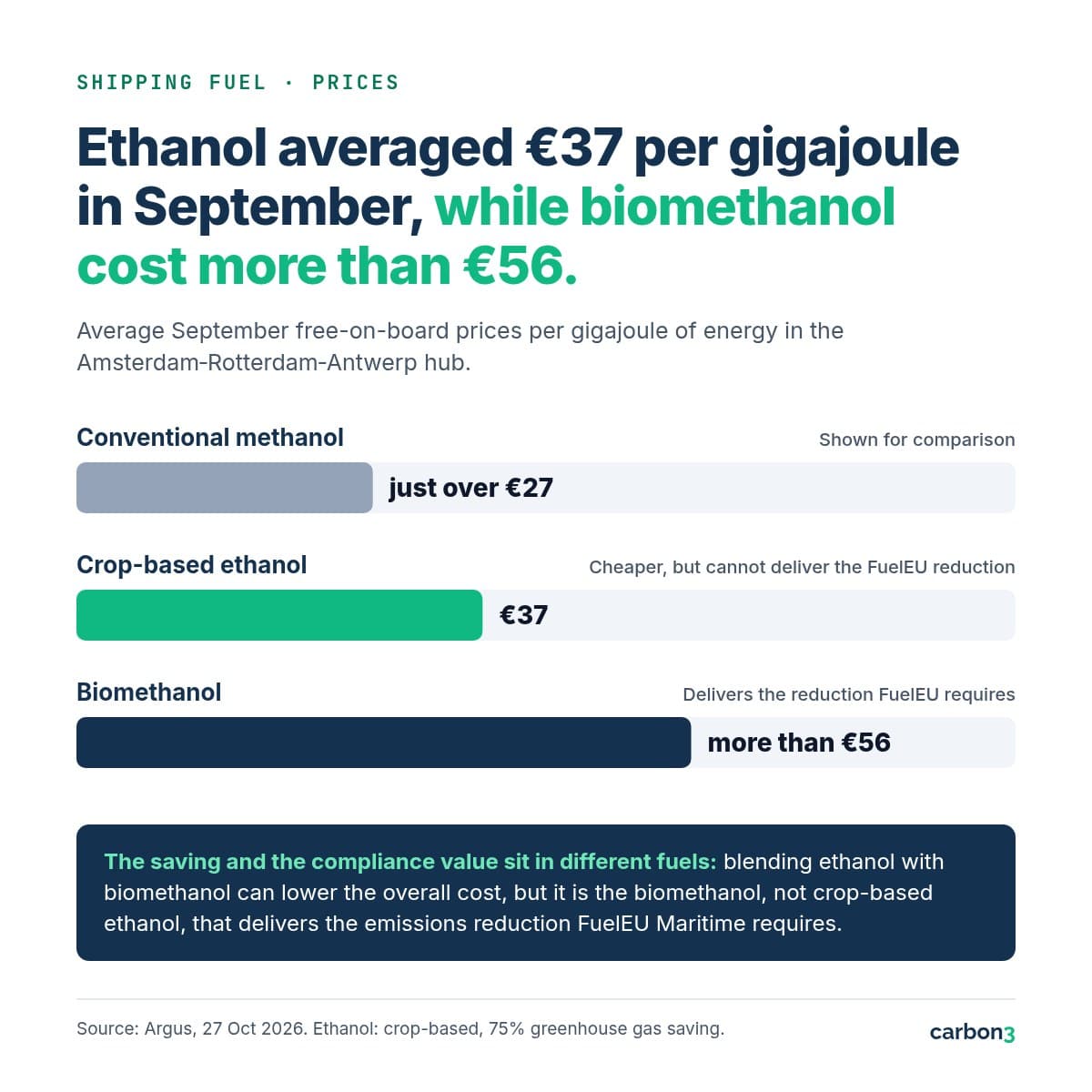
Argus reports that ethanol-methanol blends are gaining ground as a cheaper ship fuel in Europe, yet only the biomethanol in the blend delivers the reduction FuelEU Maritime requires.
Read the article
See the companies behind these figures in the Data Hub.
Look up your suppliers’ emissions and targets, free.