Shipping's climate talks move to London, and cargo owners can act before the IMO rule applies
After COP31 in Antalya, the decisions on shipping's emissions move to the International Maritime Organization in London. Voluntary goals from ports, shipowners and cargo owners are in place, while investment in ships, fuels and ports still waits for a global rule.
By Carbon3 team3 min read
Shipping's climate talks are moving from Antalya to London. Once COP31 closes, the decisions that shape the sector's emissions return to the International Maritime Organization (IMO), the UN agency that regulates international shipping.
The calendar is tight. The IMO's intersessional working group on greenhouse gas emissions meets from 23 to 27 November. The Marine Environment Protection Committee, MEPC 85, follows from 30 November to 3 December. A resumed session on the IMO Net-Zero Framework is set for 4 December, subject to confirmation by MEPC 85.
Voluntary goals, and a wait for the rule
COP31 added voluntary goals from ports, shipowners and cargo owners. These goals signal direction, yet the investment decisions behind them still wait. Ships, fuels and port infrastructure are long-lived assets, and the companies that fund them want to know which global rule will apply before they commit.
That is why the London meetings matter. A global measure adopted at the IMO would apply across flags and routes, which voluntary pledges cannot do on their own.
The coalition's call
The coalition behind the new COP31 maritime electrification goal, which includes the cargo owner alliance ZEMBA (the Zero Emission Maritime Buyers Alliance), urged IMO member states to adopt climate measures in 2026. Cargo owners joining that call shows that demand for cleaner shipping already exists on the buyer side, ahead of regulation.
What cargo owners can do now
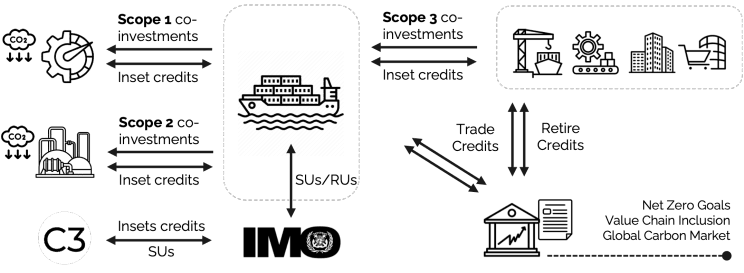
Until a global rule applies, cargo owners do not have to wait. They can co-finance cleaner voyages in their own value chains through insetting, which means financing emissions reductions inside a company's own value chain rather than elsewhere.
A freight buyer that co-finances a cleaner voyage with its carrier can claim the resulting emissions reductions once, in its Scope 3, the emissions in its value chain. The carrier gets a committed partner for the extra cost of cleaner operation, and the buyer gets reductions tied to the cargo it actually ships.
Carbon3 coordinates this co-financing between buyers and their suppliers and records each emissions reduction once, so the same reduction is not claimed twice. The project developer issues credits on the Carbon3 registry after a verification report is on file. Claim treatment depends on the applicable reporting framework.
The open question
The dates are set, with 4 December still to be confirmed. What would freight buyers need to see from the IMO on 4 December to commit more of their own capital to cleaner shipping? Carbon3 would like to hear from cargo owners, carriers and ports following the talks.
What the draft IMO Net-Zero Framework would charge ships, and the dates to watch, are set out on the Carbon3 IMO page.
Sources: IMO, MEPC 85 preview; World Ports Organization, Maritime Electrification Breakthrough Goal, 11 November 2026.
Learn more
How insetting works in shipping
Originally published on LinkedIn, 19 November 2026.
Read more from the research team.
Sector: Maritime
FuelEU Maritime only works if someone can pay the green premium
FuelEU Maritime asks ships calling at EU ports to cut the greenhouse gas intensity of their fuel 2% from 2025, rising to 80% by 2050.
Read the articleSector: Maritime
Bridging the gap to maritime net zero
How the maritime sector can turn decarbonization from obligation into opportunity ahead of the extraordinary MEPC session.
Read the articleSector: Maritime
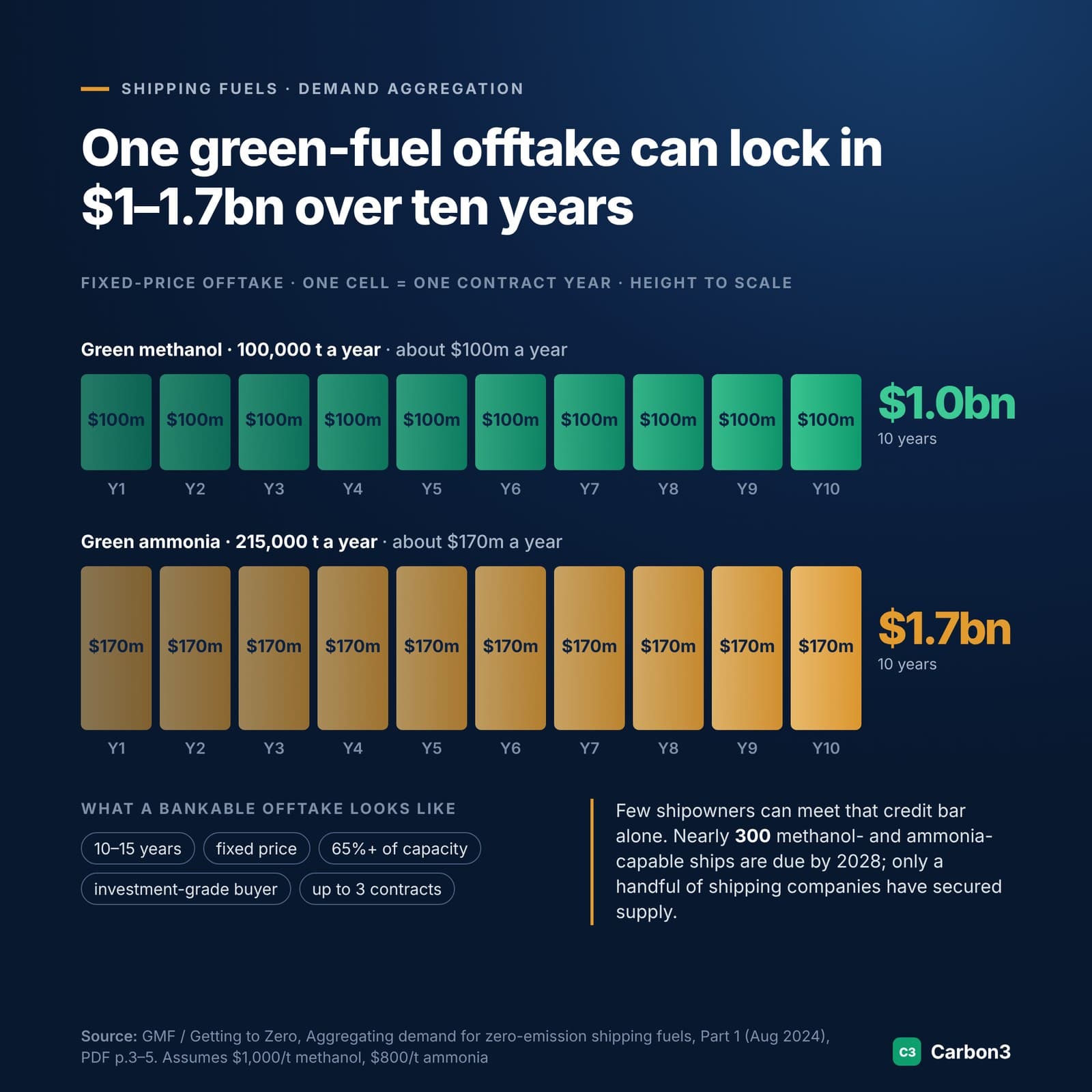
One green shipping fuel contract can commit a buyer to $1 billion or more
The Global Maritime Forum and the Getting to Zero Coalition price a 10-year green methanol or ammonia offtake at $1 billion to $1.7 billion, while nearly 300 capable ships are due by 2028.
Read the article
See the companies behind these figures in the Data Hub.
Look up your suppliers’ emissions and targets, free.