Some of the cheapest shipping emissions to cut are burned at anchor
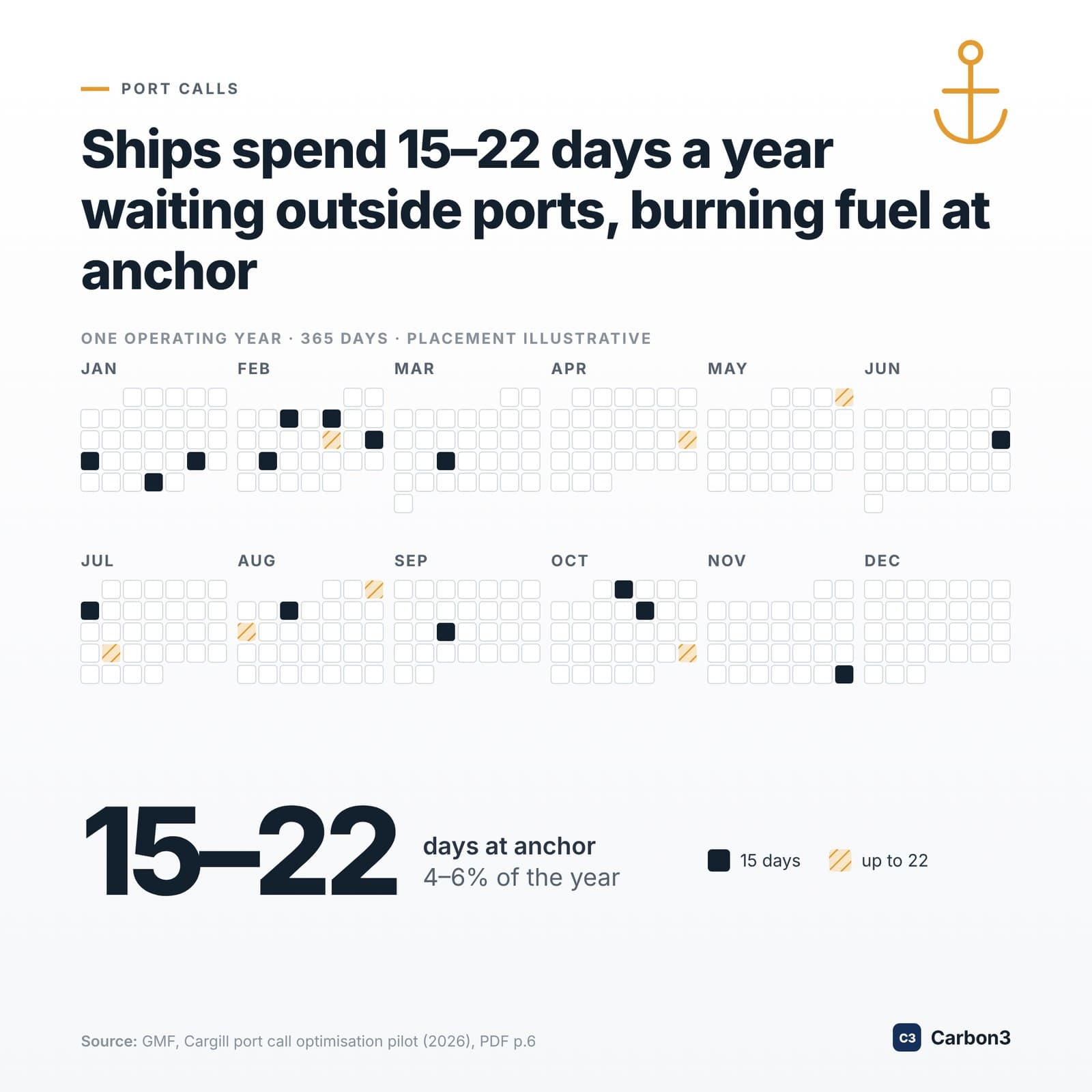
Ships spend 4–6% of their operating year waiting outside ports. In Cargill's pilot with the Global Maritime Forum, adjusting arrival times reduced emissions on the same voyages, with no new fuel.
By Carbon3 team2 min read
Some of the cheapest shipping emissions to cut are burned at anchor.
According to the Global Maritime Forum, commercial ships spend 4–6% of their operating year waiting outside ports. That is about 15 to 22 days a year in which a vessel is not carrying cargo towards its destination, but is still running engines and generators while it waits for a berth.
Waiting is an operational problem, not a fuel problem
Most of the debate on shipping decarbonization centers on new fuels and new vessels. Both matter, and both take years and significant capital. Waiting time is different. Much of it comes from how arrivals are planned: ships sail at full speed to reach port, then sit at anchor because the berth is not ready.
In Cargill's port call optimization pilot with the Global Maritime Forum, adjusting arrival times reduce emissions on the same voyages. The pilot used no new fuel and no extra vessels. The change was in coordination between the ship, the charterer and the port, so that ships arrived closer to when they could actually be served.
Why it matters for agri-food and commodity buyers
For agri-food and commodity companies, ocean freight is a material part of the footprint they report in Scope 3. The fuel burned while a chartered or contracted vessel waits outside a port sits inside that freight number.
That makes waiting time one of the more practical places to look for reductions within the value chain. The levers are commercial and operational: charter terms, arrival planning, data sharing with ports and terminals. They do not depend on a fuel that is not yet available at scale.
Turning an operational change into a record
A reduction from changing how voyages are planned is real, but it is easy to lose track of. It shows up as lower fuel consumption on specific voyages, and unless it is measured and documented, it rarely makes it into a buyer's reporting in a form that others can check.
On Carbon3, a supplier-side change like this can be co-funded by the buyer, measured, independently verified and recorded once as an inset credit, linked to the voyages and the operator that delivered it. The buyer holds a single, serialized record of a reduction inside its own supply chain, rather than an estimate in a spreadsheet.
Insetting is not offsetting. The reduction happens on the freight the buyer already uses, not in an unrelated project elsewhere.
Claim treatment depends on the applicable reporting framework.
Source: Global Maritime Forum, Cargill port call optimization pilot (2026).
Originally published on LinkedIn, 21 October 2026.
The Carbon3 Newsletter
Weekly analysis of industrial decarbonization and insetting across Scope 1 to 3, from the Carbon3 team.
Read more from the research team.
Sector: Maritime
The market premium for green shipping is shrinking
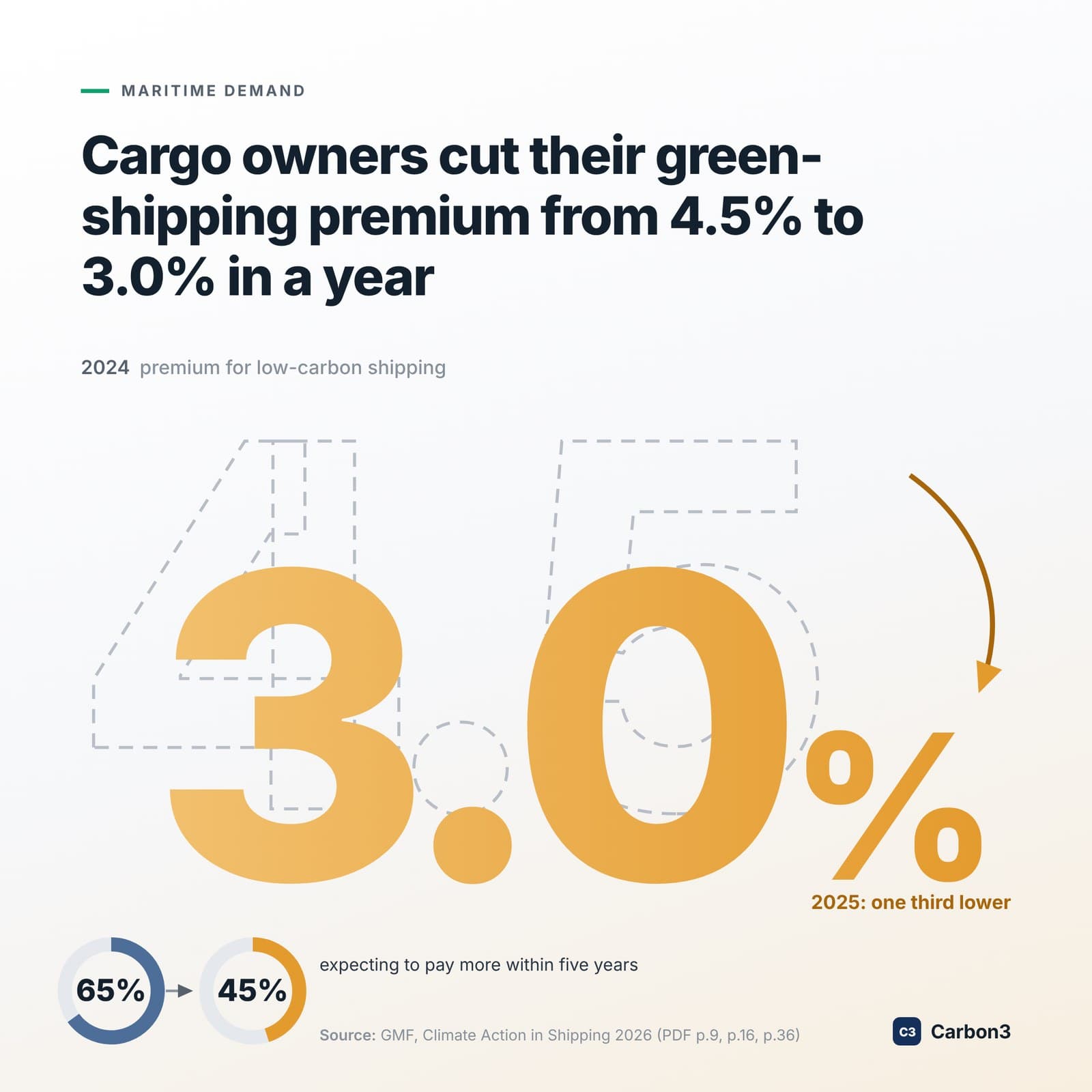
Cargo owners' willingness to pay for low-carbon shipping fell from 4.5% to 3.0% in a year, according to the Global Maritime Forum.
Read the articleSector: Maritime
2025 delivered a record fleet of green-ready ships, and a weaker orderbook
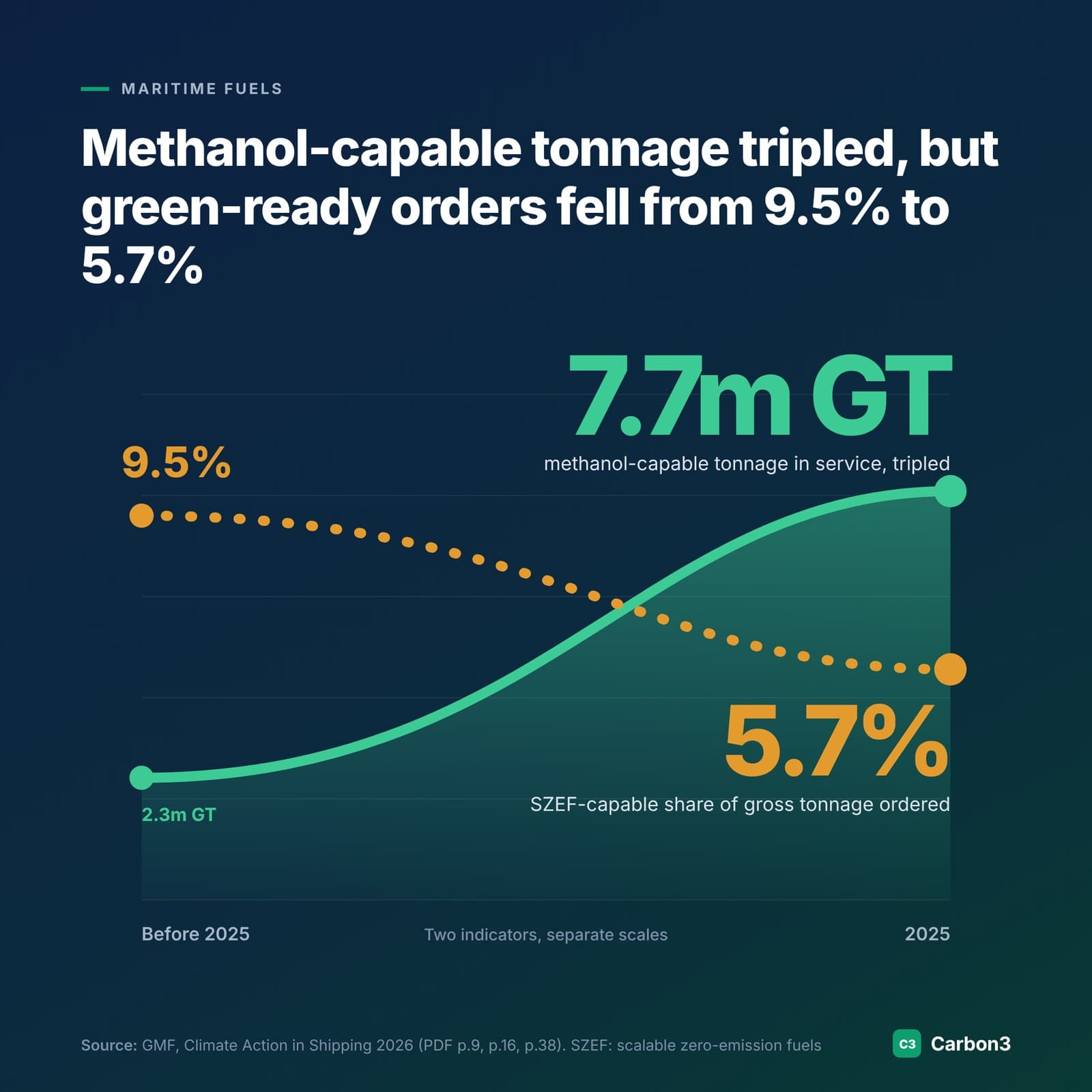
Methanol-capable tonnage in service tripled to 7.7 million gross tonnes, while ships able to run on scalable zero-emission fuels fell from 9.5% to 5.7% of tonnage ordered.
Read the articleSector: Maritime
One green shipping fuel contract can commit a buyer to $1 billion or more
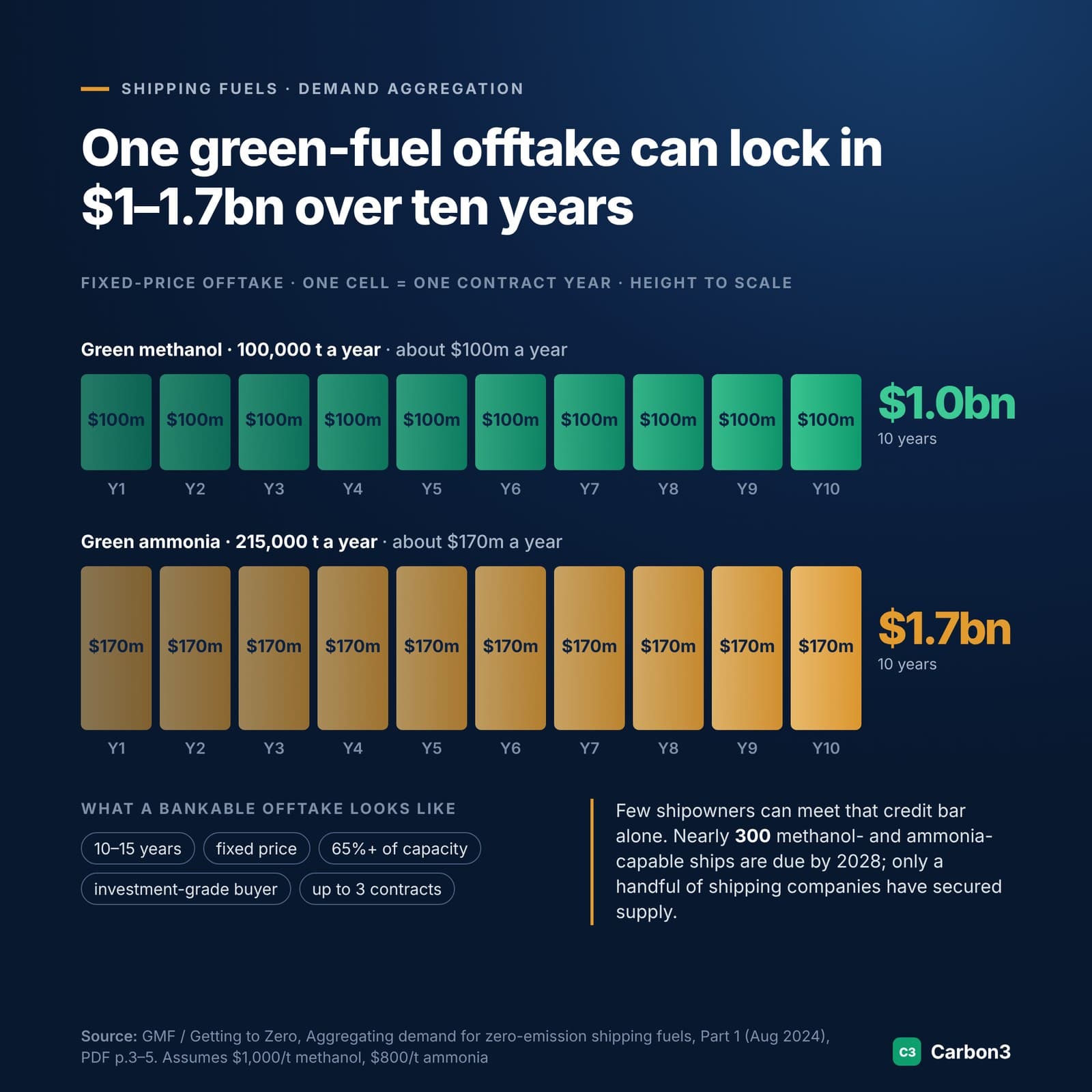
The Global Maritime Forum and the Getting to Zero Coalition price a 10-year green methanol or ammonia offtake at $1 billion to $1.7 billion, while nearly 300 capable ships are due by 2028.
Read the article
See the companies behind these figures in the Data Hub.
Look up your suppliers’ emissions and targets, free.