Emvolon will turn waste gas into bio-methanol for shipping
The US start-up will build its first commercial plant with a $22 million Series A round and government grants, and Freepoint Commodities holds a first purchase option on up to $450 million worth of its fuel.
By Carbon3 team2 min read
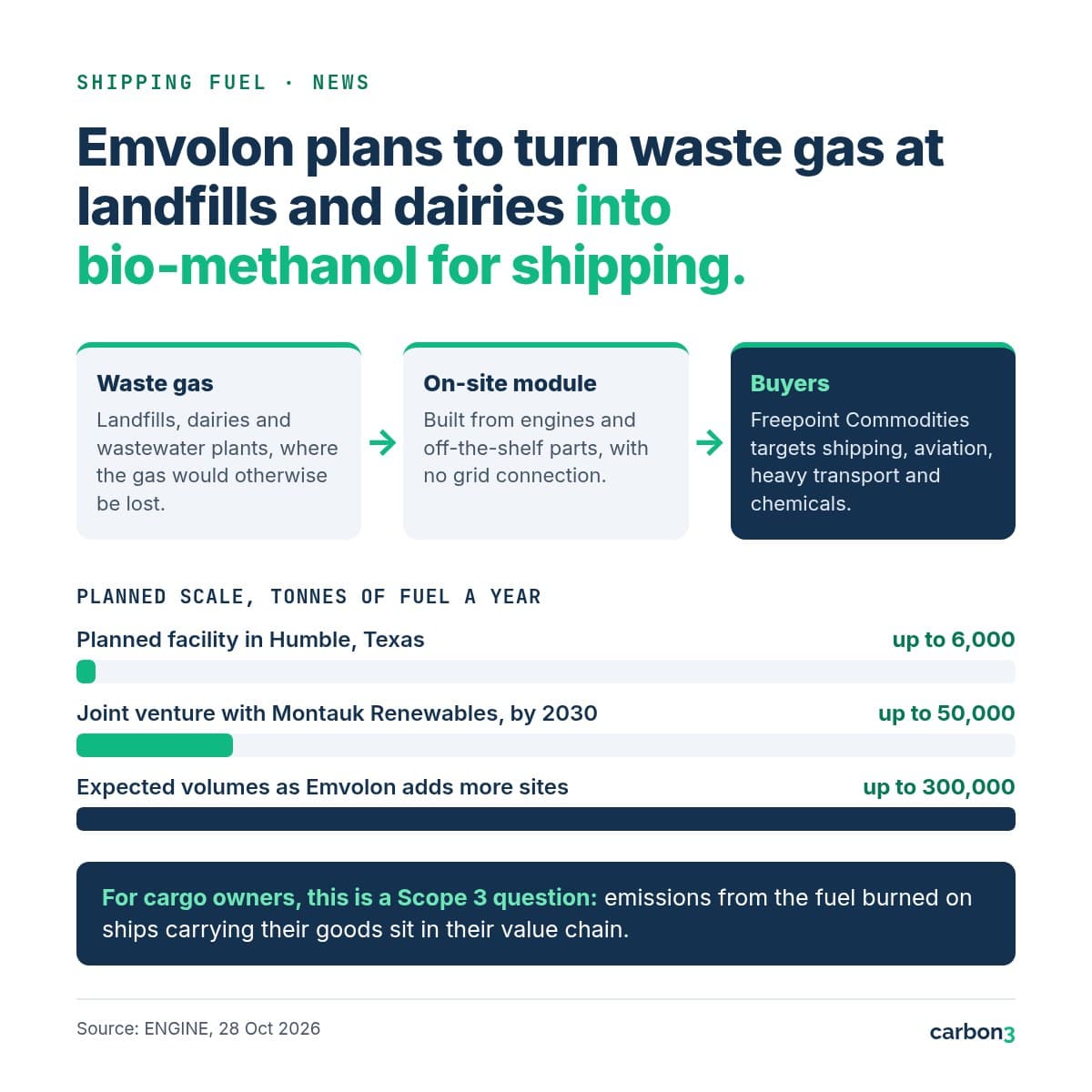
Emvolon, a US clean-tech start-up, will build its first commercial plant to turn methane-rich waste gas into liquid bio-methanol. According to ENGINE, the company is funding the first system with a $22 million Series A round and government grants.
A small plant placed at the gas source
The plant is a compact, prefabricated module built from engines and other off-the-shelf equipment. It is installed right where the gas is produced and runs without a grid connection.
Emvolon plans to place these units at landfills, dairies, wastewater plants and industrial flare sites, where the gas would otherwise be lost. Rather than relying on one large refinery, the approach spreads production across many small sites.
The company's joint venture is scaling up toward 50,000 tonnes a year across multiple sites. In August 2025, the partners said they aimed to reach that capacity by 2030, starting with a facility in Humble, Texas, that is expected to produce up to 6,000 tonnes a year. Emvolon has not said whether its first commercial system will go to that site or when production will begin.
A committed buyer from the start
Freepoint Commodities will be the primary buyer of the bio-methanol and other liquid fuels from Emvolon's sites under a seven-year agreement announced in August. Freepoint holds a first purchase option on up to $450 million worth of fuel, and volumes are expected to scale up to 300,000 tonnes a year as Emvolon adds sites.
The fuel will go into Freepoint's global distribution network, which targets buyers in shipping, aviation, heavy transport and chemicals.
Why it matters to cargo owners
For companies that ship goods by sea, the emissions from the fuel burned on those voyages sit in their Scope 3, or value-chain, emissions. Lower-emission marine fuel is therefore part of their own climate targets, not just the carriers'.
Projects like this one show that alternative fuel supply may come from many small plants as well as large ones. Each new site still has to be financed, and committed demand from the value chain is part of what makes that possible. Funding emissions reductions inside a company's own value chain is insetting, not offsetting, and the difference is explained at carbon3.net/insets-vs-offsets.
If more marine fuel comes from small waste-gas plants, the open question is who will fund the next ones.
Source: ENGINE, "Emvolon to build first commercial bio-methanol plant using waste gas" (28 October 2026).
Originally published on LinkedIn, 29 October 2026.
The Carbon3 Newsletter
Weekly analysis of industrial decarbonization and insetting across Scope 1 to 3, from the Carbon3 team.
Read more from the research team.
Sector: Maritime
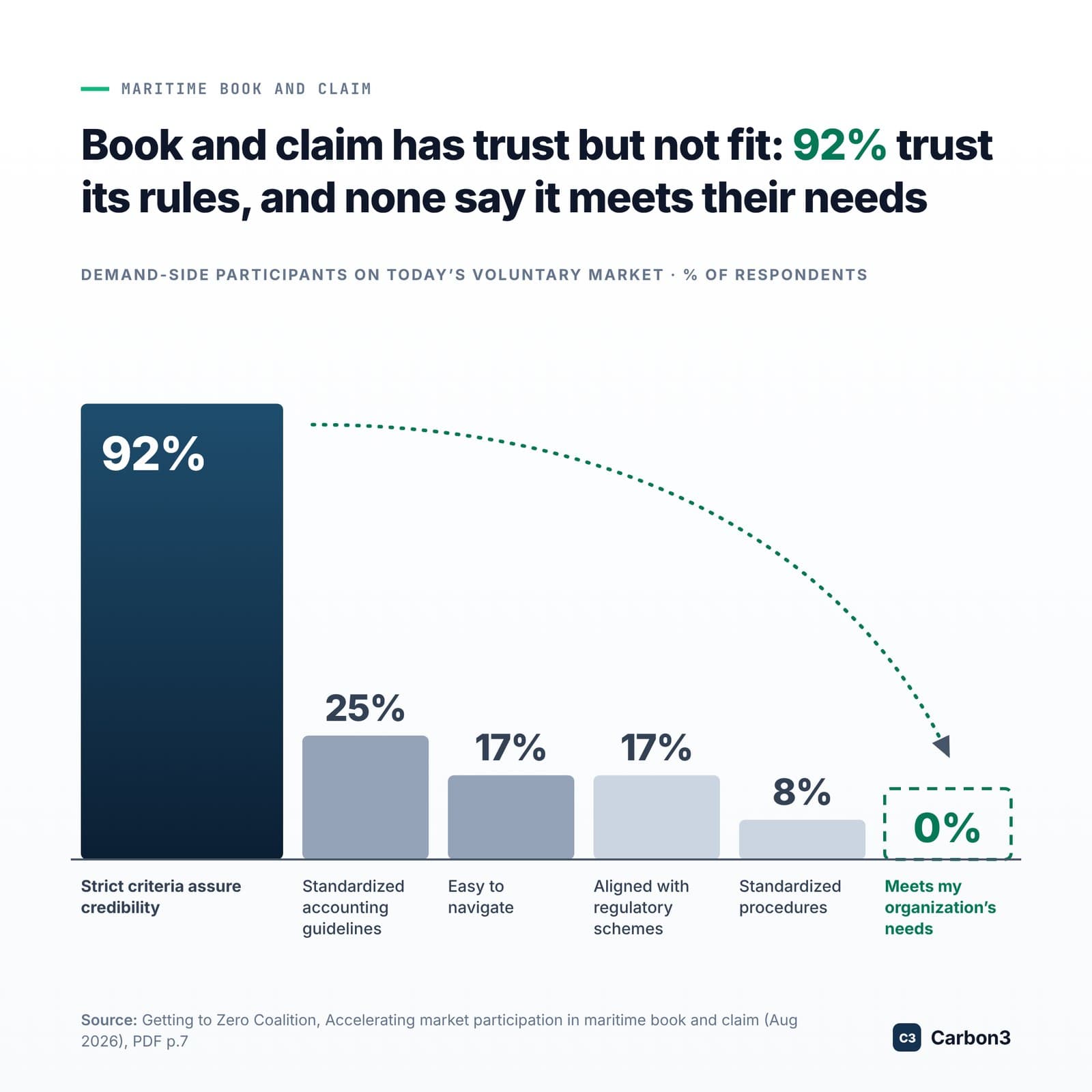
Maritime book and claim has earned trust. It has not yet earned fit.
In a Getting to Zero Coalition survey, 92% of buyers trusted book-and-claim criteria, yet not one said the market meets their organization's needs.
Read the articleSector: Maritime
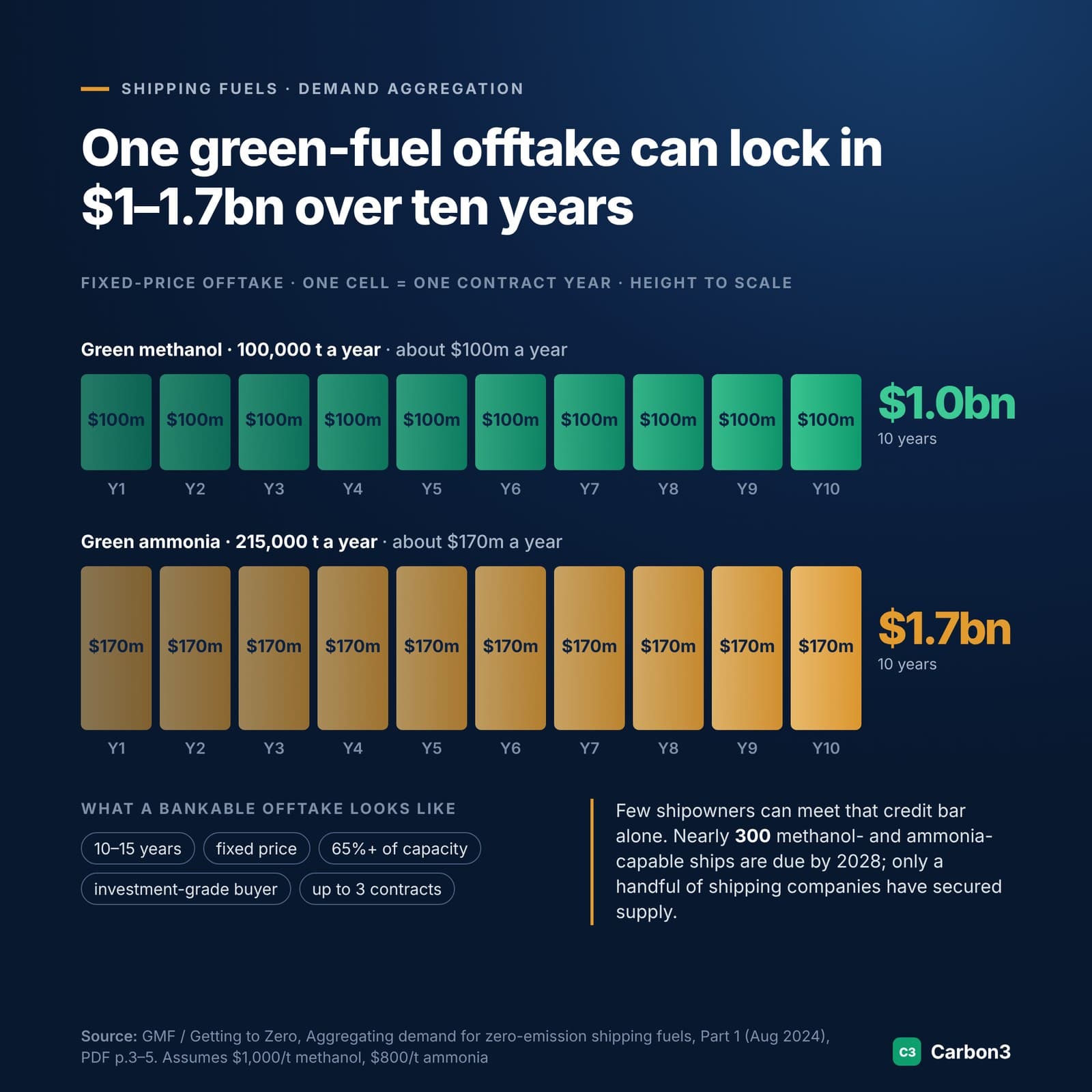
One green shipping fuel contract can commit a buyer to $1 billion or more
The Global Maritime Forum and the Getting to Zero Coalition price a 10-year green methanol or ammonia offtake at $1 billion to $1.7 billion, while nearly 300 capable ships are due by 2028.
Read the articleSector: Maritime
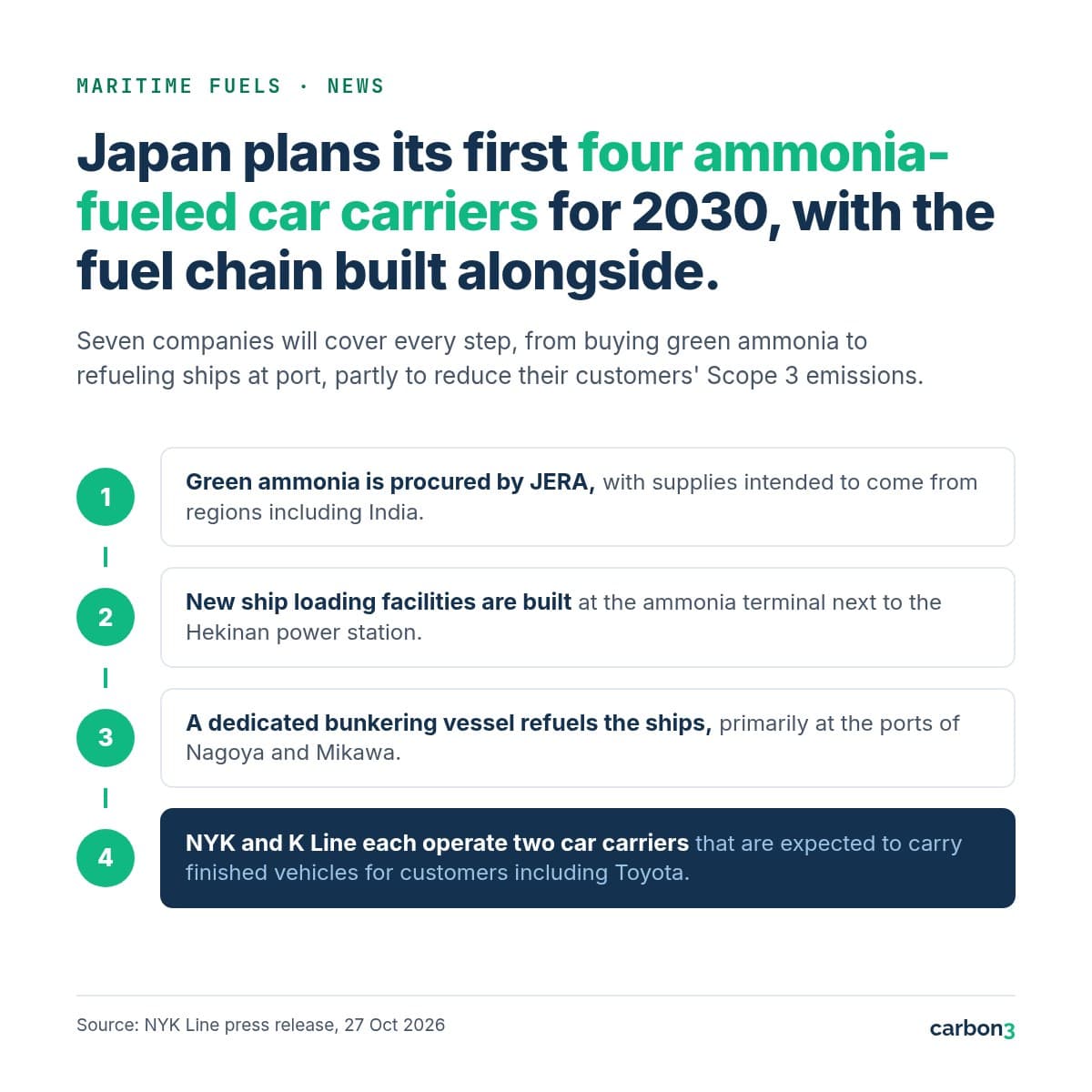
Japan will build its first ammonia-fueled car carriers, with their own fuel supply
Seven Japanese companies, including NYK, K Line and JERA, plan four ammonia-fueled car carriers for 2030, built together with the green ammonia supply and bunkering needed to run them.
Read the article
See the companies behind these figures in the Data Hub.
Look up your suppliers’ emissions and targets, free.