Maritime book and claim has earned trust. It has not yet earned fit.
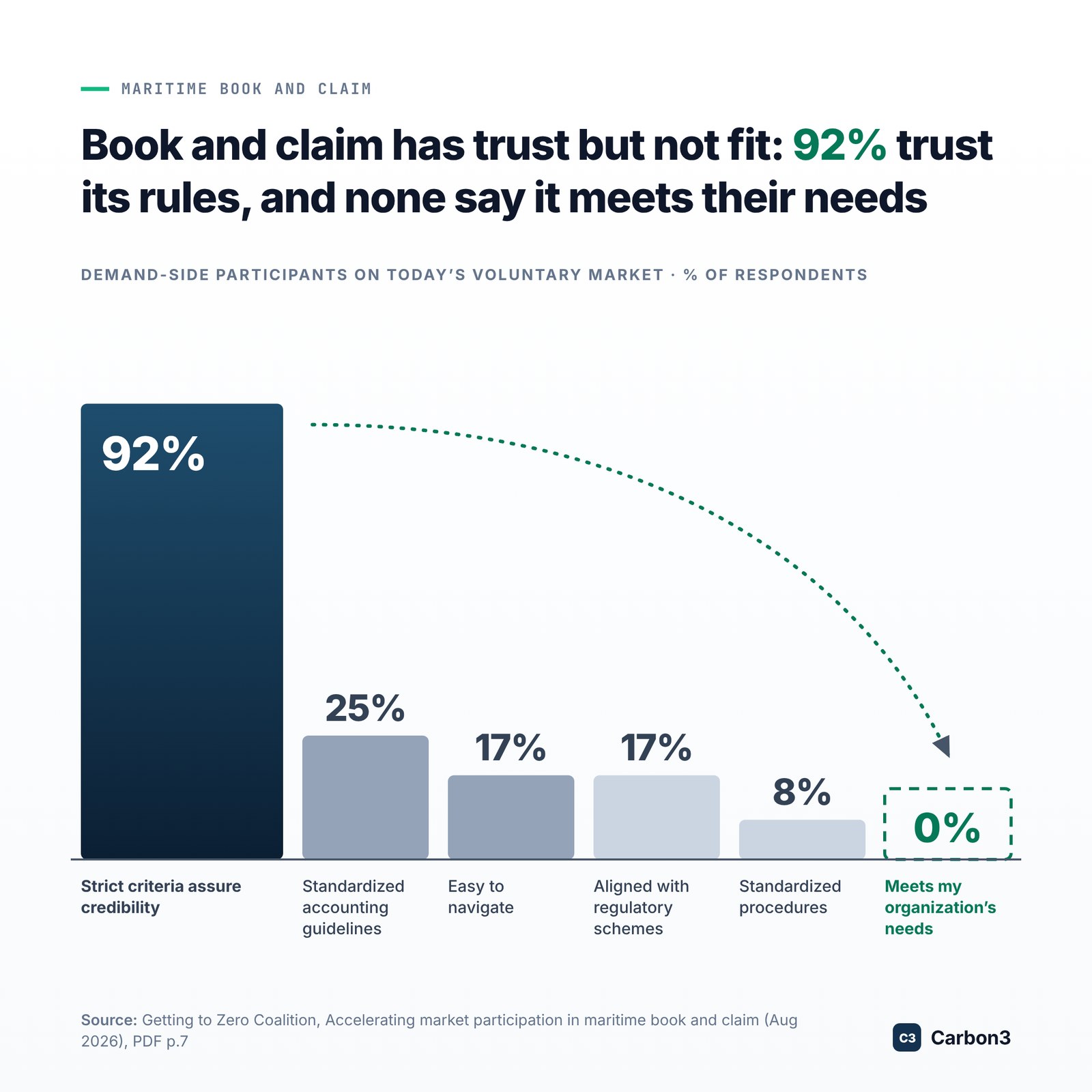
In a Getting to Zero Coalition survey, 92% of buyers trusted book-and-claim criteria, yet not one said the market meets their organization's needs.
By Carbon3 team2 min read
Book and claim has become one of the main ways cargo owners can support lower-emission shipping before clean fuels are available on every route. A new survey suggests the model has won the trust of buyers. What it has not yet done is fit the way those buyers work.
What the survey found
In August 2026, the Getting to Zero Coalition published research on accelerating market participation in maritime book and claim. It surveyed demand-side participants, the companies that buy or might buy lower-emission shipping.
Confidence in the rules was high. 92% of respondents said voluntary book-and-claim markets uphold strict criteria that assure credibility.
Confidence in how the market works day to day was much lower. Only 25% saw standardized accounting guidelines. 17% found the market easy to navigate, and 8% saw standardized procedures. Not a single respondent said the current market meets their organization's needs.
The barrier is not the rules
Those results point to a clear conclusion. For cargo owners, the integrity of the framework is not what is holding them back. The barriers are practical ones: procurement, data and claims.
Buying lower-emission voyages has to fit into existing purchasing processes. The data behind each claim has to be clear enough for sustainability and finance teams to rely on. And companies need confidence in how a purchase can be reported against their Scope 3 targets.
Turning trust into a usable lever
Co-funding lower-emission voyages in a company's own value chain is one way to close that gap. The support goes to the shipping that actually moves the company's goods, so it sits inside its Scope 3 emissions. This is insetting, not offsetting.
When those emissions reductions are verified and recorded once as inset credits, each claim has a clear owner and cannot be counted twice. The project developer issues credits on the Carbon3 registry once a verification report is on file, giving carriers, cargo owners and auditors the same view of who holds what.
That kind of shared record addresses the data and claims problems the survey highlights, and it helps turn a framework that buyers already trust into something they can use in procurement.
Claim treatment depends on the applicable reporting framework.
Correction, 30 October 2026: An earlier version of this article said the reductions behind Carbon3 credits are independently verified. Credits are issued once a verification report is on file. Carbon3 asks for a verifier that is independent of the project, but the registry does not yet check who wrote the report.
Source: Getting to Zero Coalition, Accelerating market participation in maritime book and claim (August 2026).
Learn more
How insetting works in shipping
Originally published on LinkedIn, 28 October 2026.
Read more from the research team.
Sector: Maritime
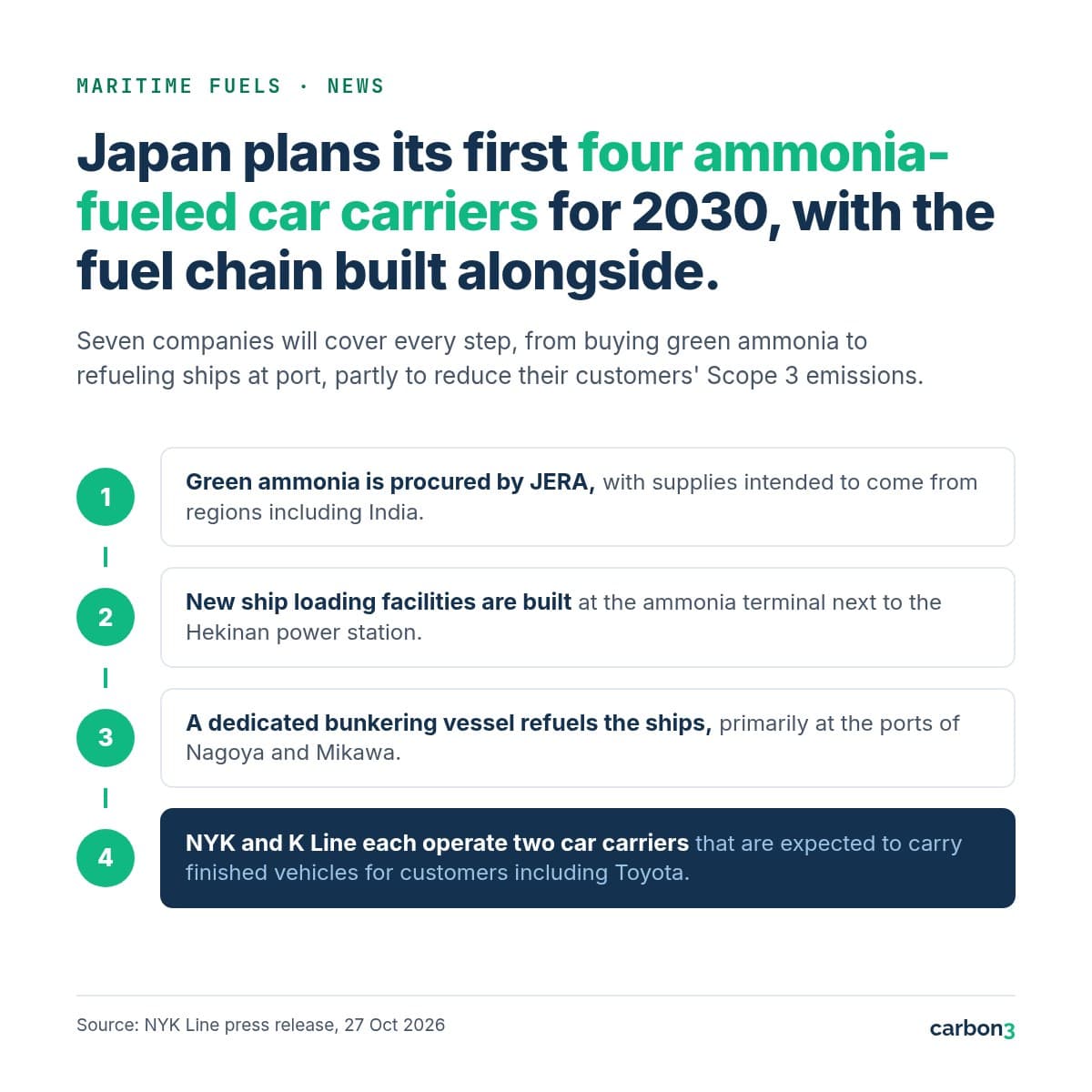
Japan will build its first ammonia-fueled car carriers, with their own fuel supply
Seven Japanese companies, including NYK, K Line and JERA, plan four ammonia-fueled car carriers for 2030, built together with the green ammonia supply and bunkering needed to run them.
Read the articleSector: Maritime
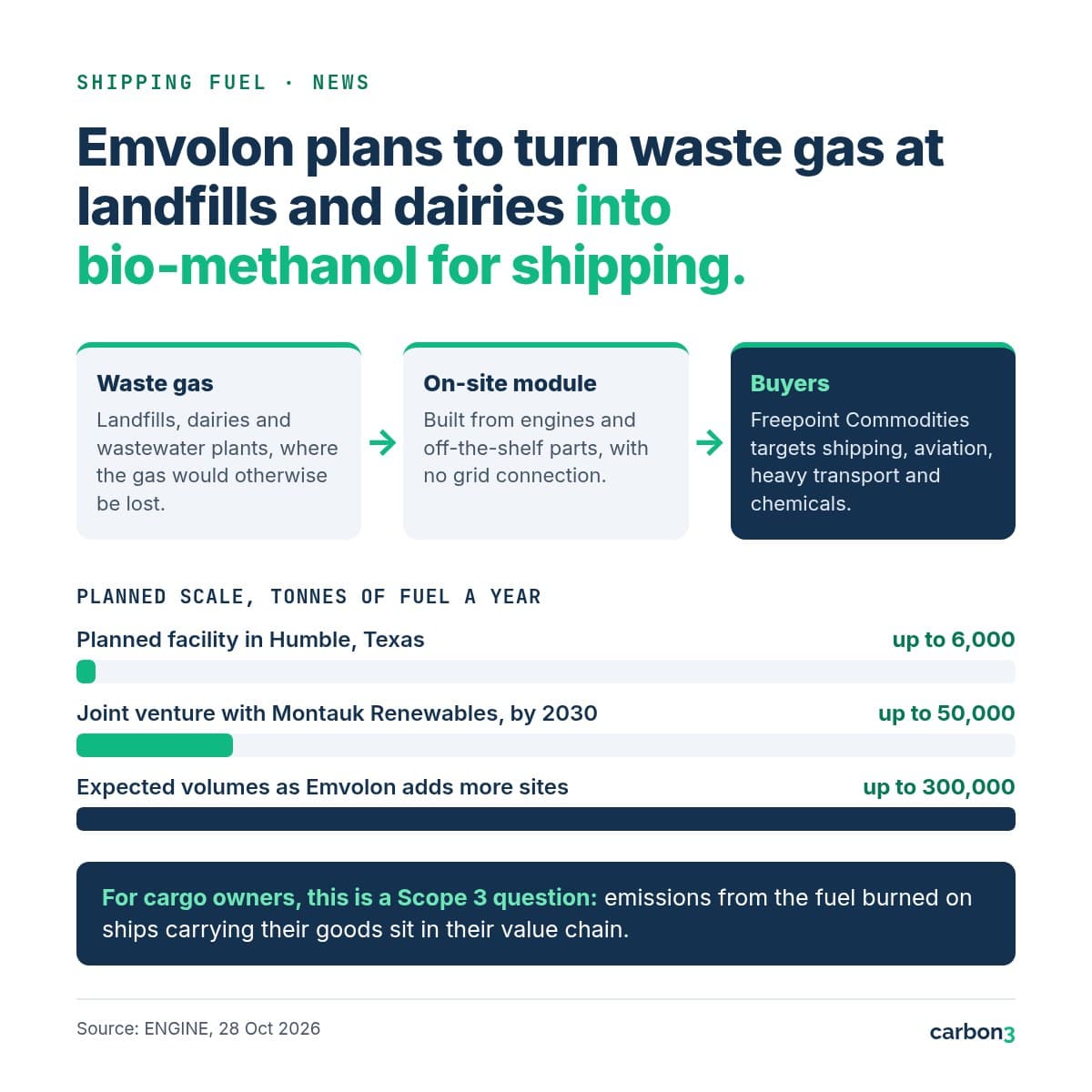
Emvolon will turn waste gas into bio-methanol for shipping
The US start-up will build its first commercial plant with a $22 million Series A round and government grants, and Freepoint Commodities holds a first purchase option on up to $450 million worth of its fuel.
Read the articleSector: Maritime
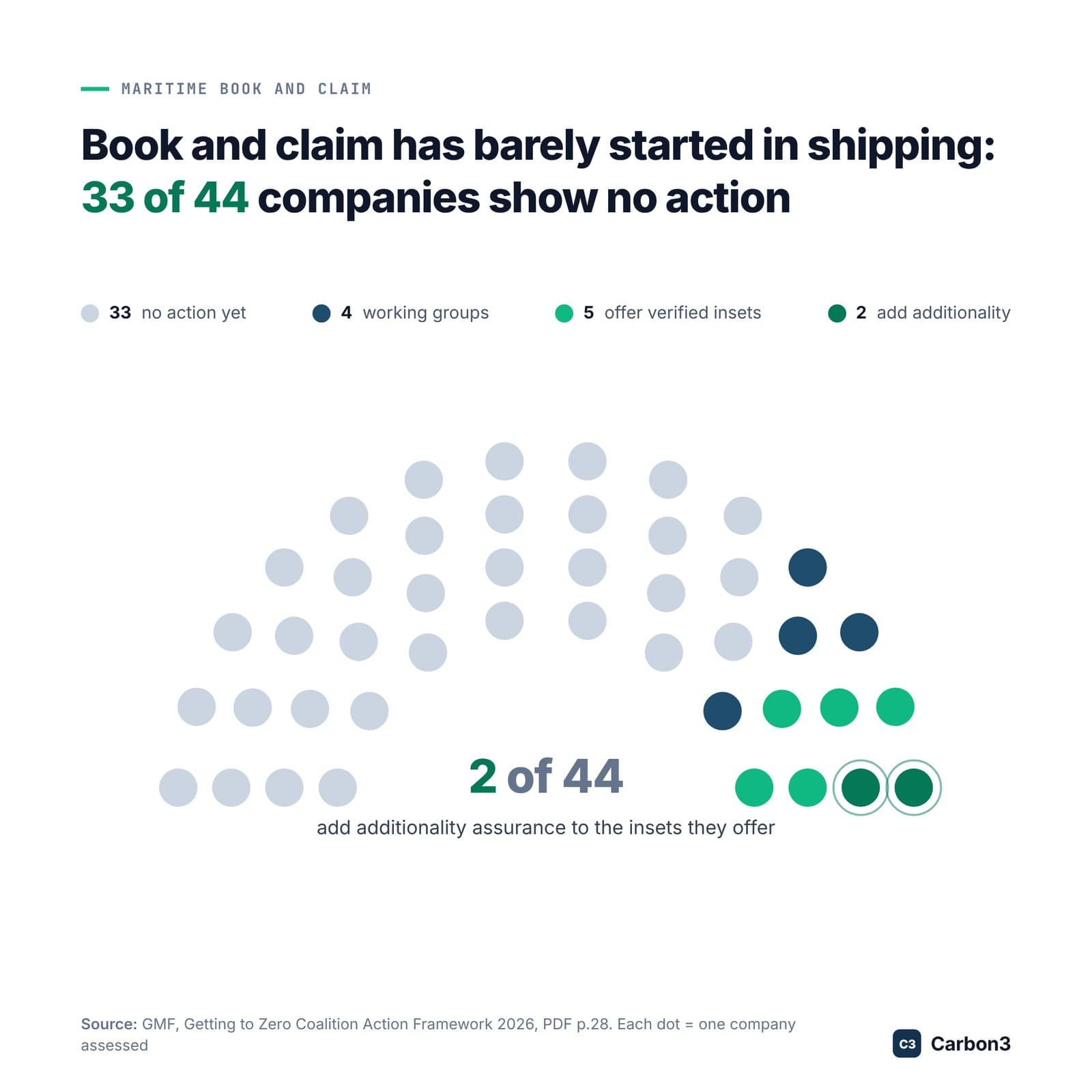
Book and claim has barely started in shipping
The Getting to Zero Coalition assessed 44 shipping companies on book and claim and found 33 showing insufficient action, while five offer verified insets.
Read the article
See the companies behind these figures in the Data Hub.
Look up your suppliers’ emissions and targets, free.