Book and claim has barely started in shipping
The Getting to Zero Coalition assessed 44 shipping companies on book and claim and found 33 showing insufficient action, while five offer verified insets.
By Carbon3 team2 min read
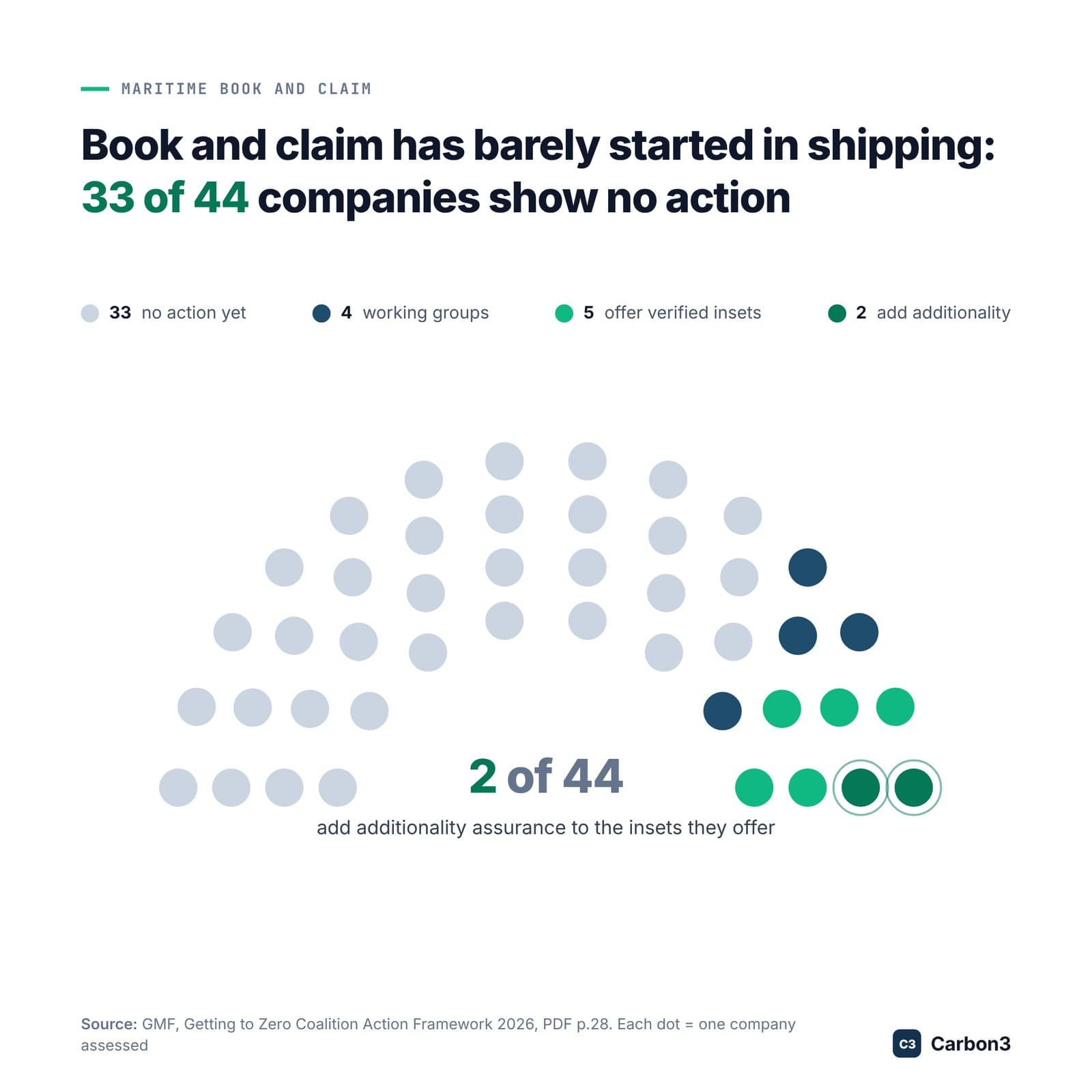
Book and claim lets cargo owners pay for zero-emission fuel they never physically receive, yet most of the shipping industry has not started using it.
What the Action Framework found
The Getting to Zero Coalition's 2026 Action Framework, published by the Global Maritime Forum, assessed 44 shipowners, operators and charterers on book and claim. Of those, 33 showed insufficient action. Four take part in working groups on the topic, five offer verified insets, and two add additionality assurance to the insets they offer.
The report itself describes book and claim as a form of insetting. That framing matters, because it places these instruments inside the value chain of the companies that use them rather than outside it.
How book and claim works
Zero-emission fuel is scarce and not available on every route. Book and claim separates the environmental attribute of a cleaner voyage from the physical cargo. A cargo owner pays for zero-emission fuel to be used on a voyage within the fleet that serves it, even if its own containers travel on a different ship, and in return it receives a record of the emissions reductions that the fuel delivered.
For carriers, that model creates a buyer for fuel that would otherwise be hard to justify at its current premium. For cargo owners, it offers a way to act on shipping emissions now instead of waiting until cleaner fuel reaches every lane they use.
Why the record is the product
For cargo owners, the value of book and claim depends entirely on the quality of the record. A verified record of a zero-emission fuel voyage is what turns a freight contract into a Scope 3 reduction. Without it, the payment is a cost with no defensible claim attached.
Inset credits record that reduction once, with no double counting. Credits are issued to the project developer after independent verification, and Carbon3 records them in its registry, so the carrier, the cargo owner and any auditor can see who holds each claim.
The Action Framework results suggest the gap is less about the concept and more about adoption. A small group of companies already offers verified insets, while most of those assessed have not moved beyond the starting line.
Claim treatment depends on the applicable reporting framework.
Source: Global Maritime Forum, Getting to Zero Coalition Action Framework 2026.
Originally published on LinkedIn, 26 October 2026.
The Carbon3 Newsletter
Weekly analysis of industrial decarbonization and insetting across Scope 1 to 3, from the Carbon3 team.
Read more from the research team.
Sector: Maritime
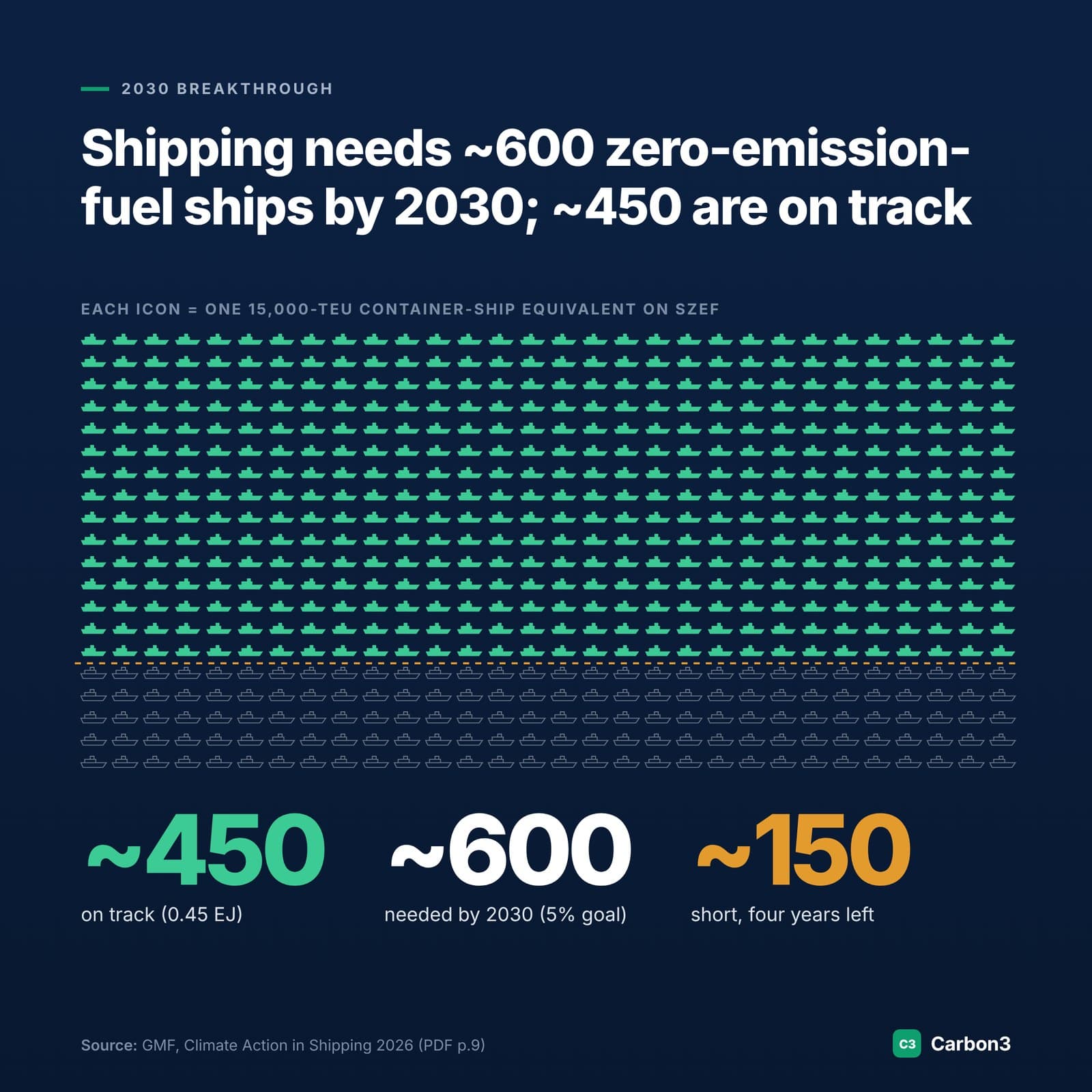
Shipping's 2030 fuel goal is about 150 ships short, with four years left
The Global Maritime Forum estimates the 5% breakthrough goal needs about 600 large container ship equivalents on scalable zero-emission fuels by 2030.
Read the articleSector: Maritime
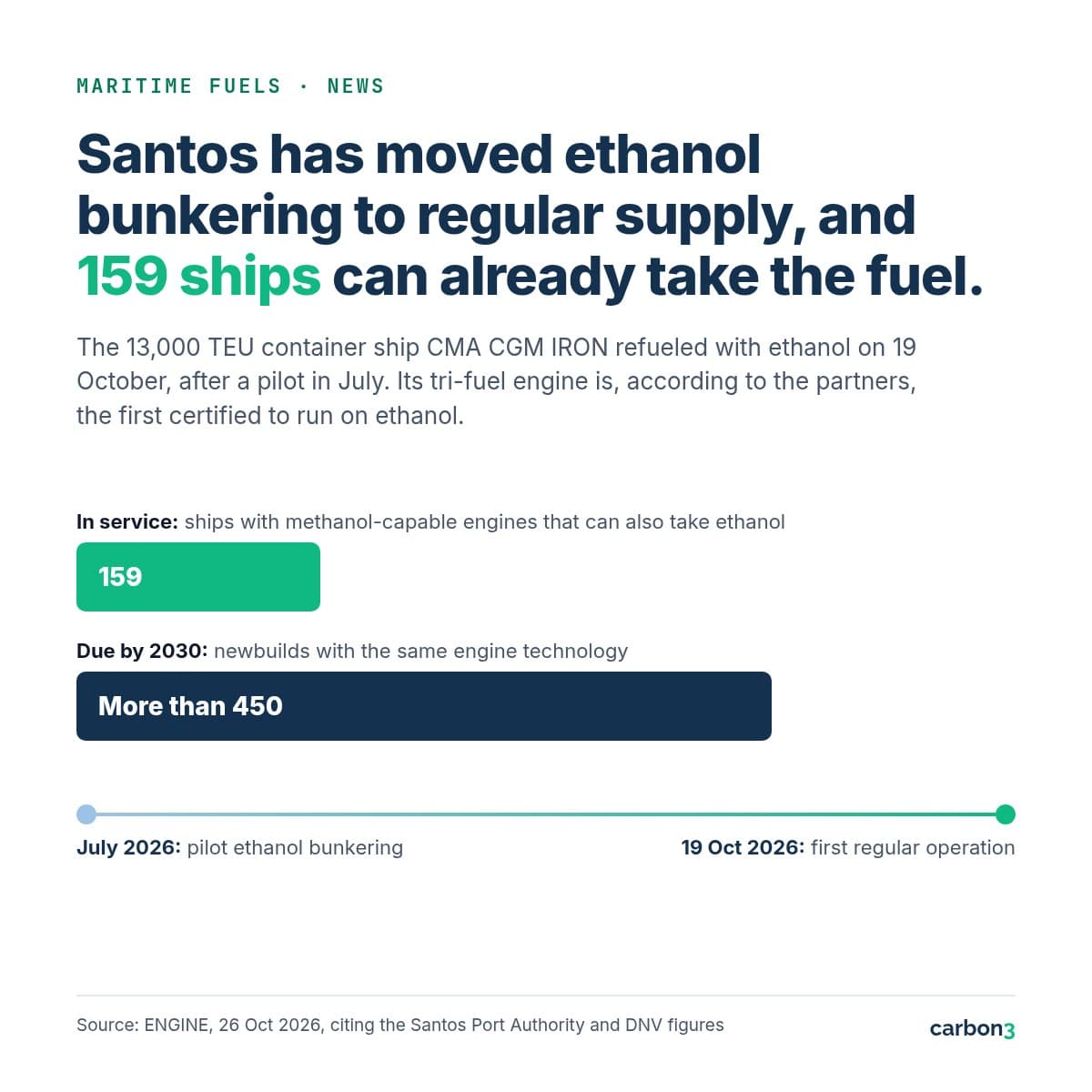
Port of Santos moves ethanol bunkering from trial to regular supply
Brazil's Port of Santos now offers ethanol as a regular marine fuel, and the port authority, citing DNV, says 159 ships already have engines that can take it.
Read the articleSector: Maritime
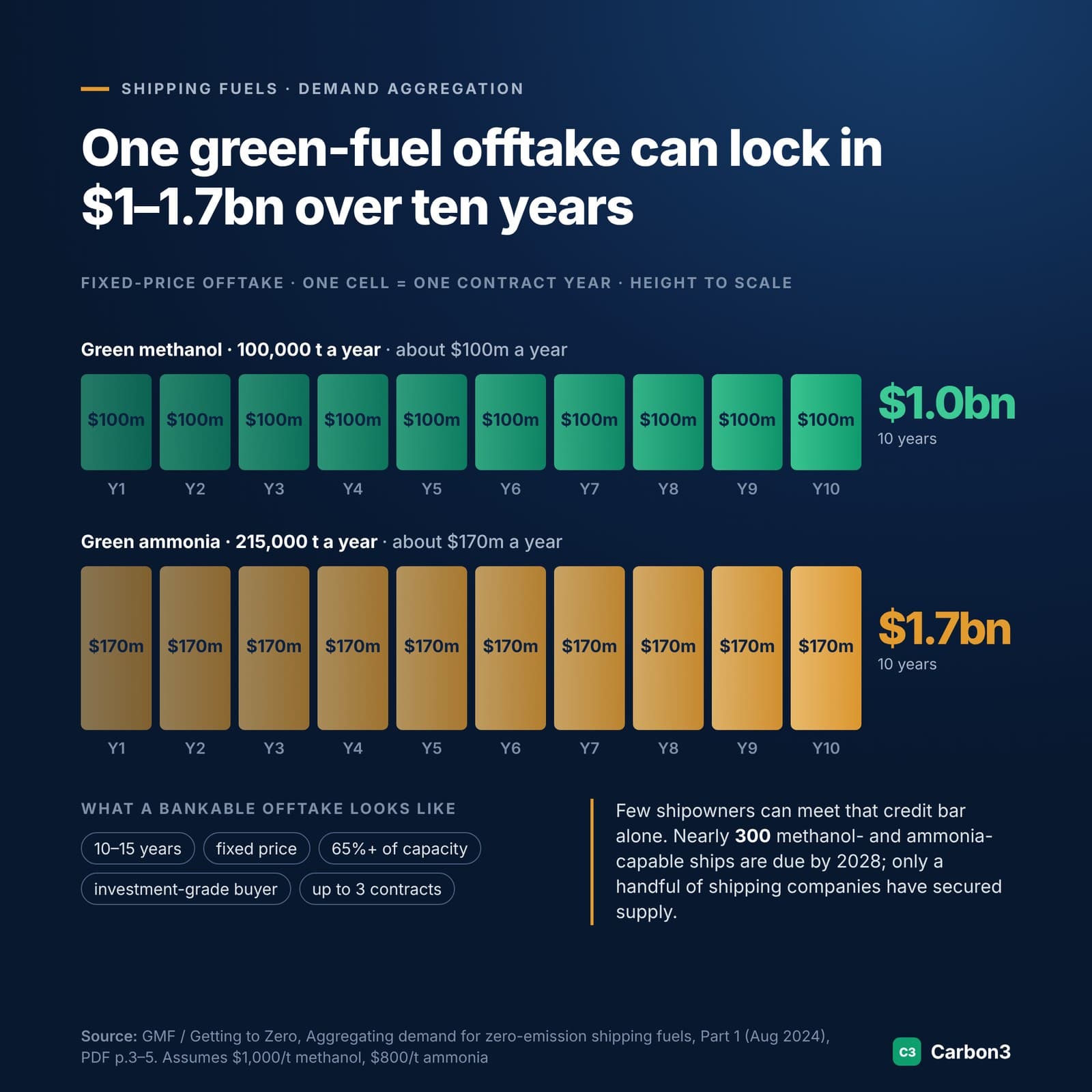
One green shipping fuel contract can commit a buyer to $1 billion or more
The Global Maritime Forum and the Getting to Zero Coalition price a 10-year green methanol or ammonia offtake at $1 billion to $1.7 billion, while nearly 300 capable ships are due by 2028.
Read the article
See the companies behind these figures in the Data Hub.
Look up your suppliers’ emissions and targets, free.