A FuelEU deficit does not stay the same price
FuelEU Maritime's €2,400 per tonne penalty rises by a tenth for each consecutive year in deficit, reaching €3,600 by the sixth. That also prices what a compliant bunker is worth.
By Carbon3 team2 min read
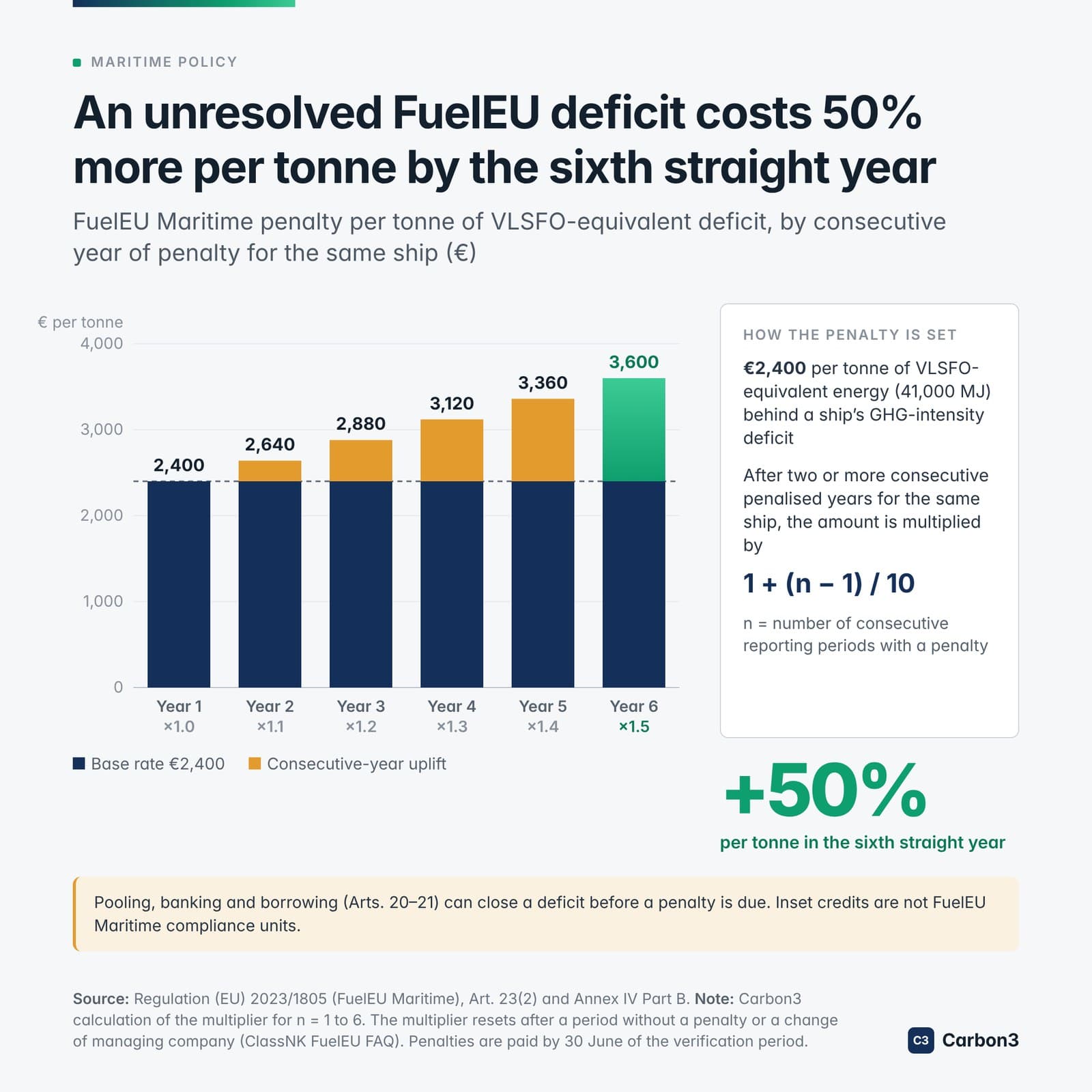
A FuelEU deficit does not stay the same price. Under FuelEU Maritime, a ship that misses its greenhouse-gas intensity target in consecutive reporting periods pays more each time, and the escalation is written into the regulation itself.
The base rate
FuelEU Maritime sets the penalty at €2,400 per tonne of VLSFO-equivalent energy behind a ship's GHG-intensity deficit. In other words, the size of the deficit is expressed as an equivalent quantity of energy, measured in tonnes of very low sulphur fuel oil, and each of those tonnes is priced at €2,400.
That rate is the starting point, not the ceiling.
The multiplier
If the same ship is penalized in consecutive reporting periods, the amount is multiplied by 1 + (n - 1)/10, where n is the number of consecutive periods with a penalty. The first year carries no uplift. Each further consecutive year adds a tenth of the base rate.
By the sixth straight year, the multiplier reaches 1.5. That is €3,600 per tonne, 50% above the base rate. A deficit that is tolerated rather than closed gets steadily more expensive to carry.
The ways out
The regulation also gives operators tools to close a deficit before a penalty is due. Pooling lets ships combine their compliance balances. Banking carries a surplus forward, and borrowing draws on future performance. A year without a penalty resets the count, so the multiplier only bites on ships that stay in deficit year after year.
That structure rewards planning. An operator that treats the penalty as a fixed annual cost underestimates it; one that looks ahead can decide when to close the gap and how.
What it means for fuel producers
The same arithmetic matters on the supply side. For fuel producers, the penalty schedule puts a number on what a compliant, lower-emission bunker is worth to an operator. A cargo of fuel that keeps a ship out of deficit avoids not just this year's penalty but the escalation that would follow. That is a concrete reference point when lower-emission fuel is priced and contracted.
Where inset credits fit
Carbon3 is clear about the boundary. Inset credits are not FuelEU compliance units. They do not count towards a ship's FuelEU balance and cannot be pooled, banked or surrendered against a penalty.
What they do is record verified value-chain reductions for Scope 3 reporting. When a cargo owner co-funds a lower-emission fuel, the verified reduction can be recorded once, with a clear holder, for the parties whose Scope 3 inventories include that shipping. Insetting is not offsetting: it records reductions inside the value chain rather than compensating for emissions elsewhere.
Source: Regulation (EU) 2023/1805, Art. 23(2) and Annex IV.
Originally published on LinkedIn, 15 October 2026.
The Carbon3 Newsletter
Weekly analysis of industrial decarbonization and insetting across Scope 1 to 3, from the Carbon3 team.
Read more from the research team.
Sector: Maritime
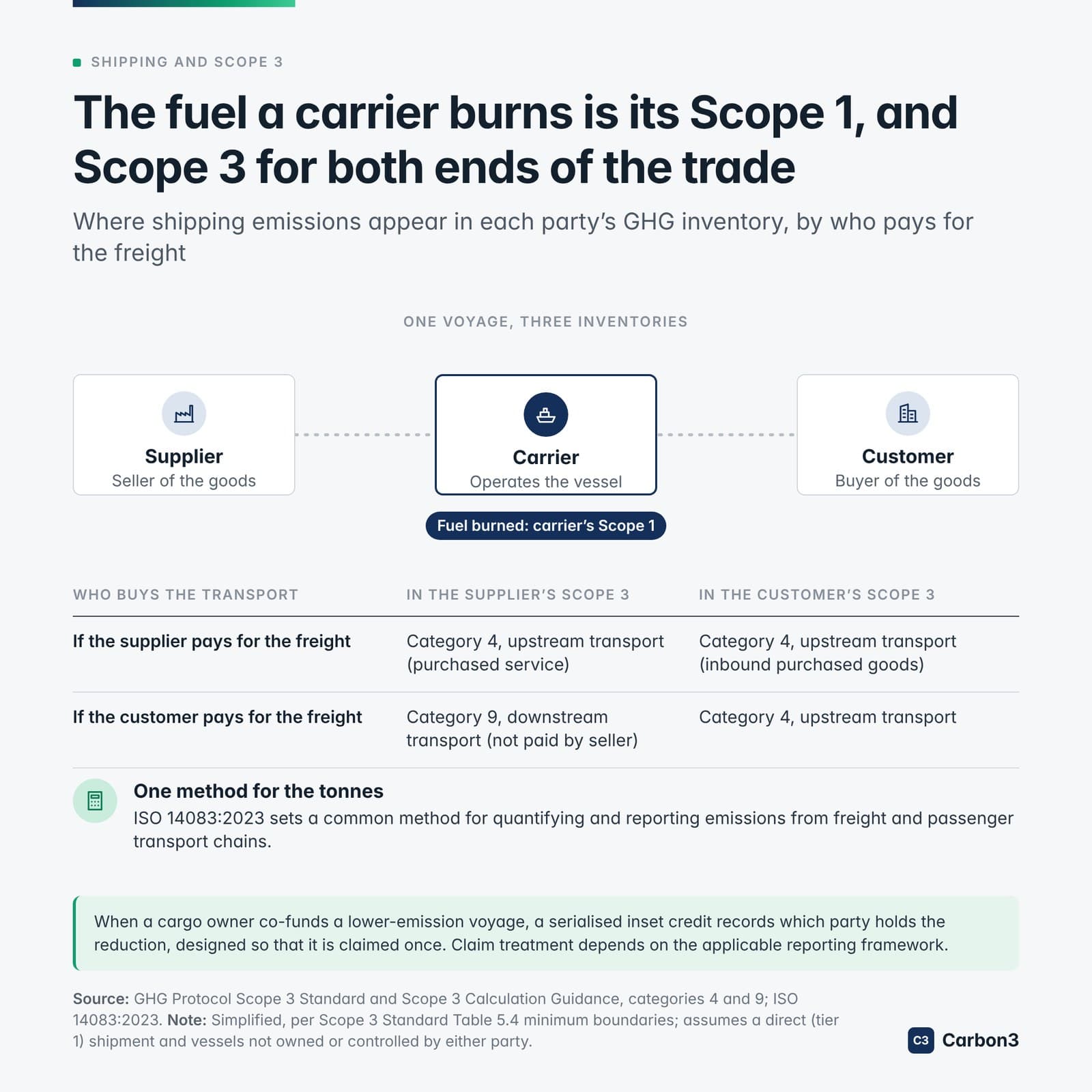
One container voyage shows up in three inventories
Carrier Scope 1, buyer category 4, seller category 4 or 9.
Read the articleSector: Maritime
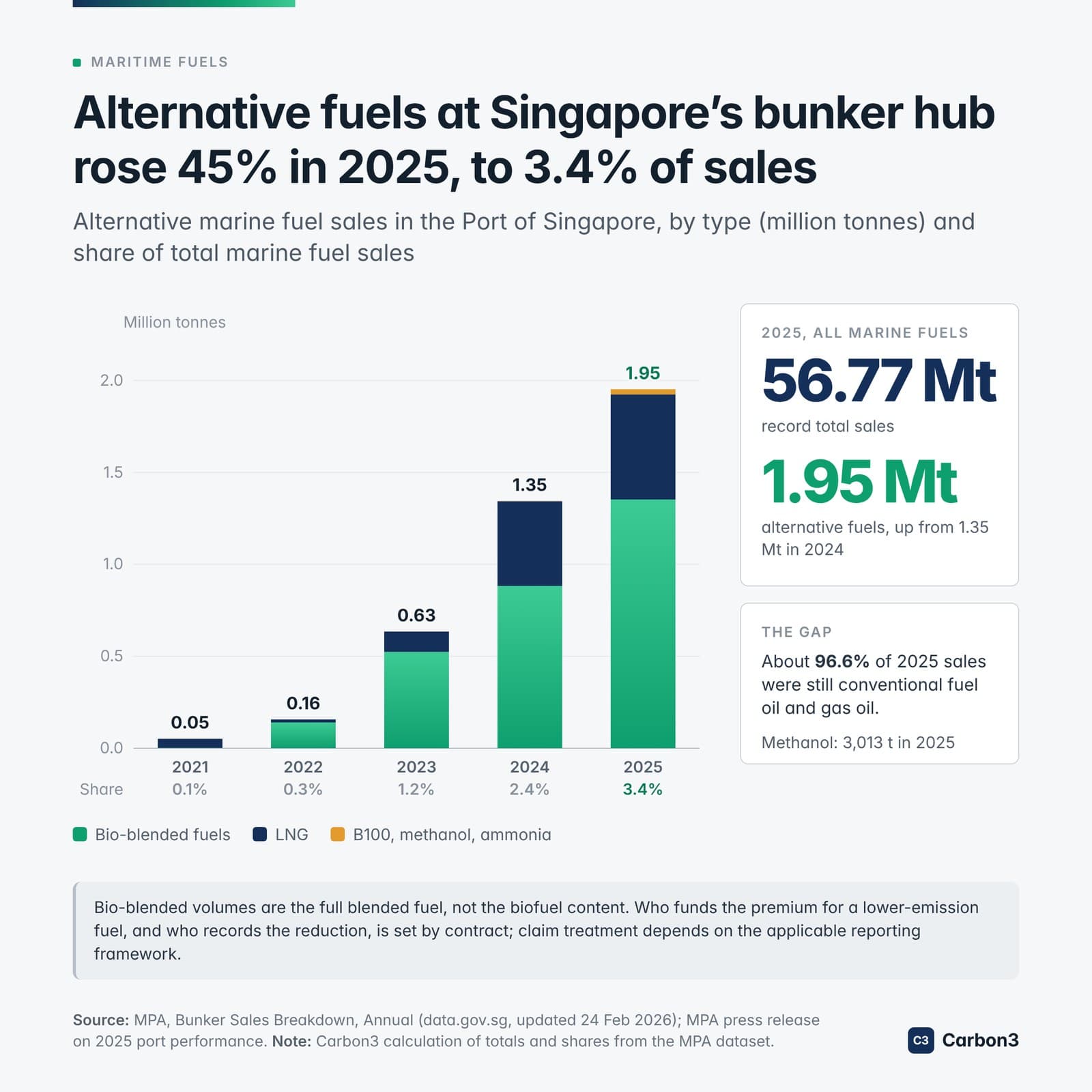
Singapore sold 1.95 million tonnes of alternative marine fuels in 2025
MPA data show a 45% rise on 2024, led by bio-blended fuels and LNG.
Read the articlePolicy
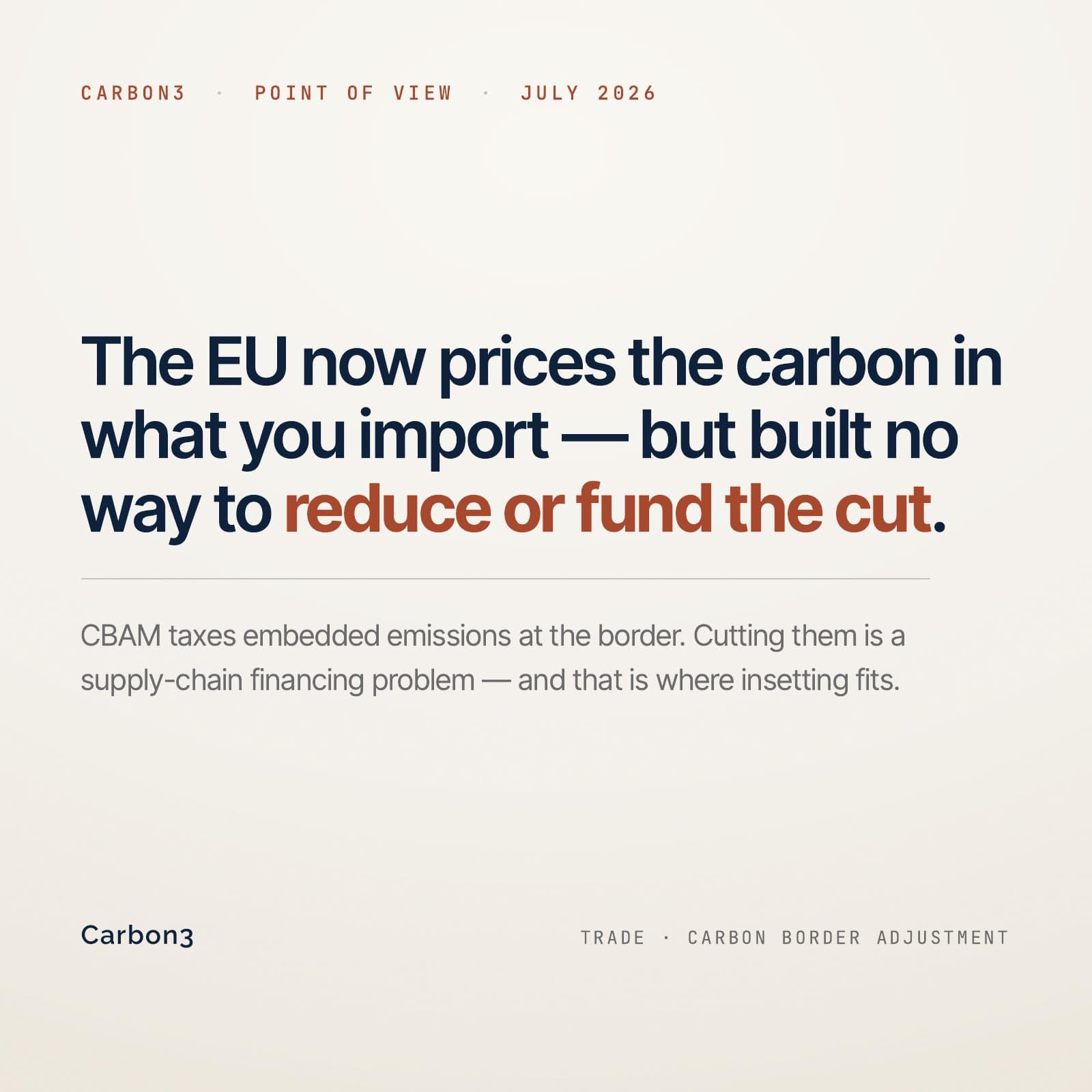
CBAM prices the tonne but does not fund removing it
The importer measures and pays, and the emissions stay.
Read the article
See the companies behind these figures in the Data Hub.
Look up your suppliers’ emissions and targets, free.