Singapore sold 1.95 million tonnes of alternative marine fuels in 2025
MPA data show a 45% rise on 2024, led by bio-blended fuels and LNG. Against record total sales of 56.77 Mt, alternatives were still 3.4% of the port's bunkers.
By Carbon3 team2 min read
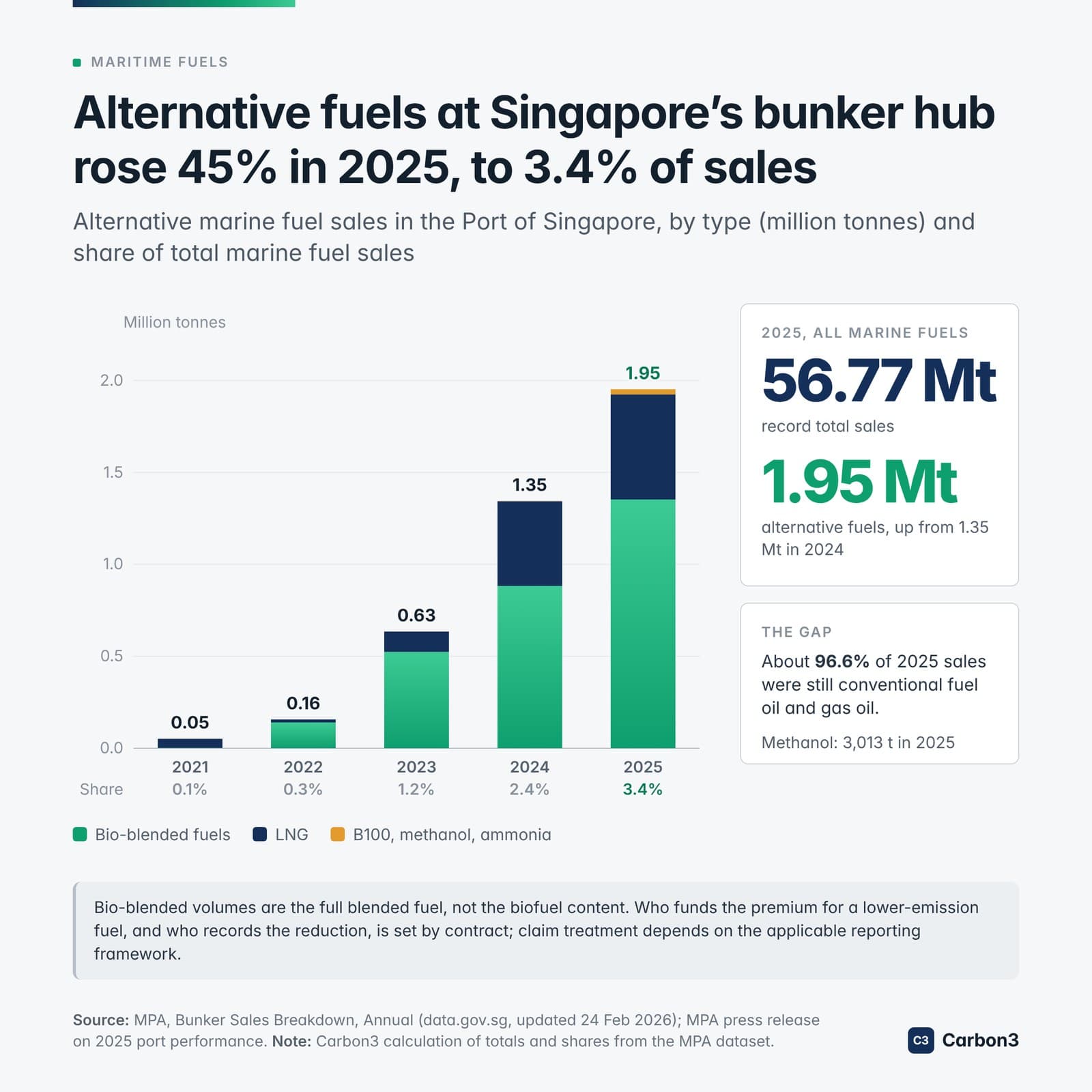
Singapore sold 1.95 million tonnes of alternative marine fuels in 2025, according to data from the Maritime and Port Authority of Singapore (MPA). That is a 45% rise on 2024 at one of shipping's main bunkering hubs. It is also a small share of what the port sells.
What the numbers show
The growth was led by bio-blended fuels, at 1.35 million tonnes, and LNG, at 0.57 million tonnes. Total marine fuel sales in Singapore reached a record 56.77 million tonnes in 2025.
Set against that total, alternative fuels were 3.4% of sales. About 96.6% was still conventional fuel oil and gas oil.
One detail matters when reading the bio-blended figure. MPA's bio-blended numbers are blend volumes, not biofuel content. A tonne of bio-blended fuel is a tonne of the finished blend, of which only part is biofuel. The 1.35 million tonnes therefore overstates the amount of biofuel actually delivered, and the true biofuel share of Singapore's bunker sales is smaller than the headline suggests.
Two readings at once
Both readings of the data are true. Alternative fuel sales are growing quickly, from a low base at a major bunkering hub. And the overwhelming majority of fuel going into ships at that port is still conventional.
For shipping decarbonization, the gap between those two readings is where the cost sits. Lower-emission fuels generally cost more than the fuel oil they replace, and someone has to pay the difference for each tonne bunkered.
Who pays the premium
In container and bulk shipping, the party paying for fuel is often not the party whose emissions inventory the voyage lands in. Carriers and charterers buy the bunker. Cargo owners carry the transport emissions in their Scope 3 inventories. That split makes the premium hard to allocate: the cargo owner wants the reduction, while the carrier faces the cost.
One way to close that gap is for the cargo owner to co-fund a lower-emission bunker directly. When it does, the verified reduction can be issued as inset credits and retired once, so the reduction is recorded against the value chain where it happened rather than being counted by several parties at the same time.
Set by contract
Who funds the premium and who records the reduction is set by contract between the parties. The arrangement has to be clear about which party retires the credits, against which shipments, and under which methodology the reduction was verified. Claim treatment depends on the applicable reporting framework.
This is insetting, not offsetting. The reduction takes place on ships carrying the funder's own cargo, inside its own value chain.
Why it matters now
The 2025 data show that supply of alternative marine fuels is building in Singapore, even if it remains a small slice of the market. As that supply grows, the question of who pays for each lower-emission tonne, and who records the reduction it delivers, becomes a practical one for carriers and cargo owners alike. Carbon3 builds the registry layer for that: a record of each verified value-chain reduction so it is issued, transferred and retired once.
Source: Maritime and Port Authority of Singapore (MPA), 2025 bunker sales data.
Originally published on LinkedIn, 16 October 2026.
The Carbon3 Newsletter
Weekly analysis of industrial decarbonization and insetting across Scope 1 to 3, from the Carbon3 team.
Read more from the research team.
Sector: Maritime
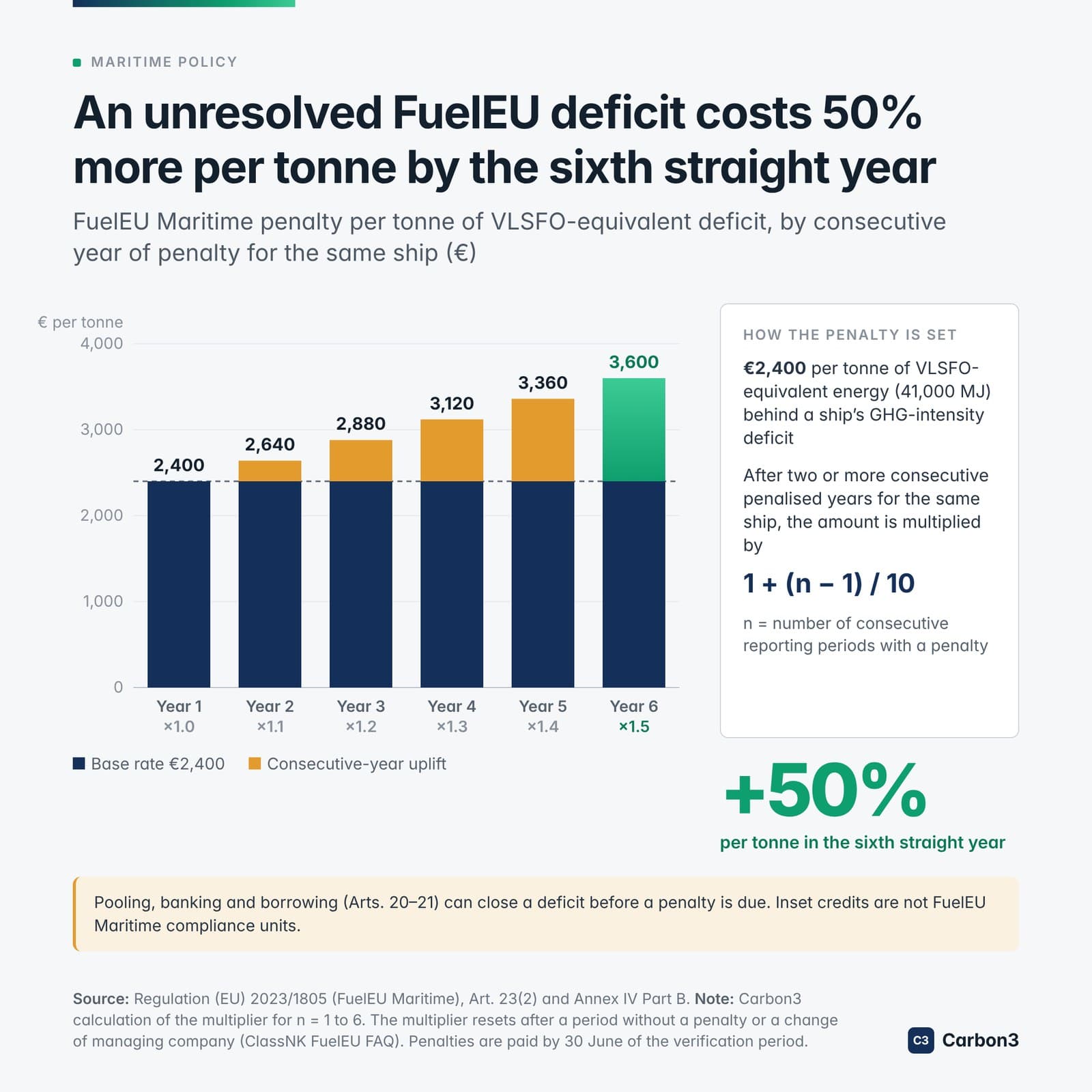
A FuelEU deficit does not stay the same price
FuelEU Maritime's €2,400 per tonne penalty rises by a tenth for each consecutive year in deficit, reaching €3,600 by the sixth.
Read the articleSector: Maritime
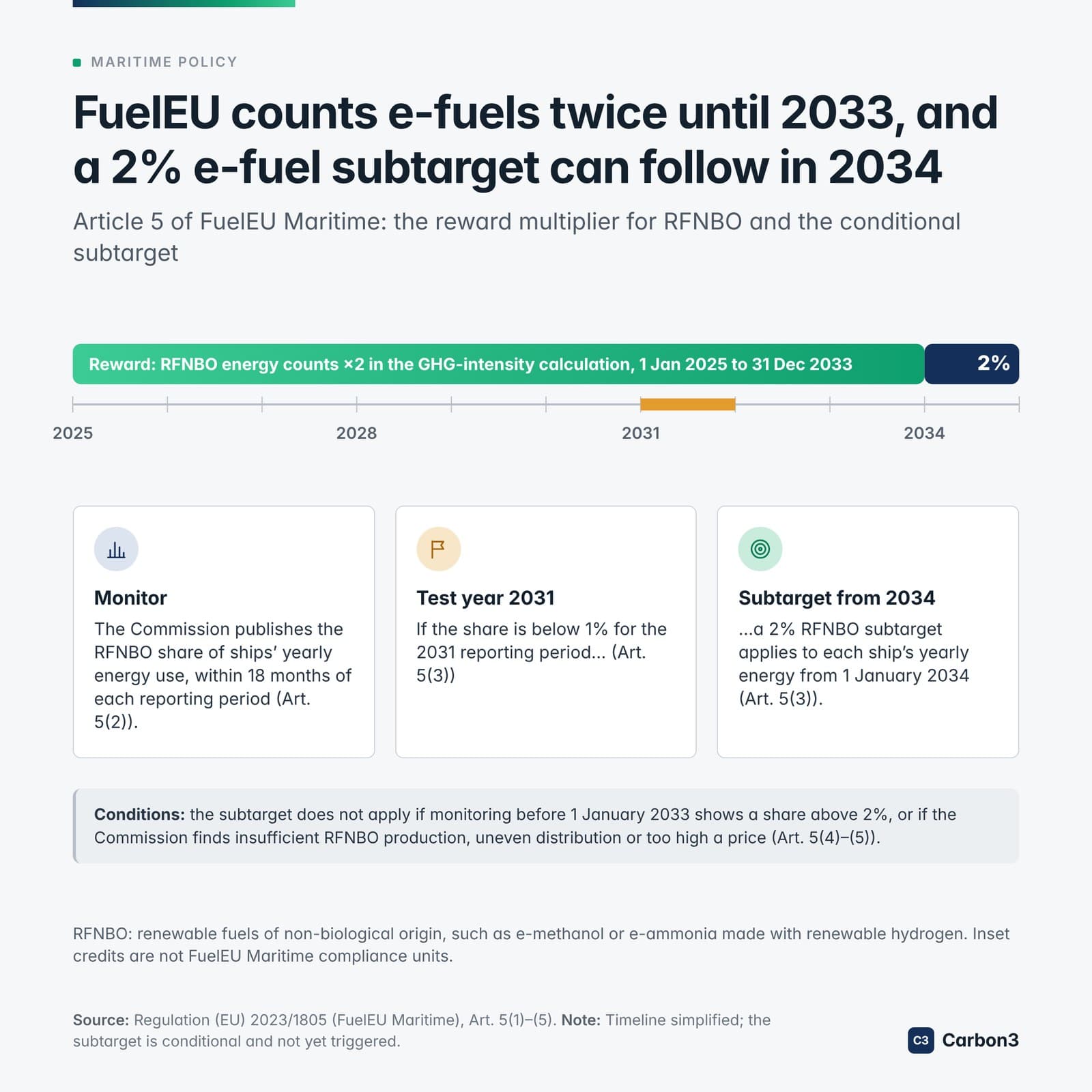
FuelEU counts e-fuels twice until 2033, and a 2% e-fuel subtarget can follow in 2034
Article 5 of FuelEU Maritime doubles the weight of RFNBO energy from 2025 to 2033.
Read the articleSector: Maritime
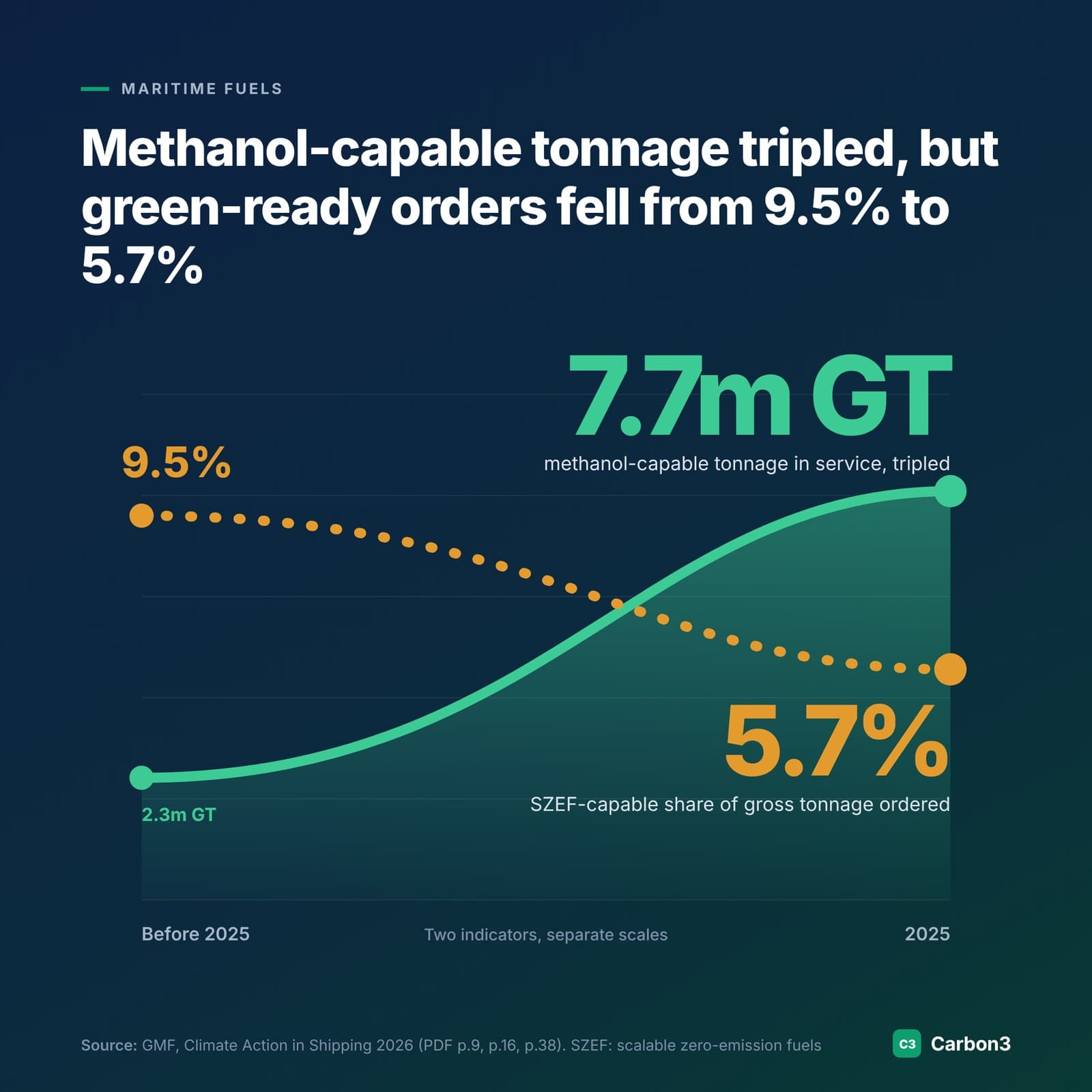
2025 delivered a record fleet of green-ready ships, and a weaker orderbook
Methanol-capable tonnage in service tripled to 7.7 million gross tonnes, while ships able to run on scalable zero-emission fuels fell from 9.5% to 5.7% of tonnage ordered.
Read the article
See the companies behind these figures in the Data Hub.
Look up your suppliers’ emissions and targets, free.